


























Views
Downloads



Complete Motion & Tangents Worksheet | Grade 12 Calculus
Paste this activity's link or code into your existing LMS (Google Classroom, Canvas, Teams, Schoology, Moodle, etc.).
Students can open and work on the activity right away, with no student login required.
You'll still be able to track student progress and results from your teacher account.
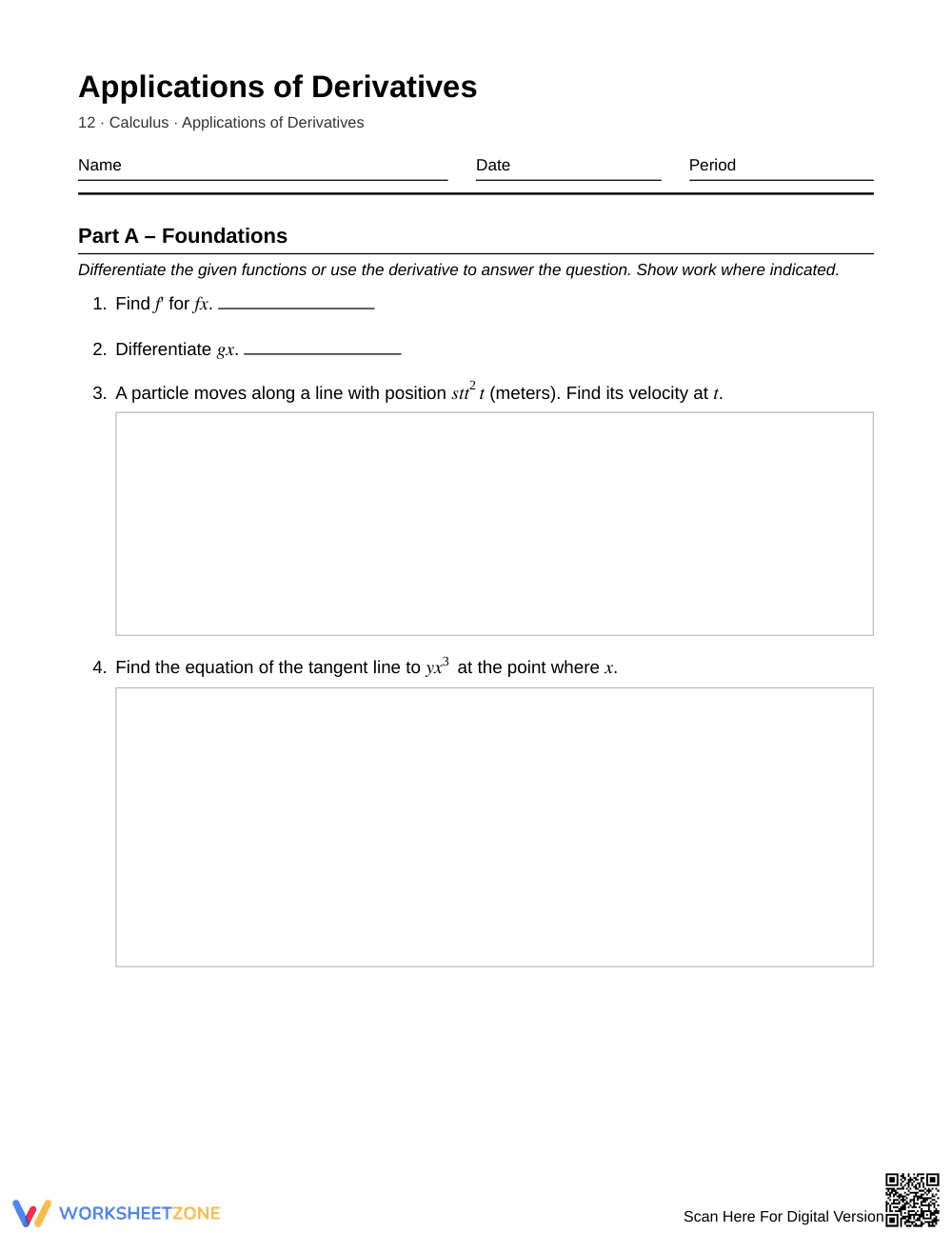
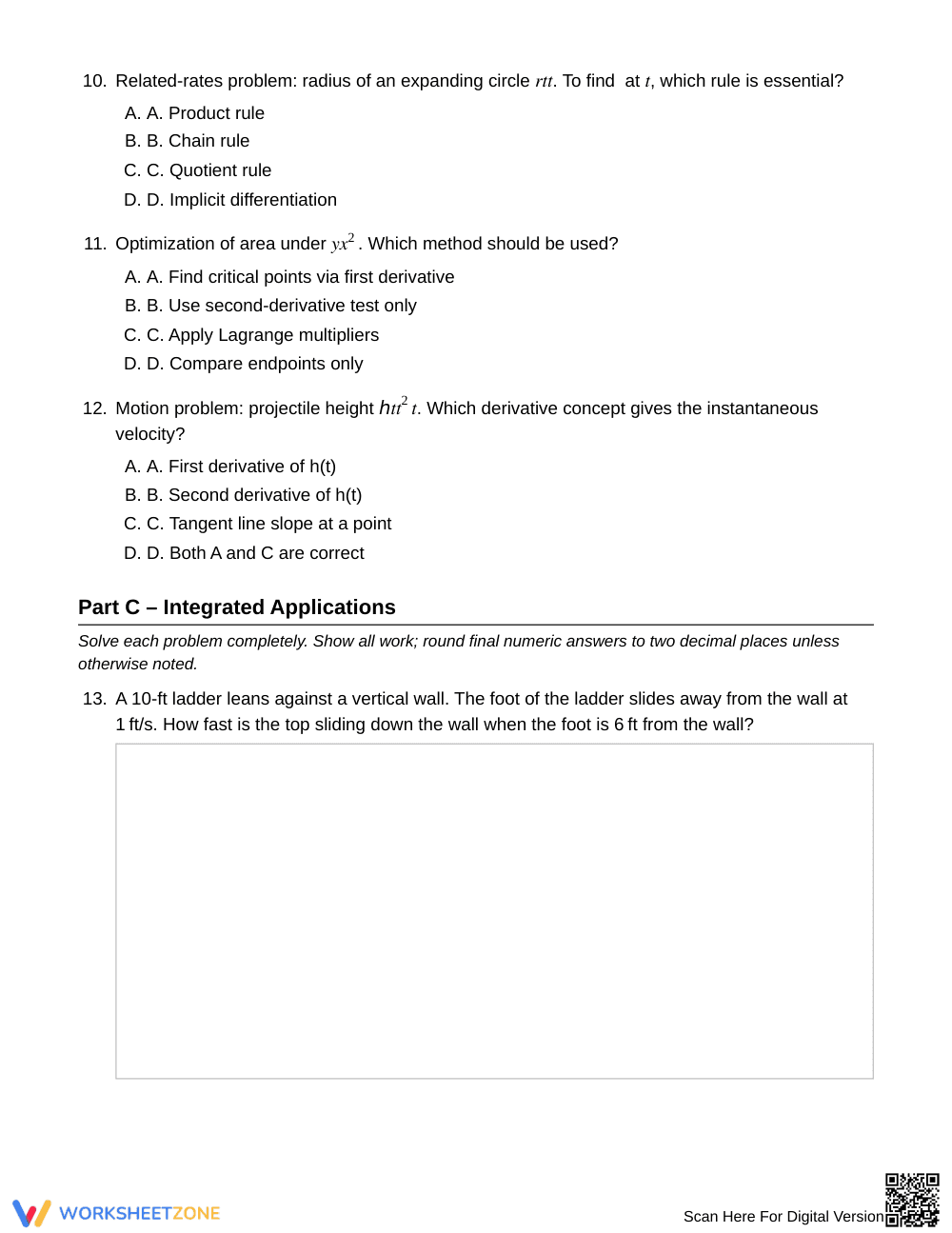
This comprehensive calculus worksheet equips Grade 12 students to master core applications of derivatives across particle motion, tangent lines, and optimization models. Through 16 rigorous exercises, learners analyze rates of change, select suitable differentiation rules, and solve multi-step real-world modeling problems with precision and procedural fluency.
At a Glance
- Grade: 12 · Subject: Calculus
- Standard:
Calculus Applications— Apply derivative concepts to model rectilinear motion, tangent lines, and optimization- Skill Focus: Mix Motion, Tangents, and Optimization
- Format: 5 pages · 16 problems · Answer key included · PDF
- Best For: Unit review and exam prep
- Time: 45–60 minutes
This 5-page instructional resource contains 16 varied problems organized across three progressive sections, supported by a 2-page detailed answer key. Students begin with foundational derivative evaluation, transition into targeted multiple-choice rule selection, and conclude with authentic free-response modeling scenarios spanning related rates, geometric optimization, and kinematic distance calculations.
Skill Progression
- Guided practice (Part A – Foundations): 4 computational tasks prompt students to compute derivatives, find particle velocity, and construct tangent line equations.
- Supported practice (Part B – Method Selection): 8 targeted decision-making problems require students to identify appropriate differentiation rules—such as chain, product, or implicit rules—before calculating.
- Independent practice (Part C – Integrated Applications): 4 modeling tasks challenge students to solve ladder related rates, cylinder optimization, and tangent intersections without scaffolds.
This progression mirrors the gradual release of responsibility model, guiding students systematically from procedural recall to independent problem-solving.
Standards Alignment
This resource aligns with advanced high school calculus objectives covering rates of change, tangent approximations, and extreme value optimization. Students demonstrate proficiency calculating instantaneous rates, determining local extrema in contextual boundaries, and relating position functions to velocity and acceleration. Both standard codes can be copied directly into lesson plans, IEP goals, or district curriculum mapping tools.
How to Use It
Deploy this worksheet after direct instruction on derivative applications as an intensive summative review or small-group workshop activity. During Part B, check student reasoning by observing whether learners identify composite structures before selecting the chain rule, providing immediate corrective feedback. Expect completion within 45 to 60 minutes across one extended block period or two standard sessions.
Who It's For
Designed for Grade 12 Calculus and Advanced Placement Calculus AB students preparing for cumulative unit assessments. Teachers can differentiate by providing formula anchor charts for students needing scaffolding in Part C or assigning Part C as an honors extension. Pair this resource with a visual curve-sketching demonstration or related-rates graphic organizer.
Mastering calculus applications requires students to bridge conceptual differentiation with procedural application in kinematics, geometry, and optimization. According to research on structured instructional design by Fisher & Frey (2014), scaffolding problem sets through purposeful shifts—from isolated derivative computation to autonomous mathematical modeling—substantially reinforces long-term skill retention and conceptual mastery in secondary mathematics. This 16-task resource operationalizes that evidence-based pedagogy by guiding learners through foundational velocity calculations, deliberate method selection among product and chain rules, and rigorous multi-step word problems involving related rates and geometric extrema. By confronting common misconceptions in identifying rates of change before working through unassisted contextual tasks, high school students develop authentic analytical resilience and operational fluency. Educators receive a reliable, classroom-verified assessment tool complete with comprehensive scoring keys that accurately diagnose student readiness for advanced collegiate mathematics and standardized calculus examinations.


