




























Views
Downloads



Complete Lion King Characters Word Search | Grades 7–8 ELA

Paste this activity's link or code into your existing LMS (Google Classroom, Canvas, Teams, Schoology, Moodle, etc.).
Students can open and work on the activity right away, with no student login required.
You'll still be able to track student progress and results from your teacher account.
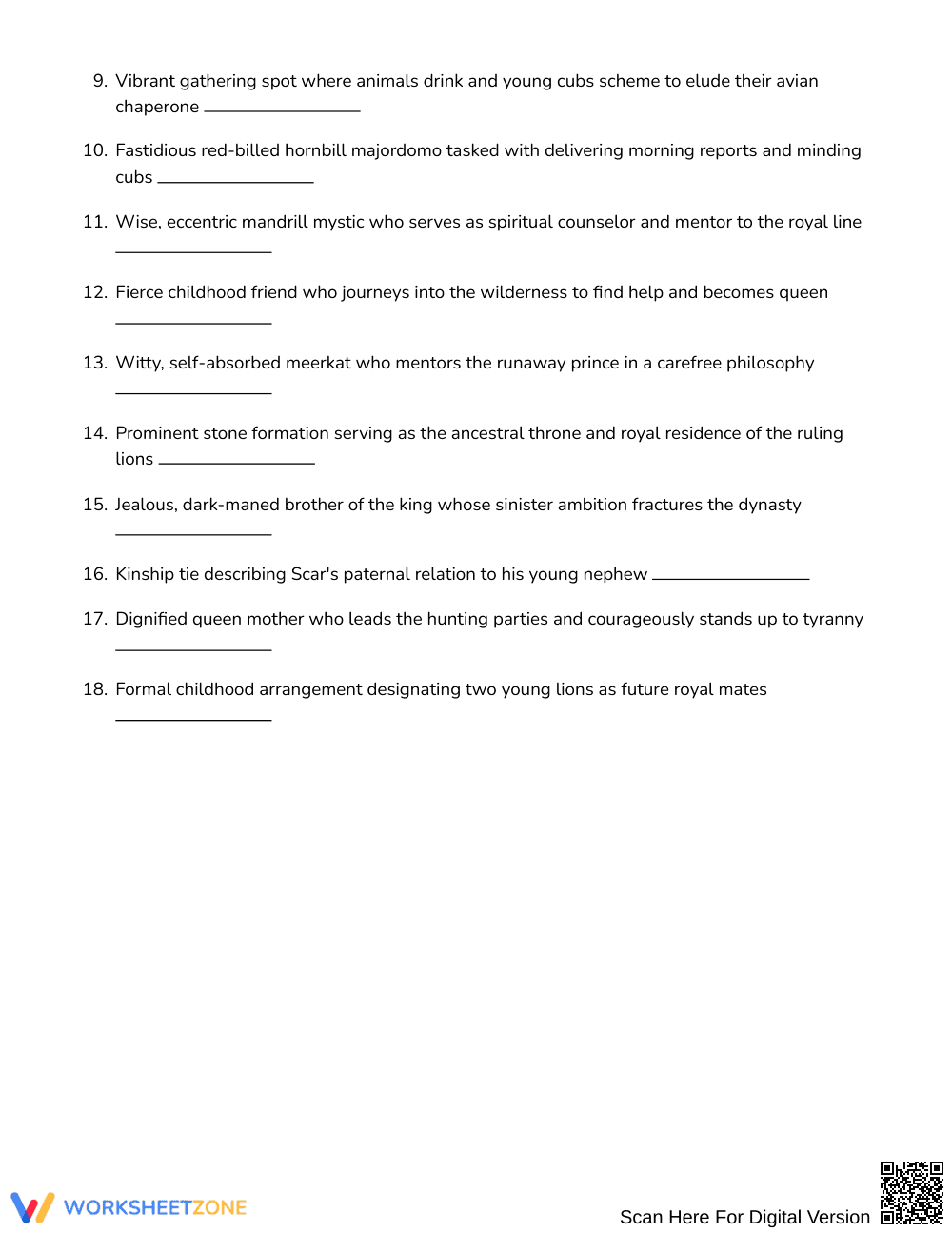
This literature word search reinforces key story elements from The Lion King through focused vocabulary review. Students read contextual definitions to identify major characters, critical settings, and key narrative relationships before locating all eighteen hidden terms. It strengthens reading comprehension, literary recall, and domain-specific vocabulary retention across middle school English language arts classrooms.
At a Glance
- Grade: Grades 7–8 · Subject: English Language Arts (ELA)
- Standard: Not standards-assessed — vocabulary enrichment
- Skill Focus: Characters, settings, and relationships
- Format: 3 pages · 18 words · Answer key included · PDF
- Best For: Cumulative review or substitute plans
- Time: 25–35 minutes
What's Inside
This 3-page printable activity features eighteen text-dependent clues paired with a dense letter grid. Instead of presenting a simple checklist, the activity requires students to match descriptive clues—covering royal titles, kinship dynamics, and pivotal settings—to correct literary terms. A comprehensive 4-page answer key provides clear visual coordinates for fast verification and effortless grading.
Puzzle Mechanics & Design
The activity is built upon an expansive 20 x 20 letter grid engineered to challenge intermediate readers. Hidden vocabulary words run in all eight possible compass directions: north, northeast, east, southeast, south, southwest, west, and northwest. A shuffled word bank provides reference support, while the clue-first structure ensures students process literary context rather than scanning for letter patterns in isolation.
Standards Alignment
This resource serves as targeted vocabulary enrichment and thematic review rather than an assessment of a formal grade-level standard. It supports broader literary analysis by reinforcing core narrative terminology—including concepts like heir, betrothal, and monarch—alongside text-specific character names and symbolic locations.
How to Use It
Deploy this word search as an engaging culminating activity after completing a script reading, film study, or comparative drama unit. It works effectively during the independent practice stage following a lesson on dramatic foil pairs and character motivation. Alternatively, use it as a low-stakes review station during small-group rotations. For formative assessment, observe whether students identify terms directly from the text clues or rely solely on letter scanning, intervening to check comprehension of complex vocabulary like betrothal. Expect completion within 25 to 35 minutes.
Who It's For
This puzzle is designed for middle school students in Grades 7–8 studying narrative structure, character relationships, and drama. It offers natural scaffolding for English language learners through its descriptive contextual clues and pairs smoothly with an introductory character map or a hero's journey anchor chart.
Literary word puzzles that pair analytical clues with orthographic searching reinforce semantic memory and text engagement during middle school reading instruction. Rather than functioning as passive filler, clue-driven vocabulary searches require students to retrieve character roles, symbolic settings, and thematic terminology from working memory before initiating visual search strategies. Research by Fisher & Frey (2014) emphasizes that intentional vocabulary acquisition relies on multiple meaningful exposures to academic and domain-specific words within authentic instructional contexts. By integrating eighteen literary terms—spanning narrative concepts like monarchy and kinship alongside focal characters—across an eight-directional 20 x 20 matrix, this resource promotes sustained cognitive focus, strengthens orthographic mapping, and cements thematic comprehension for intermediate readers exploring classic story structures.


