


























Views
Downloads




Complete Heat Sign & System Worksheet | Grade 11 Chemistry
Paste this activity's link or code into your existing LMS (Google Classroom, Canvas, Teams, Schoology, Moodle, etc.).
Students can open and work on the activity right away, with no student login required.
You'll still be able to track student progress and results from your teacher account.
Mastering thermochemical sign conventions requires students to track energy transfers across defined boundaries with precision. This comprehensive Grade 11 chemistry resource delivers rigorous practice in distinguishing systems from surroundings, assigning correct algebraic heat signs, and calculating heat flow and molar enthalpy changes in calorimetry experiments.
At a Glance
- Grade: 11 · Subject: Chemistry
- Standard: Differentiate thermodynamic systems from surroundings and calculate heat exchange across defined boundaries
- Skill Focus: System, Surroundings, and Heat Sign Conventions
- Format: 6 pages · 12 problems · Answer key included · PDF
- Best For: Calorimetry practice and AP chemistry preparation
- Time: 45–60 minutes
What's Inside
This 6-page practice set features a reference header complete with thermodynamic equations, sign conventions, and specific heat constants followed by 12 multi-part analytical and computational problems. Students work with realistic aqueous dissolution, neutralization, and thermal equilibrium scenarios. The package includes a detailed 4-page answer key showing step-by-step algebraic substitutions, significant figures, and explicit sign tracking.
Skill Progression
- Guided practice (Tasks 1–4): Conceptual boundary identification, distinguishing temperature from thermal energy, and assigning algebraic signs to endothermic and exothermic phase changes.
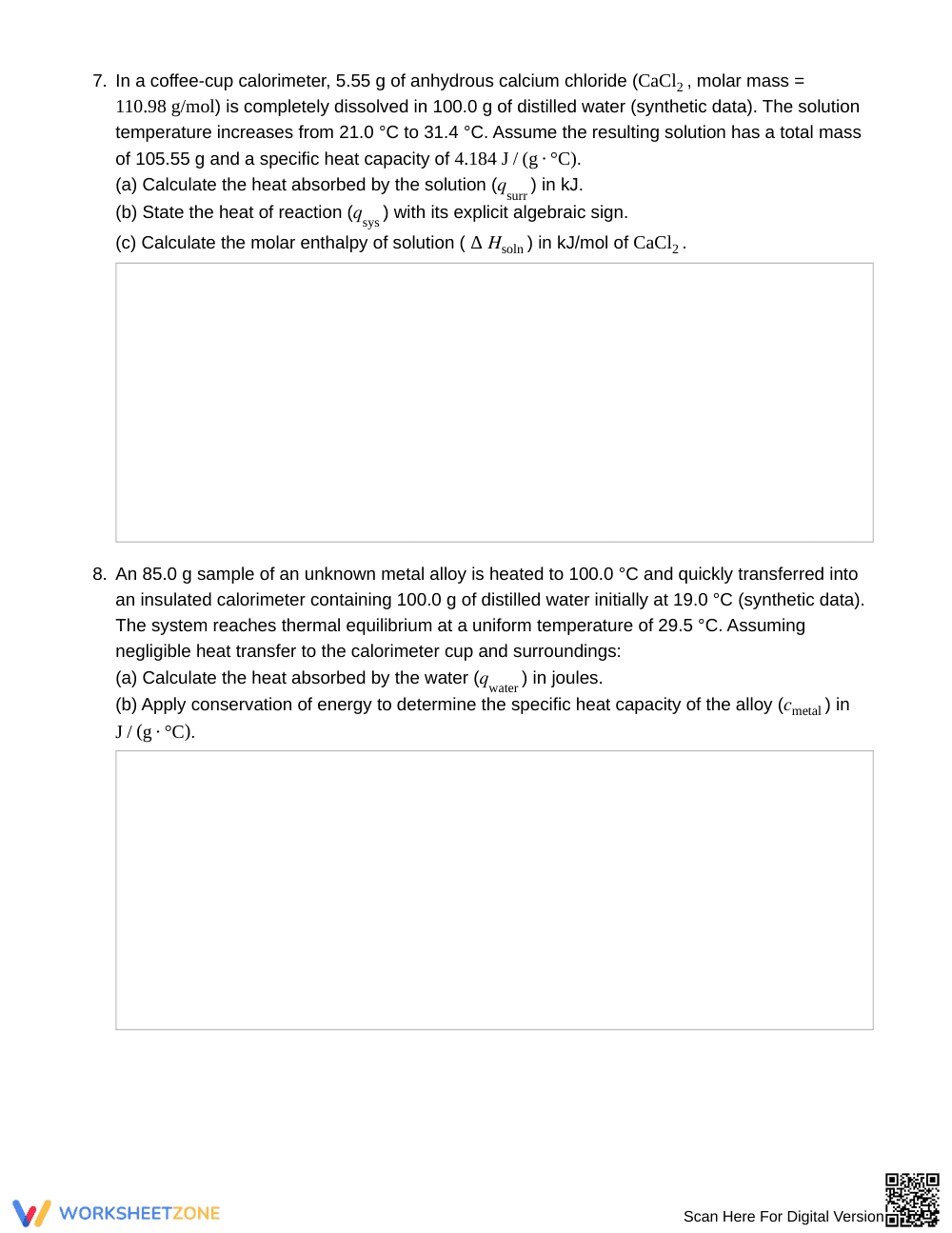
- Supported practice (Tasks 5–10): Quantitative direct calorimetry applying
q = mcΔT, energy conservation across thermal boundaries, and computing molar enthalpies of solution and neutralization. - Independent practice (Tasks 11–12): Error analysis and experimental critique, identifying thermodynamic misconceptions and tracing how uninsulated calorimeter heat loss affects calculated enthalpy values.
This sequence follows a proven gradual-release model, building student confidence from conceptual clarity to complex quantitative error analysis.
Standards Alignment
This worksheet aligns directly with high school chemistry thermochemistry standards requiring students to apply the law of conservation of energy to calculate heat exchange and model energy transfers between a thermodynamic system and its surroundings. Both standard concepts and explicit sign conventions can be copied directly into lesson plans, IEP goals, or district curriculum mapping tools.
How to Use It
Deploy this activity after direct instruction on specific heat capacity and thermodynamic sign conventions. During class, monitor student work during Part B to ensure learners assign negative signs to exothermic reaction heats (q_sys = -q_surr) rather than confusing system and surroundings temperature changes. Allocate 45 to 60 minutes for complete individual or paired completion.
Who It's For
Designed for on-level, honors, and introductory AP Chemistry high school students. Pair this resource with a coffee-cup calorimetry laboratory experiment or an enthalpy diagram anchor chart to reinforce the connection between observable temperature shifts and molecular potential energy changes.
According to Fisher & Frey (2014), structured problem sets that scaffold conceptual boundary definitions before introducing complex quantitative calculations significantly improve student mastery of abstract physical chemistry principles. In thermochemistry, novice learners frequently confuse the observed temperature change of the calorimeter surroundings with the internal energy change of the reacting system. This 12-task worksheet explicitly targets this persistent misconception by requiring students to define thermodynamic boundaries, track algebraic signs systematically through conservation equations, and evaluate uninsulated laboratory heat leakages. The embedded reference formulas and scaffolded progression empower Grade 11 chemistry students to achieve fluency in direct calorimetry calculations, molar enthalpy derivations, and rigorous scientific error evaluation.


