




























Views
Downloads



Complete Harvest and Storage Word Search | Grades 6–7 ELA

Paste this activity's link or code into your existing LMS (Google Classroom, Canvas, Teams, Schoology, Moodle, etc.).
Students can open and work on the activity right away, with no student login required.
You'll still be able to track student progress and results from your teacher account.
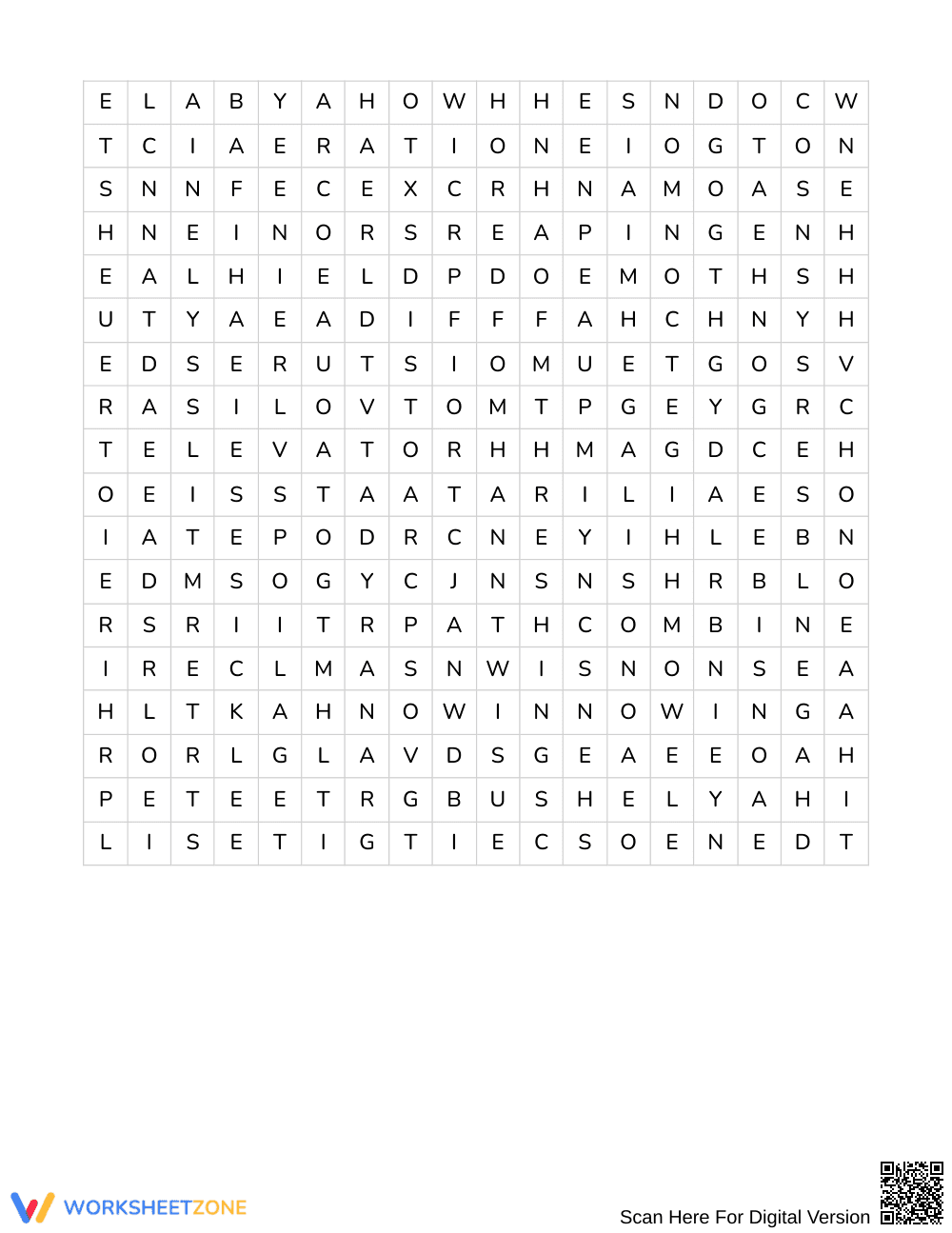
This agricultural vocabulary word search reinforces harvest and storage terminology for Grades 6–7 students through targeted clue retrieval. Learners read comprehensive agronomic definitions to identify 16 specialized terms before locating them across the grid, deepening conceptual understanding of crop production, grain preservation, and traditional farming implements.
At a Glance
- Grade: Grades 6–7 · Subject: English Language Arts (ELA) Vocabulary Study
- Standard: Not standards-assessed — vocabulary enrichment
- Skill Focus: Harvest and storage agricultural domain vocabulary mastery
- Format: 3 student pages · 16 hidden words · Complete 4-page answer key included · Printable PDF
- Best For: Cross-curricular agricultural vocabulary enrichment and independent review
- Time: 25–35 minutes
What's Inside
This 3-page printable activity presents a clue-based format without a word bank. Students analyze 16 agricultural definitions covering equipment, traditional tools, and storage facilities to determine each term before finding it in the puzzle. The resource includes a 4-page answer key displaying solved terms and grid coordinates for fast verification.
How the Puzzle Works
The activity features an 18 x 18 letter grid without a word bank. Students read each clue to deduce the target vocabulary term. Words run in all eight compass directions: north, northeast, east, southeast, south, southwest, west, and northwest. Searching across forward, reverse, and diagonal orientations reinforces systematic visual scanning and spelling retention.
Standards Alignment
This word search serves as a domain-specific vocabulary enrichment activity and is not aligned to a formal academic standard. Middle school educators can integrate these 16 terms into interdisciplinary agricultural literacy units, technical reading modules, or contextual science vocabulary studies without standard-specific reporting constraints.
How to Use It
Deploy this word search after direct instruction on food systems to reinforce technical terms, or assign it during independent station rotations. For formative assessment, observe whether students solve clues conceptually before searching or rely on random scanning; struggle with terms like winnowing or silage indicates a need for reteaching. Expected completion time is 25 to 35 minutes.
Who It's For
This resource is built for Grades 6–7 students expanding domain-specific vocabulary in ELA or agriculture units. For differentiation, provide emerging readers with an illustrated glossary to support clue solving, while advanced learners compare paired concepts such as threshing and winnowing. Pair this puzzle with an informational reading passage on modern grain farming.
This Grades 6–7 agricultural vocabulary word search develops domain-specific mastery of 16 essential harvest and storage terms through clue-based retrieval. Designed as a non-standardized vocabulary enrichment resource, the activity challenges learners to define specialized terms including combine, silo, granary, winnowing, and aeration before locating them within an 18 x 18 grid across eight directional orientations. By replacing passive word banks with rigorous definitional clues, the puzzle requires students to actively retrieve conceptual knowledge from memory. According to Fisher & Frey (2014), intentional acquisition of domain-specific vocabulary directly enhances informational text comprehension by anchoring specialized terminology into existing knowledge schema. The included four-page answer key provides coordinate-level verification, enabling efficient self-monitoring and independent classroom practice. This structured print-and-go activity equips middle school educators with an engaging tool for agricultural literacy, cross-curricular science connections, and technical language development.


