




























Views
Downloads



Complete Harry Potter Word Search | Grades 7–8 ELA

Paste this activity's link or code into your existing LMS (Google Classroom, Canvas, Teams, Schoology, Moodle, etc.).
Students can open and work on the activity right away, with no student login required.
You'll still be able to track student progress and results from your teacher account.
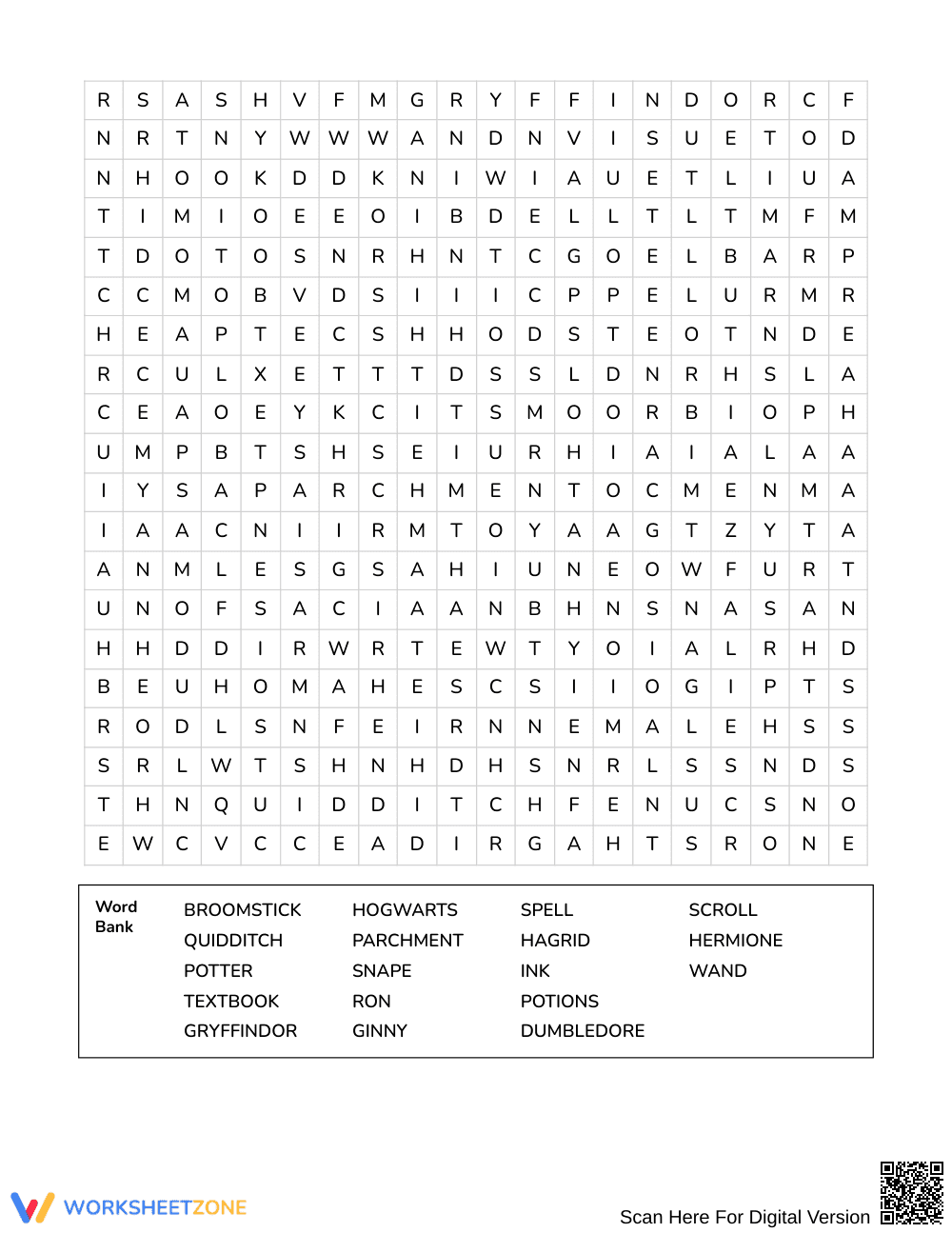
This Grades 7–8 vocabulary word search reinforces literary recall and contextual understanding through 18 themed vocabulary terms from the fantasy genre. Students connect character descriptions, magical objects, and Hogwarts school subjects to hidden terms, strengthening word recognition, spelling accuracy, and text-based recall across an engaging print-and-go activity format.
At a Glance
- Grade: Grades 7–8 · Subject: ELA
- Standard: Not standards-assessed — vocabulary enrichment
- Skill Focus: Literary character, setting, and equipment vocabulary
- Format: 3 pages · 18 words · Answer key included · PDF
- Best For: Vocabulary enrichment and novel review
- Time: 20–30 minutes
Inside this 3-page printable activity, learners discover a large letter grid accompanied by a shuffled word bank and text-based clues. Students solve 18 clues identifying key characters, school subjects, and magical equipment before locating each term in the puzzle. A full 3-page answer key provides clear solution paths for efficient teacher grading or student self-checking.
The activity is built around a dense 20-by-20 letter grid designed to challenge middle school readers. The 18 vocabulary words are hidden across all 8 compass directions: north, northeast, east, southeast, south, southwest, west, and northwest. Students must decode the clue definitions, reference the shuffled bank, and track multi-directional letter sequences to identify each character name, magical object, or academic course.
This resource serves as targeted vocabulary enrichment and is not aligned to a specific Common Core or state academic standard. Instead, it supports general literary comprehension, orthographic awareness, and thematic terminology. Educators can integrate the activity into broader English Language Arts reading units without tracking formal standards-based mastery targets.
Use this word search immediately after concluding a novel study chapter or as an engaging mid-unit vocabulary review. It functions effectively during independent work time or literacy centers, requiring approximately 20 to 30 minutes to complete. For formative assessment, observe whether students identify terms directly from memory using the descriptive clues or rely primarily on letter-by-letter visual scanning in the grid.
This puzzle is designed for Grades 7–8 English Language Arts students studying fantasy literature or building thematic vocabulary. The paired clue definitions provide built-in scaffolding for striving readers who need contextual prompts. Pair this word search with a novel study reading guide, character tracking chart, or introductory creative writing assignment.
Vocabulary enrichment activities that combine semantic clues with active letter search reinforce orthographic mapping and thematic word associations for middle school readers. While this resource is non-standards-assessed vocabulary enrichment rather than a standards-aligned assessment, structured word retrieval activities directly support reading development. According to Fisher & Frey (2014), intentional word exposure and vocabulary manipulation across varied print contexts deepen conceptual understanding and support long-term memory consolidation in adolescent learners. Solving clue-based word puzzles requires students to retrieve semantic knowledge before executing orthographic searches across a 20-by-20 grid, combining reading comprehension with visual pattern recognition. This multi-step process promotes active processing of literary terminology, character relationships, and domain-specific vocabulary. Consequently, incorporating puzzle-based vocabulary tasks provides an effective low-stakes instructional mechanism for consolidating literary terminology during upper middle school English Language Arts units, independent study, or supplementary novel studies.


