


























Views
Downloads


Complete Fraction Portions Worksheet | Grade 6 Math
Paste this activity's link or code into your existing LMS (Google Classroom, Canvas, Teams, Schoology, Moodle, etc.).
Students can open and work on the activity right away, with no student login required.
You'll still be able to track student progress and results from your teacher account.
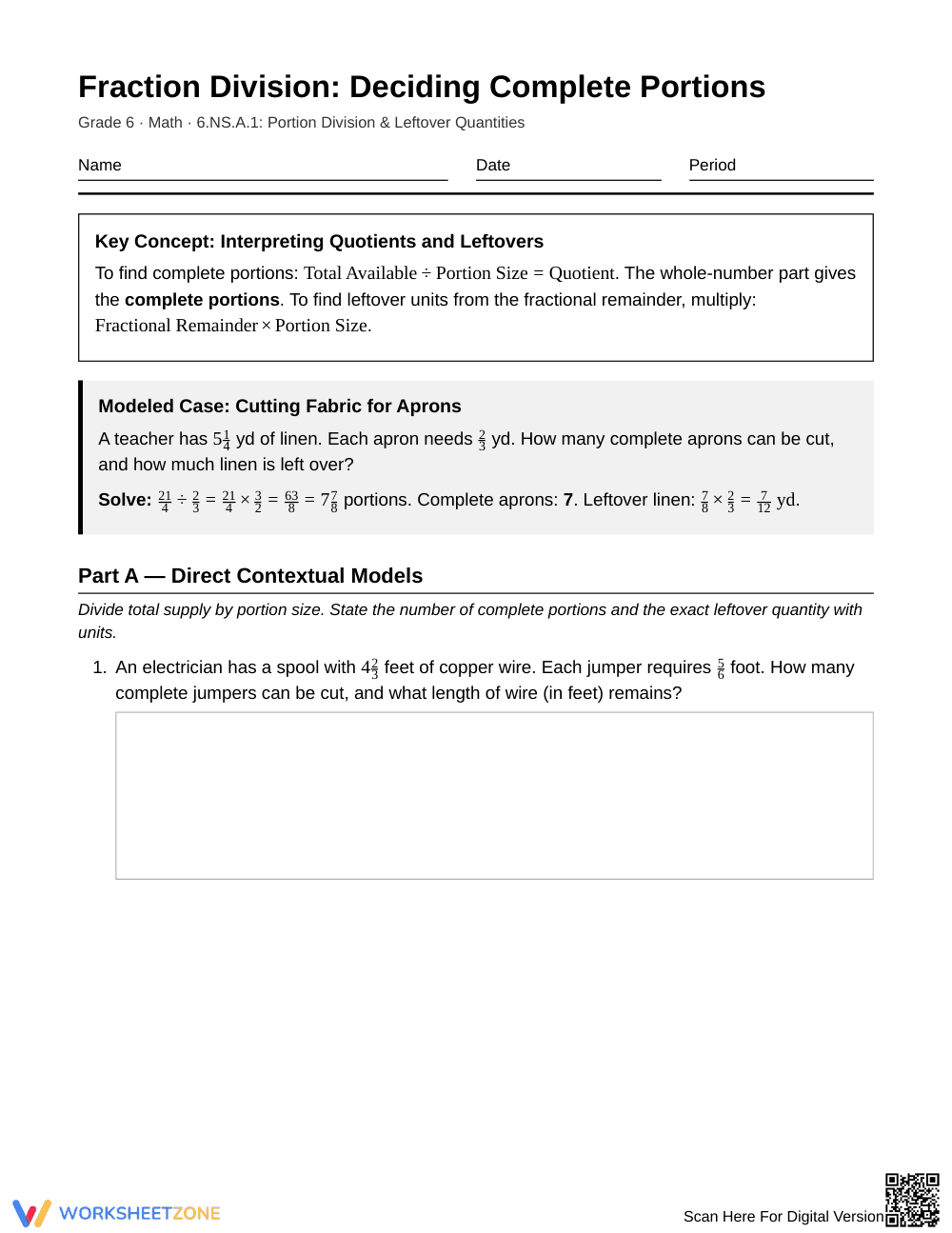
This targeted math worksheet helps sixth-grade students master fraction division in real-world scenarios. Learners calculate how many complete portions can be made from a given quantity and determine exact leftover amounts. Through contextual modeling and constraint-based decision-making, students build conceptual fluency and interpret remainders with precision.
At a Glance
- Grade: 6 · Subject: Math
- Standard:
6.NS.A.1— Solve word problems involving division of fractions by fractions- Skill Focus: Decide How Many Complete Portions Are Possible
- Format: 5 pages · 10 problems · Answer key included · PDF
- Best For: Small group intervention or core practice
- Time: 35–45 minutes
What's Inside
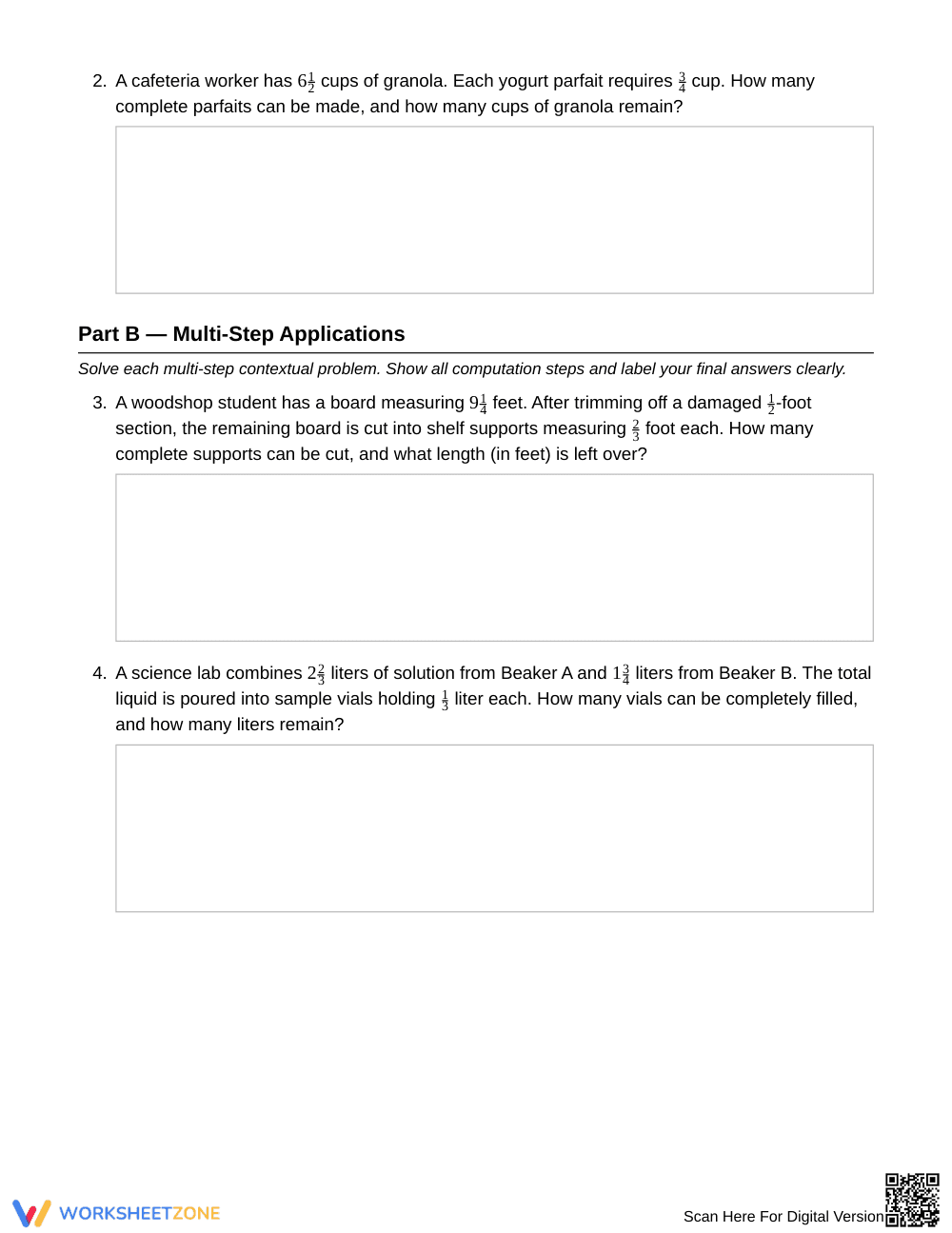
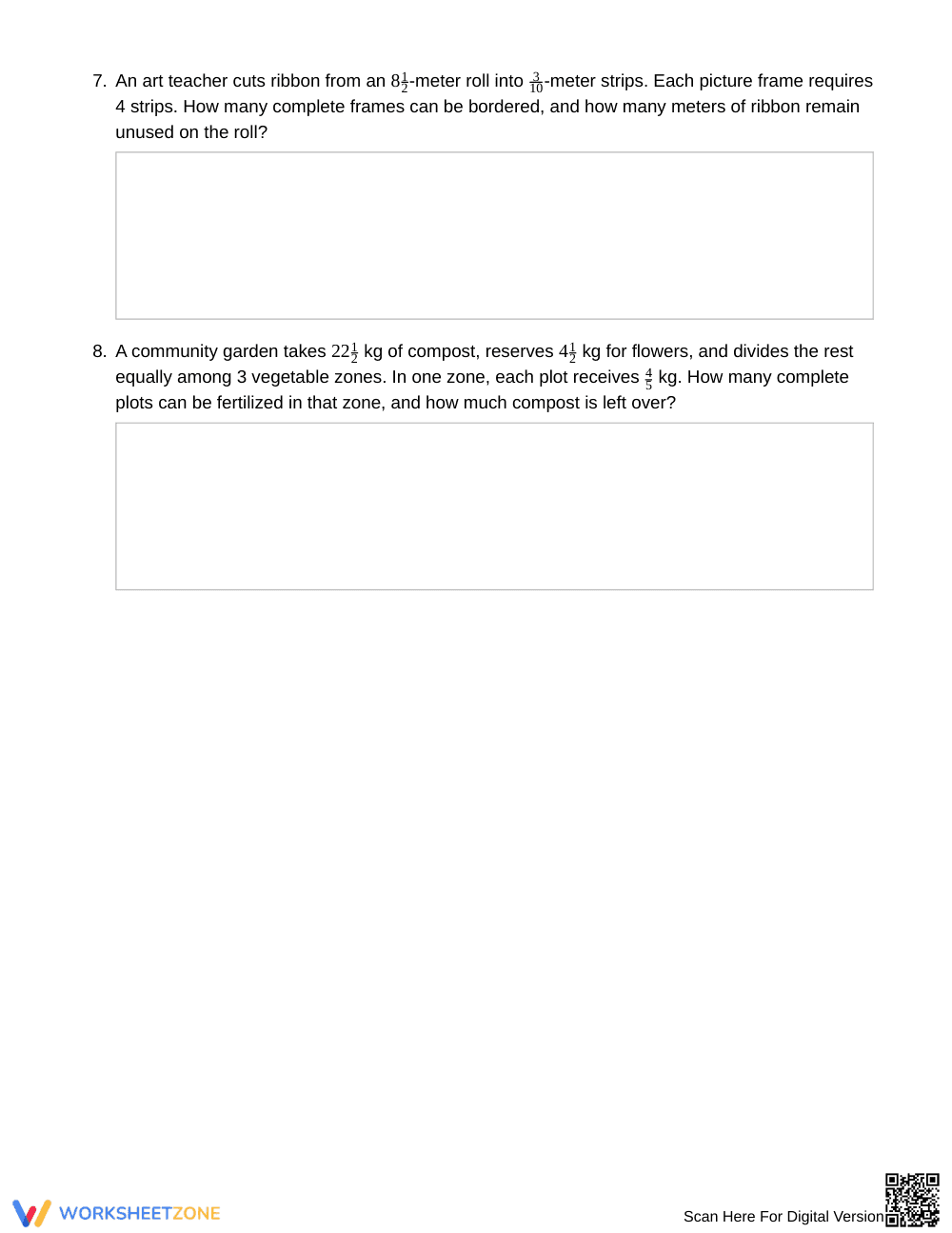
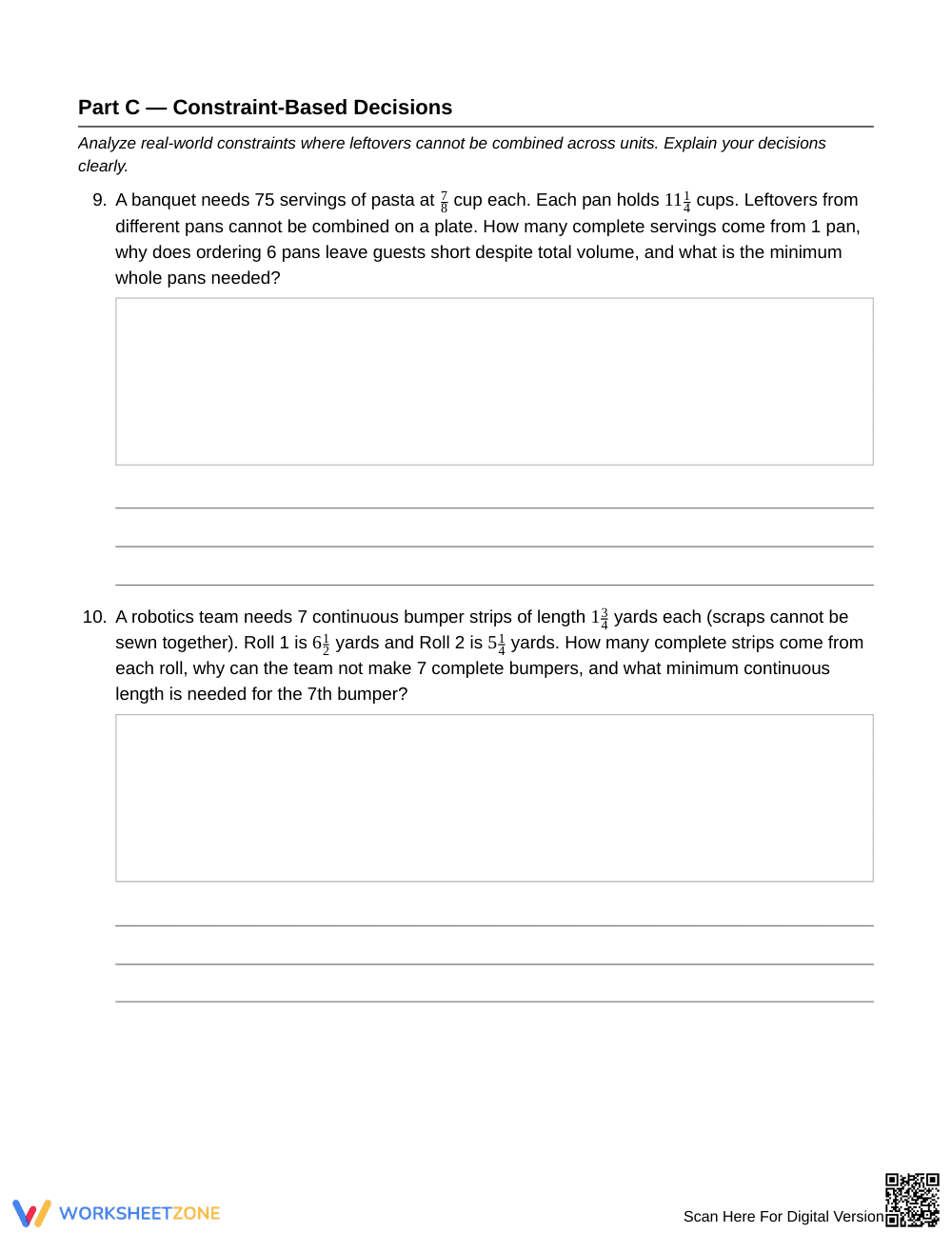
This 5-page printable resource features 10 multi-part math tasks organized into three distinct sections. It begins with a clear conceptual rule box and a modeled worked example detailing how to convert fractional remainders back into original measurement units. The document includes structured comparison tables, multi-step word problems, and a comprehensive 2-page answer key showing all division steps and labeled units.
Skill Progression
- Guided Practice (Part A, Problems 1–2): Students solve direct single-step division models with spool wire and granola measurements, supported by modeled reference steps to identify whole portions and convert fractional remainders.
- Supported Practice (Part B, Problems 3–8): Learners complete multi-step applications involving board trimming, volume packaging comparisons, and multi-zone distribution charts with moderate scaffolding.
- Independent Practice (Part C, Problems 9–10): Students tackle rigorous constraint-based scenarios requiring critical explanations where physical leftovers cannot be combined across distinct pans or rolls.
This structured sequence follows the gradual-release framework, moving students systematically from guided procedural execution to independent conceptual reasoning.
Standards Alignment
Primary standard: 6.NS.A.1 — Interpret and compute quotients of fractions, and solve word problems involving division of fractions by fractions, e.g., by using visual fraction models and equations to represent the problem. Supporting standard 6.EE.B.6 applies variables and expressions to real-world quantities. Both standard codes can be copied directly into lesson plans, IEP goals, or district curriculum mapping tools.
How to Use It
Use this resource directly after initial fraction division instruction during targeted station rotations or as a focused mid-unit check. For formative assessment, observe whether students mistakenly report the quotient's fractional remainder as the leftover unit instead of multiplying it back by the portion divisor. Expected completion time is 35 to 45 minutes.
Who It's For
Designed for general education Grade 6 math classrooms, tier-2 math intervention, and resource room support. Pair this worksheet with fraction strip manipulatives or a visual anchor chart on fraction division models.
According to research highlighted by Fisher & Frey (2014), structured problem sets that transition from explicit worked examples to complex contextual applications significantly enhance mathematical retention and conceptual understanding. This 5-page resource addresses standard 6.NS.A.1 by targeting one of the most persistent hurdles in Grade 6 fraction division: distinguishing between the fractional part of a portion and the leftover quantity in original units. Across 10 rigorous tasks, students construct mathematical models, compare packaging options, and evaluate physical constraints. By embedding explicit remainder conversion strategies within authentic real-world contexts, this worksheet ensures students build fluency in interpreting fraction quotients accurately.


