




























Views
Downloads


Complete Food Web Disruption Worksheet | Grade 6 Science

Paste this activity's link or code into your existing LMS (Google Classroom, Canvas, Teams, Schoology, Moodle, etc.).
Students can open and work on the activity right away, with no student login required.
You'll still be able to track student progress and results from your teacher account.
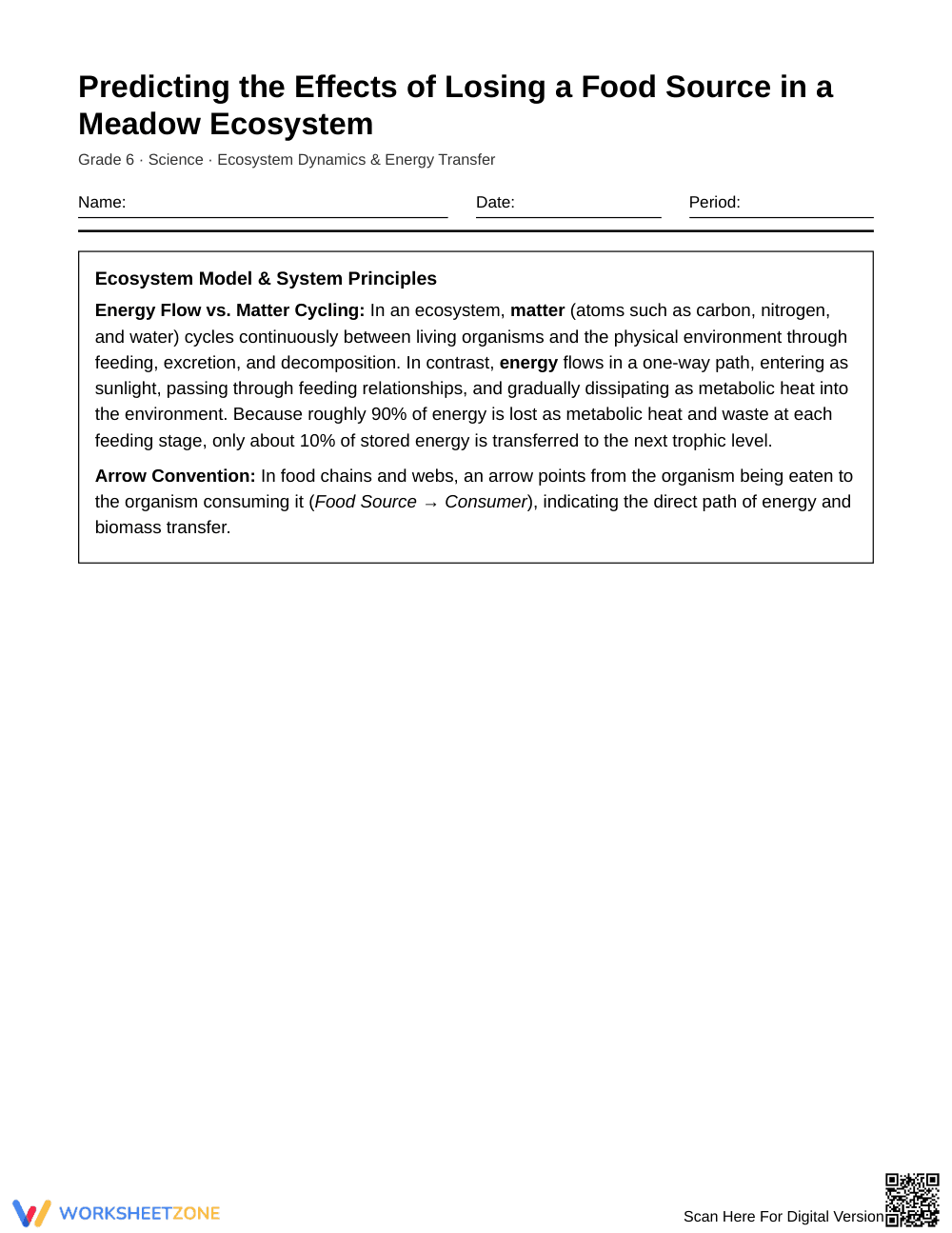
This Grade 6 science worksheet equips middle school students to model energy flow and predict how losing a single food source impacts an ecosystem. Through 10 analytical problems, learners analyze feeding relationships in a grassland community, evaluate trophic disruptions, and critique scientific claims about matter cycling and energy dissipation.
At a Glance
- Grade: 6 · Subject: Science
- Standard: Ecosystem Dynamics — Predict how resource disruptions affect populations and energy transfer across trophic levels
- Skill Focus: Food web disruptions and energy flow modeling
- Format: 5 pages · 10 problems · Answer key included · PDF
- Best For: Independent practice or formative assessment
- Time: 40–50 minutes
What's Inside
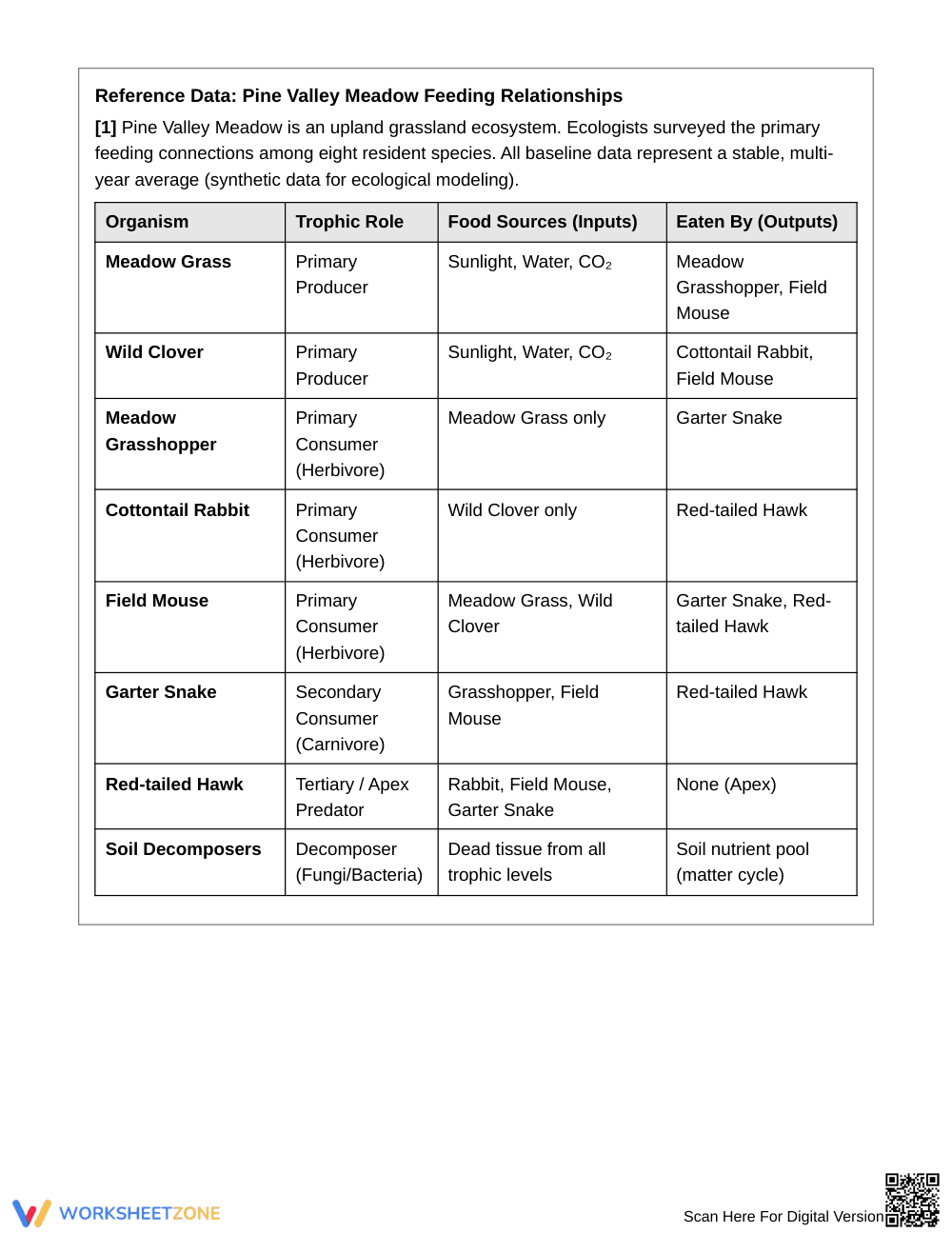
This 5-page printable resource includes a baseline ecological reference table depicting eight meadow species, structured scenario prompts, and a comprehensive 3-page answer key. Students interpret trophic roles, examine specialist versus generalist diets, trace indirect population cascades during species loss, and distinguish one-way energy flow from continuous matter cycling across three distinct worksheet sections.
Skill Progression
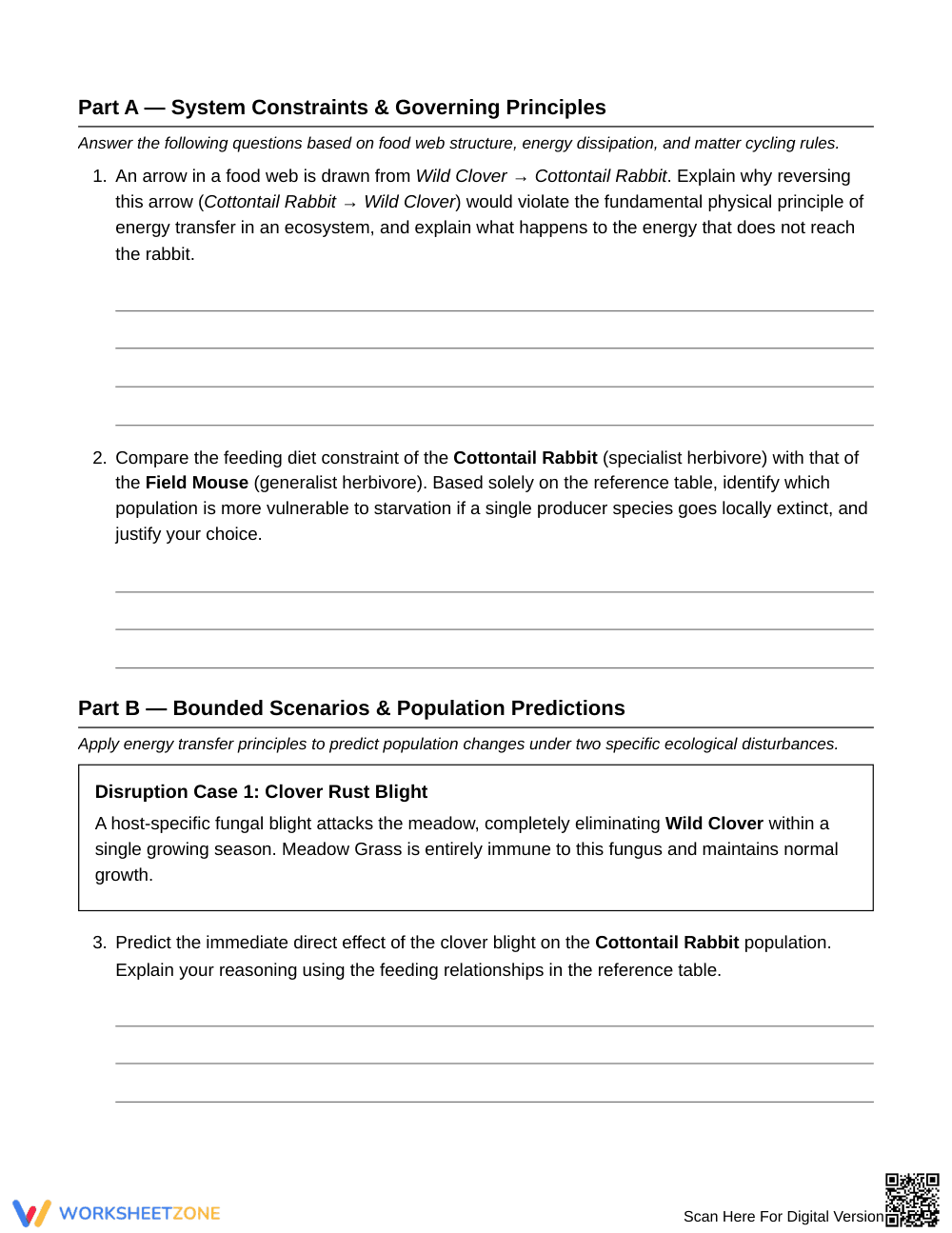
- Guided practice: Part A features 2 foundational tasks exploring arrow directionality conventions and comparing dietary constraints between specialist and generalist herbivores.
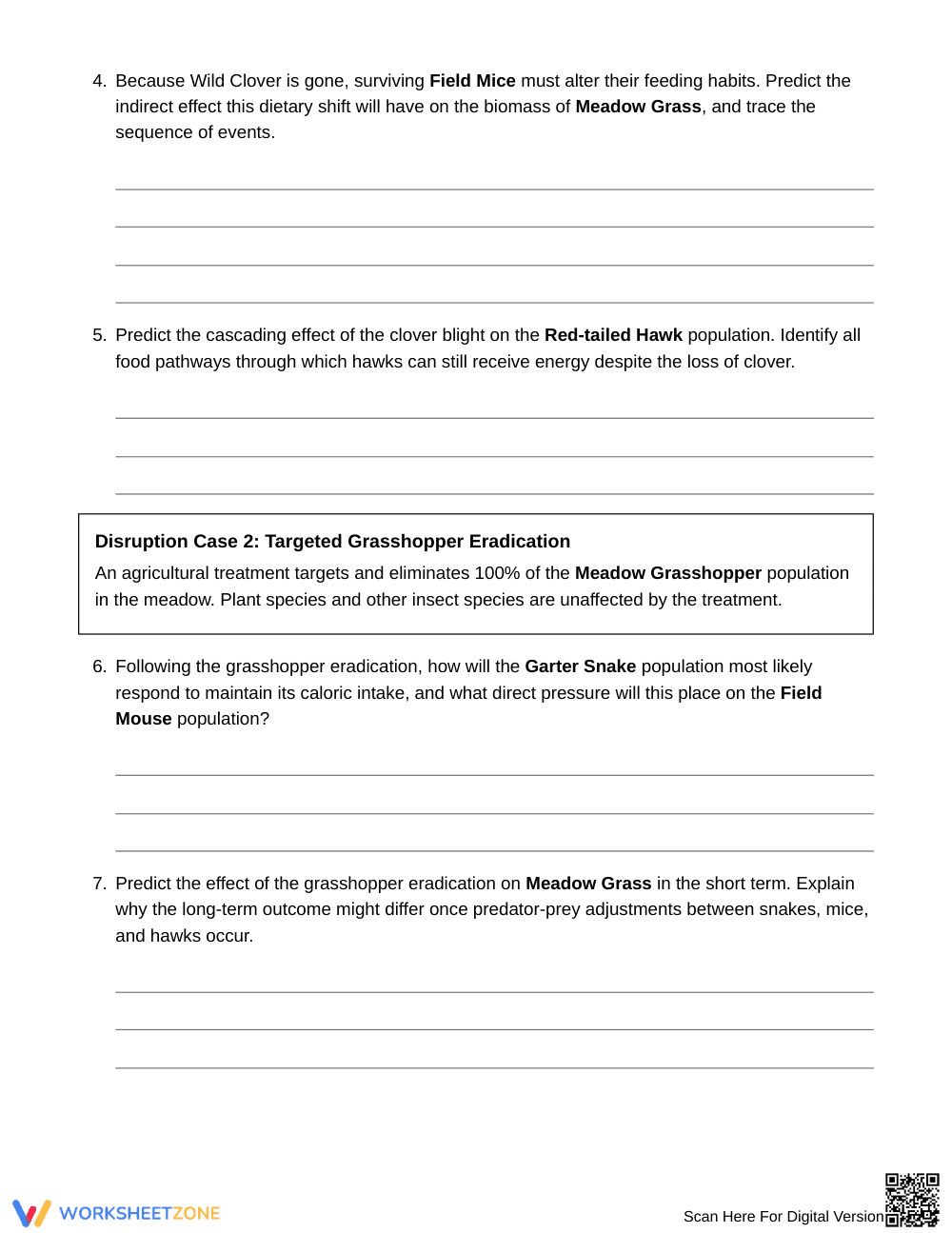
- Supported practice: Part B presents 6 scenario-based tasks analyzing specific disturbances, including fungal blight and insect eradication across multiple trophic tiers.
- Independent practice: Part C challenges learners with 2 scientific claim evaluations requiring written critique and evidence-based justification.
This gradual-release structure moves students from core system principles to independent ecological reasoning.
Standards Alignment
This activity aligns with middle school life science standards addressing ecosystem interactions, resource availability, and energy dynamics. Students construct explanations demonstrating how biotic and abiotic changes shift organism interactions and energy distribution across food webs. Both standard codes can be copied directly into lesson plans, IEP goals, or district curriculum mapping tools.
How to Use It
Deploy this worksheet after direct instruction on trophic pyramids and food web mechanics. Use Part A as a collaborative mid-lesson check to ensure students understand energy flow conventions. Assign Parts B and C for individual analysis or small-group inquiry. During work time, observe whether students confuse matter cycling with energy loss when explaining population shifts. Expected completion time is 40 to 50 minutes.
Who It's For
This activity is designed for Grade 6 science classrooms, life science intervention blocks, and middle school ecology units. Scaffolding makes it accessible for developing readers, while rigorous claim evaluations offer depth for advanced learners. Pair this worksheet with an interactive food web diagram or biomass pyramid anchor chart.
Middle school science instruction achieves maximum conceptual retention when students actively trace cause-and-effect relationships through structured ecological modeling rather than memorizing vocabulary in isolation. Research from Fisher & Frey (2014) highlights that intentional gradual-release frameworks provide the necessary scaffolding for students to transition from foundational system rules to high-level analytical evaluations. By exploring bounded disturbance scenarios—such as targeted pest eradication or producer elimination—learners confront common misconceptions regarding matter conservation and energy dissipation. As students critique scientific arguments and predict multi-tiered population outcomes across feeding networks, they internalize the quantitative reality of the 10 percent energy transfer rule. This evidence-based progression ensures learners develop robust scientific literacy, mastering the distinction between cyclic nutrient movement and unidirectional caloric loss within complex biotic environments across diverse secondary science learning environments.


