




























Views
Downloads


Complete Feasible Points Worksheet | Grade 9 Algebra I

Paste this activity's link or code into your existing LMS (Google Classroom, Canvas, Teams, Schoology, Moodle, etc.).
Students can open and work on the activity right away, with no student login required.
You'll still be able to track student progress and results from your teacher account.
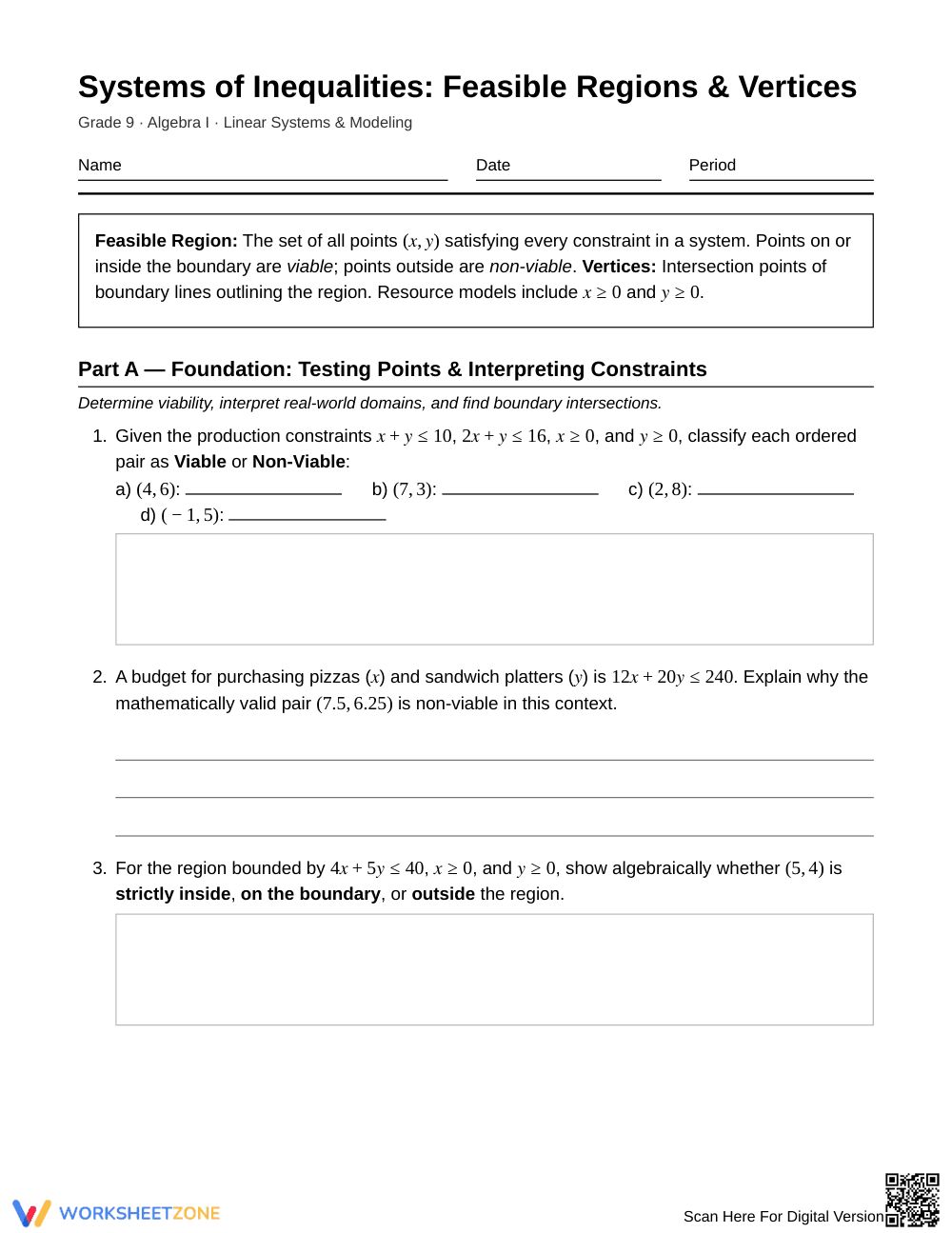
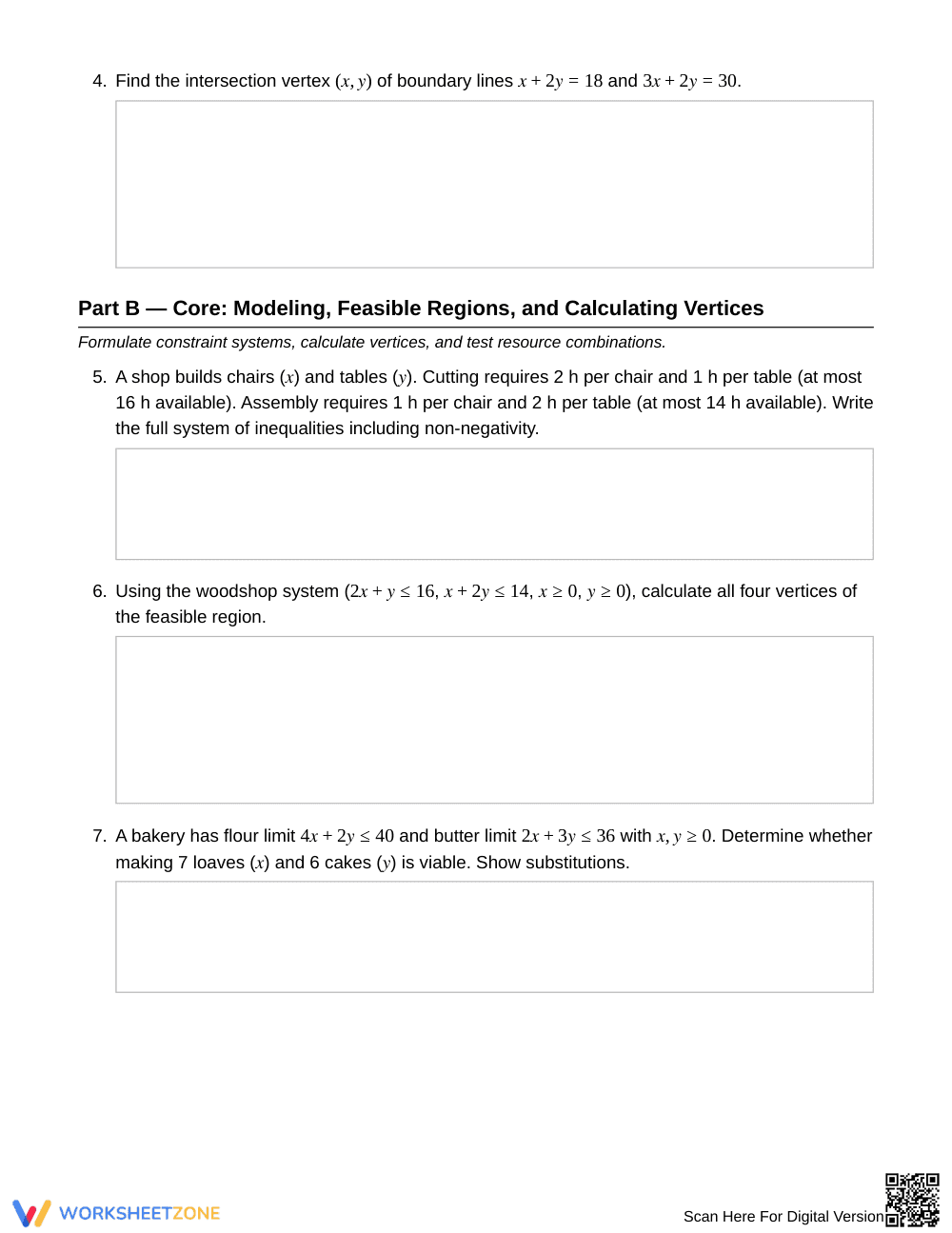
This 5-page Algebra I worksheet equips Grade 9 students to identify feasible points and calculate boundary vertices in systems of linear inequalities. Through 18 modeling problems, learners evaluate coordinate viability against constraints, calculate intersection vertices algebraically, and test resource optimization models to develop procedural fluency with linear systems.
At a Glance
- Grade: 9 · Subject: Algebra I
- Standard:
HSA-CED.A.3— Represent constraints by systems of equations or inequalities and interpret solutions- Skill Focus: Identify Feasible Points and Vertices
- Format: 5 pages · 18 problems · Answer key included · PDF
- Best For: Linear programming and constraint practice
- Time: 45–60 minutes
What's Inside
The 5-page printable resource delivers 18 scaffolded tasks across three parts, plus a 3-page full-solution answer key. Students complete point-testing tables, graphic analysis, boundary substitutions, vertex calculations, and discrete domain checks. The activity features clear definitions of feasible regions, non-negativity boundaries, and coordinate verification prompts.
Skill Progression
- Guided Practice (Part A, 4 tasks): Students review core concepts, evaluate points against basic production limits, examine discrete contextual limits such as whole-number purchases, and solve single-vertex intersections with scaffolding.
- Supported Practice (Part B, 10 tasks): Learners construct full inequality systems from word problems, compute 3-to-4 boundary vertices algebraically, interpret graphical feasible sets, and complete resource allocation tables.
- Independent Practice (Part C, 4 tasks): Students analyze complex multi-boundary systems, verify exterior intersection viability, track parameter shifts, and optimize linear models without prompts.
This structure implements a gradual-release instructional model, transitioning students from teacher-supported constraint testing to independent mathematical synthesis.
Standards Alignment
This worksheet directly aligns with HSA-CED.A.3: Represent constraints by equations or inequalities, and by systems of equations and/or inequalities, and interpret solutions as viable or non-viable options in a modeling context. It also supports standard HSA-REI.C.6 by having students solve systems to find boundary vertices. Both standard codes can be copied directly into lesson plans, IEP goals, or district curriculum mapping tools.
How to Use It
Deploy this worksheet after direct instruction on graphing linear systems. In a 50-minute period, use Part A as a guided check, assign Part B for collaborative practice, and reserve Part C for extension. As students work, check whether they solve boundary equations algebraically or rely on visual estimates. Expected completion time is 45 to 60 minutes.
Who It's For
Designed for Grade 9 Algebra I students, this practice set supports core instruction and targeted intervention. For students needing support, provide graph paper and color-code boundary lines. Pair this activity with an introductory anchor chart on systems of inequalities.
Mastering linear systems modeling requires students to interpret algebraic solutions within real-world constraints rather than treating inequalities as isolated graphing drills. Aligned directly to standard HSA-CED.A.3, this comprehensive practice set develops high school learners' proficiency in identifying feasible points and calculating boundary vertices across multi-step resource models. According to Fisher & Frey (2014), intentional gradual-release frameworks that transition from guided constraint evaluation to independent multi-variable problem-solving produce measurable gains in conceptual retention and procedural accuracy. Students who systematically test ordered pairs against non-negativity boundaries (x ≥ 0, y ≥ 0) and algebraically compute intersection vertices establish the mathematical reasoning necessary for advanced linear programming and economic modeling. By connecting algebraic systems to tangible production scenarios, this resource ensures that high school mathematicians can distinguish viable operational outcomes from non-viable mathematical solutions with precision and confidence across diverse modeling environments.


