




























Views
Downloads

Complete Dog Care Word Search | Grades 7–8 ELA

Paste this activity's link or code into your existing LMS (Google Classroom, Canvas, Teams, Schoology, Moodle, etc.).
Students can open and work on the activity right away, with no student login required.
You'll still be able to track student progress and results from your teacher account.
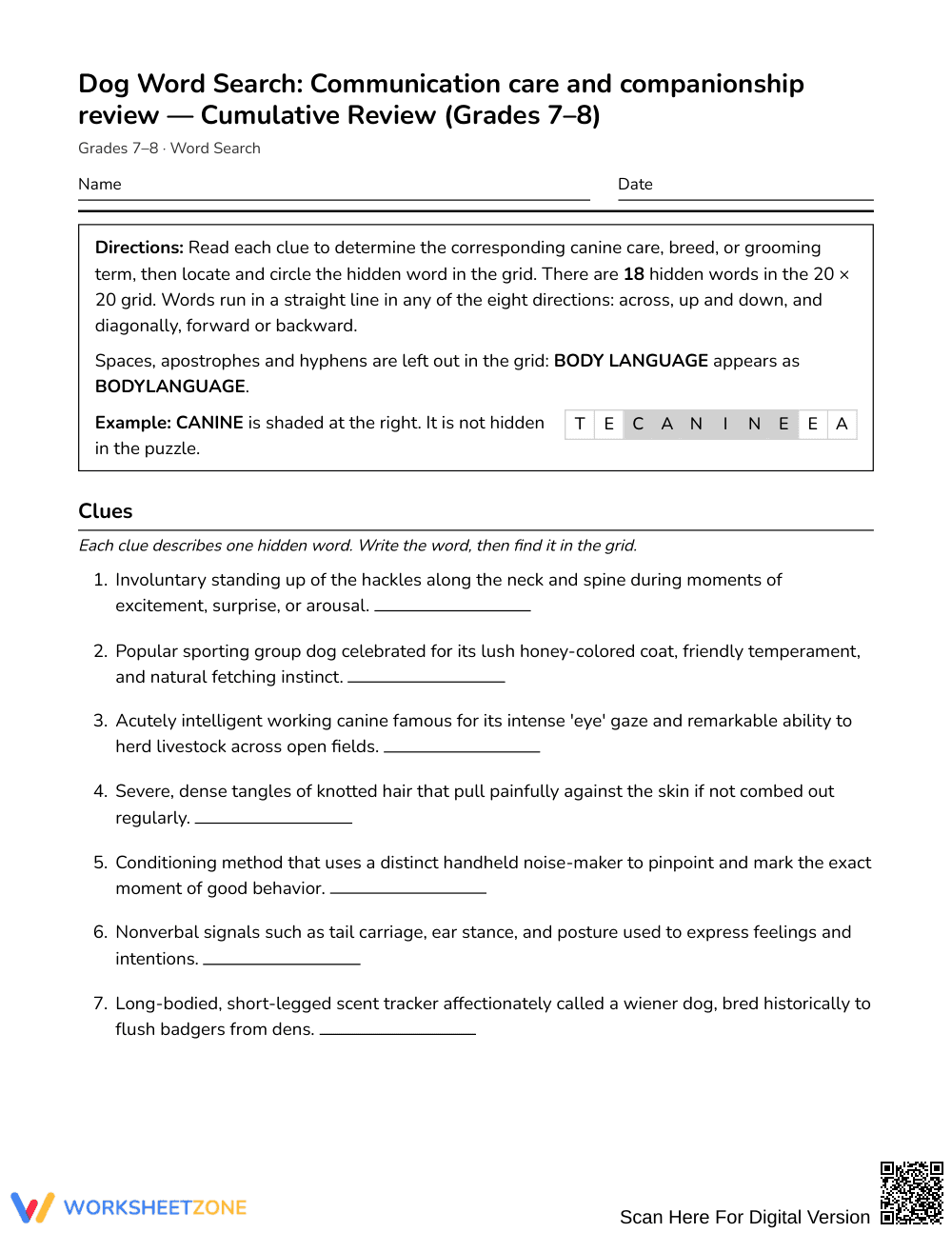
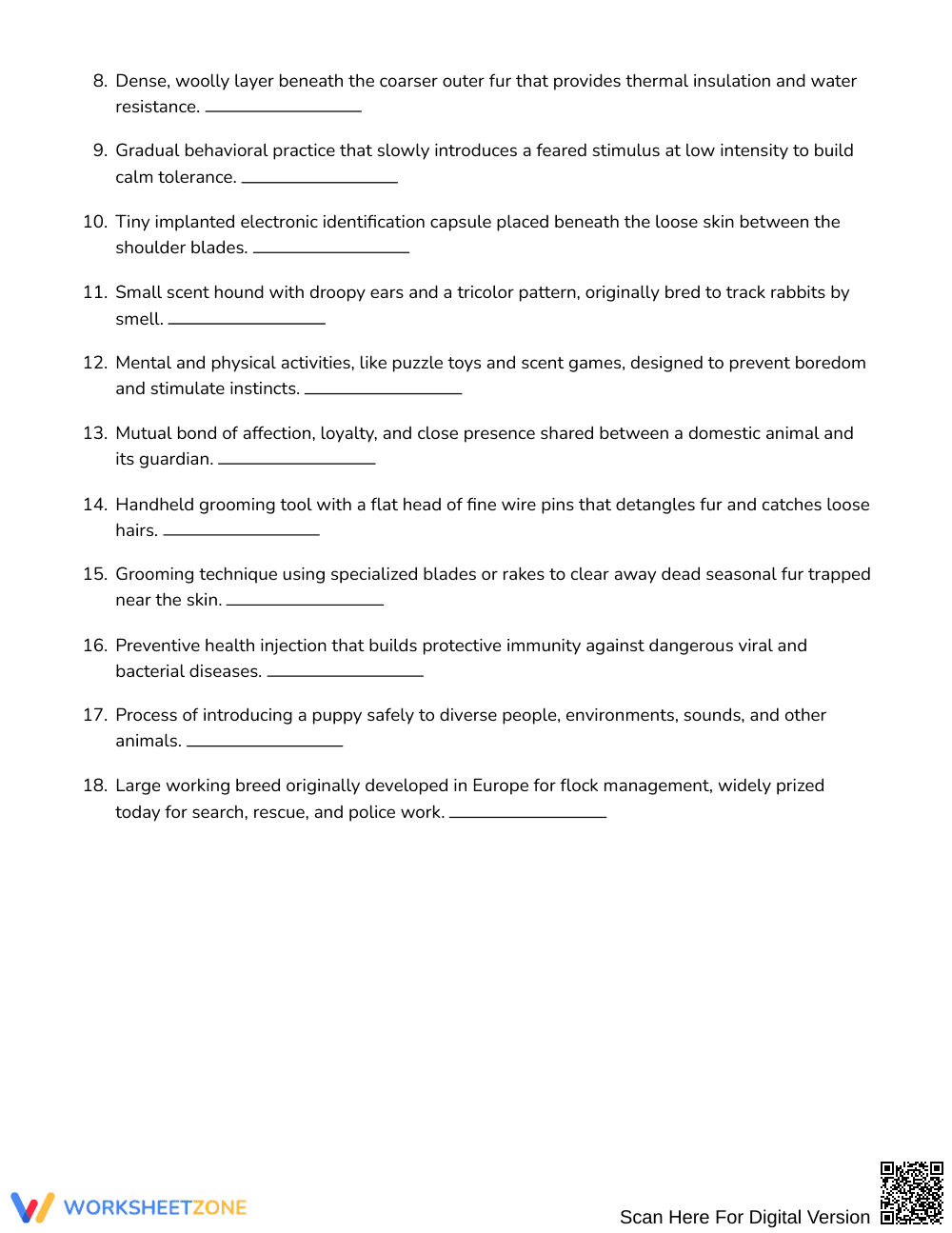
This canine care and companionship word search reinforces secondary vocabulary through engaging puzzle solving. Students in Grades 7–8 read detailed informational clues to identify 18 essential terms spanning canine communication, wellness, training, and dog breeds. By pairing contextual definitions with targeted search, learners solidify domain-specific language.
At a Glance
- Grade: Grades 7–8 · Subject: English Language Arts (ELA)
- Standard: Not standards-assessed — vocabulary enrichment and secondary literacy support
- Skill Focus: Canine care, communication, and companionship vocabulary
- Format: 3 pages · 18 words · Answer key included · PDF
- Best For: Middle school vocabulary review, sub plans, and early finisher enrichment
- Time: 25–35 minutes
What's Inside
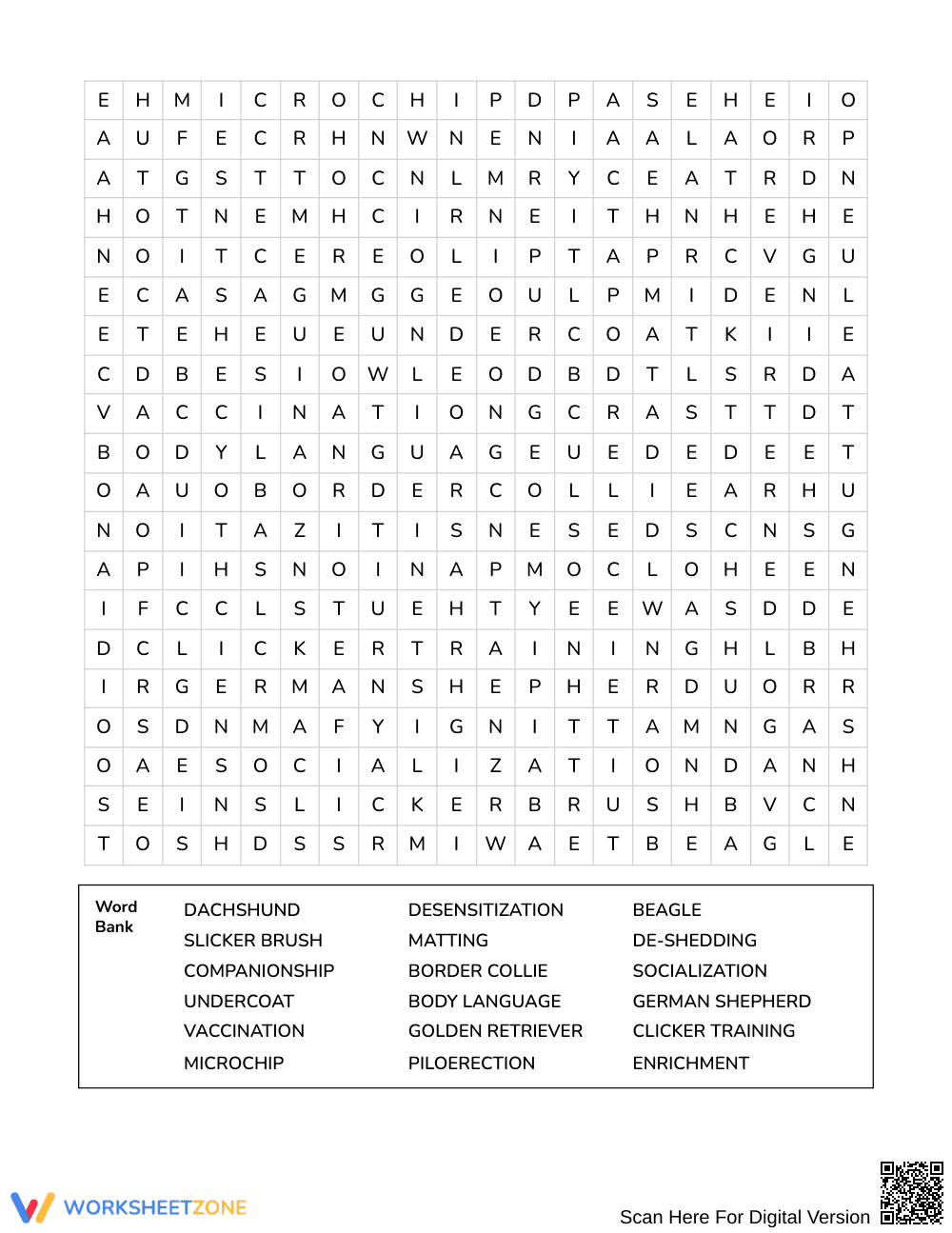
The 3-page activity packet features 18 hidden vocabulary terms embedded within a dense letter grid. It includes a comprehensive clue bank defining complex concepts like desensitization, piloerection, and socialization, along with a full 4-page answer key showing circled grid solutions for rapid grading.
Puzzle Structure and Mechanics
Students develop visual tracking and semantic recall through a challenging puzzle layout:
- 20 x 20 Grid: A substantial letter grid prevents quick skimming and demands sustained attention from middle schoolers.
- Eight Directional Paths: Words run horizontally, vertically, diagonally, and backward (N, NE, E, SE, S, SW, W, NW) to deepen orthographic awareness.
- Clue-Based Search: Learners read informational clues, match each to the shuffled word bank, and locate the term.
Standards Alignment
This activity provides non-standardized vocabulary enrichment rather than formal standards-based practice. It builds secondary literacy by connecting middle school students to specialized behavioral, veterinary, and care terminology through rigorous contextual definitions.
How to Use It
Use this word search during an informational text unit on domestic animals or following direct instruction on context clues. Students can solve the puzzle individually or with a partner. Formatively assess comprehension by checking whether students correctly match definitions before locating words in the grid. Expected completion time is 25 to 35 minutes.
Who It's For
This resource serves Grades 7–8 ELA classrooms, animal science electives, and early finisher stations. It provides visual learners with structured word-study practice. Pair it with an informational reading passage on animal behavior or a canine care anchor chart to reinforce comprehension.
According to Fisher & Frey (2014), intentional vocabulary instruction requires multiple exposures to domain-specific words across diverse reading and word-study contexts. This 18-word search strengthens Grades 7–8 lexical acquisition by linking rigorous definitions with active orthographic retrieval. As learners analyze complex clues covering animal communication, behavioral desensitization, grooming, and working dog breeds, they interact with technical terms in varied formats. Shifting between conceptual definitions and visual letter-pattern recognition encourages deeper cognitive processing than passive memorization drills. Furthermore, locating hidden target vocabulary across multi-directional letter arrays prompts students to repeatedly inspect spelling sequences and morphological structures. While designed as non-standardized vocabulary enrichment rather than formal assessment, the activity cultivates secondary literacy stamina and syntactic awareness. Educators can incorporate the 3-page puzzle into bell-ringer routines, cooperative partner challenges, or independent study stations to support sustained retention of specialized informational vocabulary across ELA curricula.


