


























Views
Downloads


Complete Density Calculation Worksheet | Grade 6 Science
Paste this activity's link or code into your existing LMS (Google Classroom, Canvas, Teams, Schoology, Moodle, etc.).
Students can open and work on the activity right away, with no student login required.
You'll still be able to track student progress and results from your teacher account.
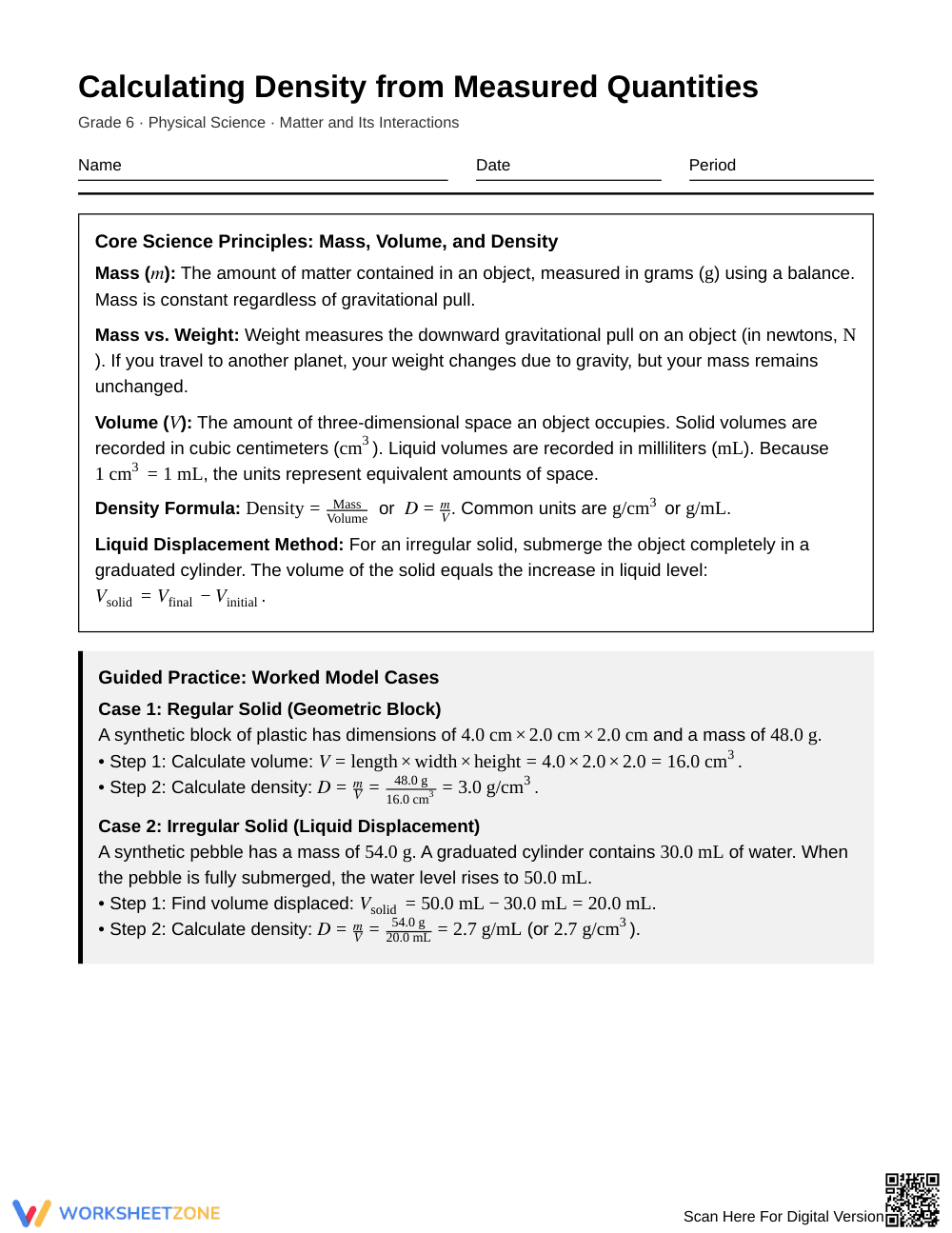
This Grade 6 science worksheet trains students to calculate density from measured mass and volume data. Learners explore both regular geometric solids and irregular objects using water displacement methods. By progressing from scaffolded calculations to independent problem sets and conceptual questions, students build enduring physical science competency.
At a Glance
- Grade: 6 · Subject: Science
- Standard: Physical Science — Calculate density from measured mass and volume data
- Skill Focus: Calculating density from mass and volume
- Format: 5 pages · 10 problems · Answer key included · PDF
- Best For: Independent practice and lab reinforcement
- Time: 45–60 minutes
What's Inside
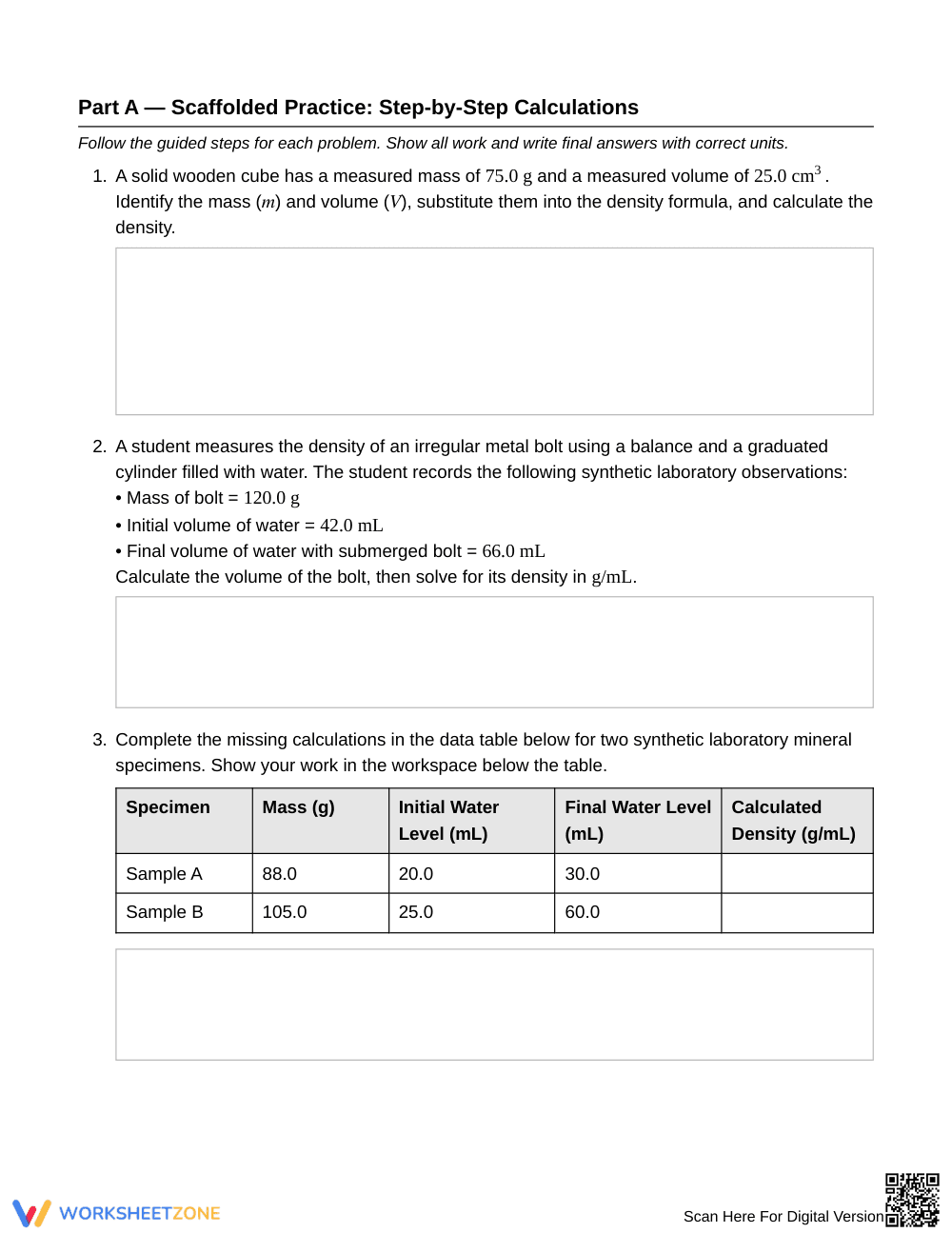
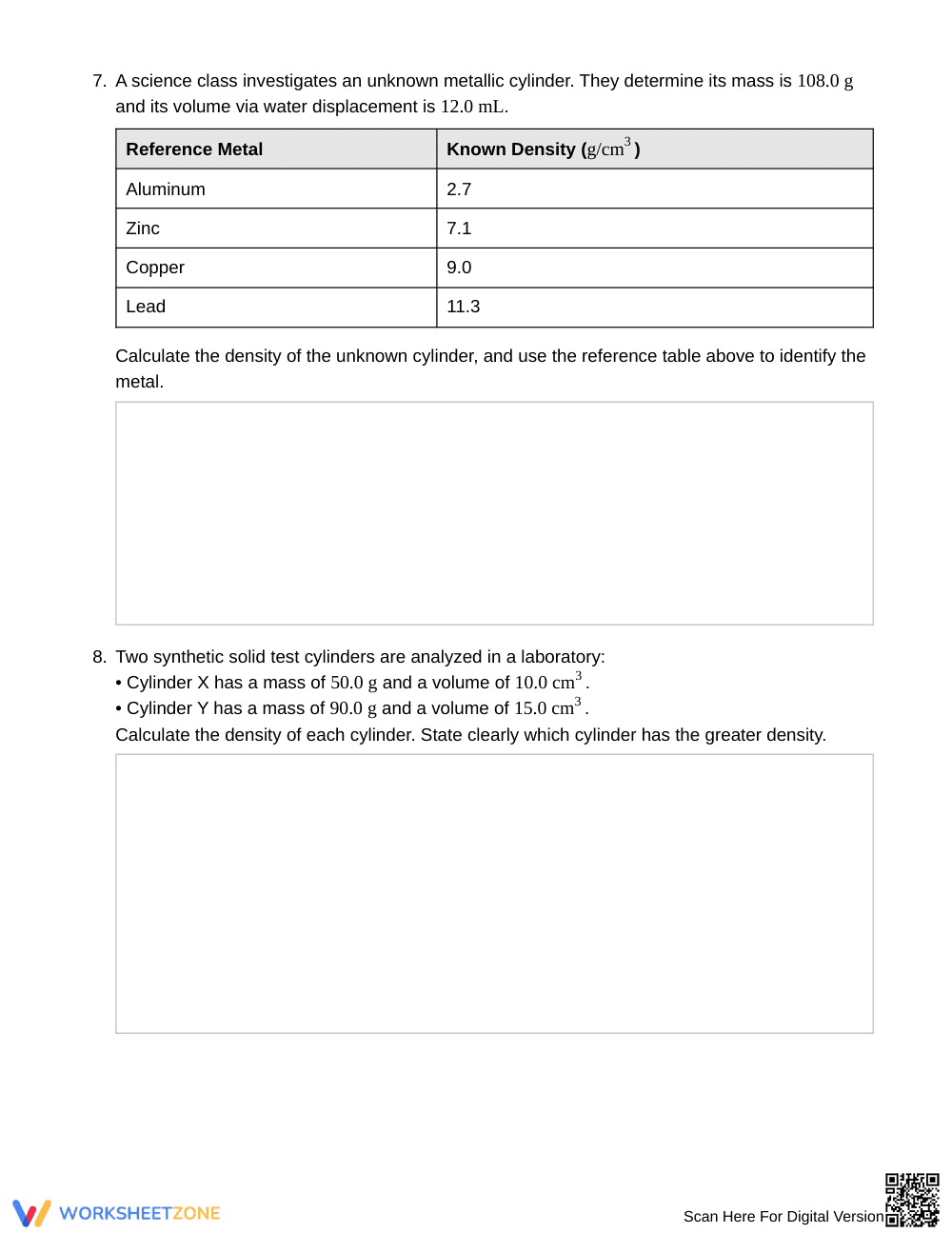
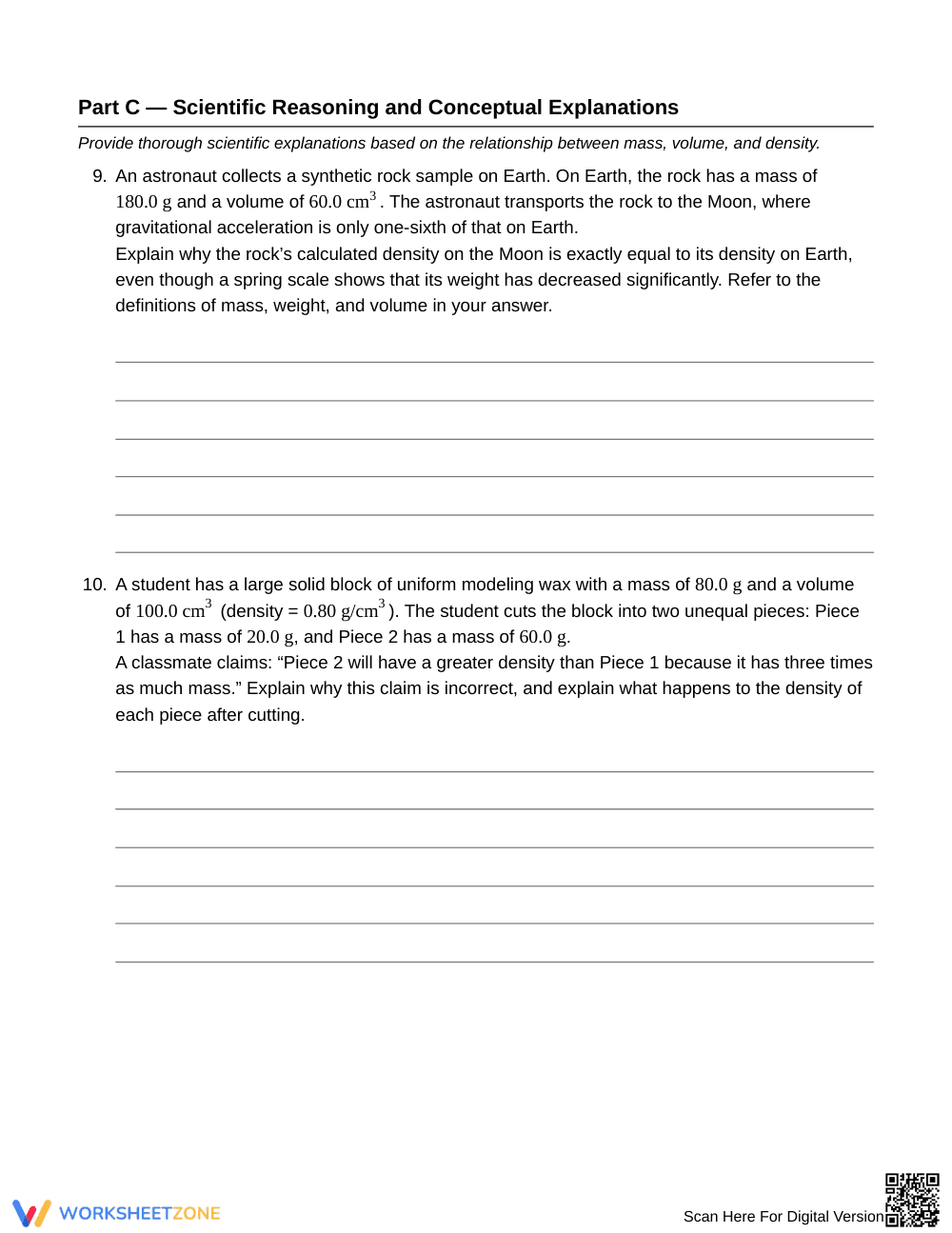
The 5-page printable resource includes reference summaries of mass, volume, and density formulas, accompanied by two step-by-step worked model cases. Students complete 10 rigorous tasks across three structured sections featuring regular prism calculations, liquid displacement data tables, unknown substance identification, and conceptual explanations. A comprehensive 2-page answer key provides complete mathematical steps and sample explanations.
Skill Progression
- Guided Practice (Part A, Problems 1–3): Students follow step-by-step scaffolds to calculate density for geometric blocks and irregular specimens using water displacement data tables.
- Supported Practice (Part B, Problems 4–8): Students independently set up the density formula, determine values from experimental scenarios, identify unknown metals, and compare relative densities.
- Independent Application (Part C, Problems 9–10): Students write extended scientific arguments analyzing how gravity affects mass versus weight and why cutting an object preserves its intrinsic density.
This sequence embodies the gradual-release model, moving systematically from teacher-guided modeling to autonomous scientific reasoning.
Standards Alignment
This worksheet aligns directly with middle school physical science expectations for matter and its interactions, focusing on characteristic properties such as density. Students measure, calculate, and analyze mass and volume relationships to identify substances. Standard descriptions can be copied directly into lesson plans, IEP goals, or district curriculum mapping tools.
How to Use It
Deploy this resource immediately after direct instruction on the density formula (D = m/V) or as a post-laboratory processing activity following a liquid displacement lab. During classwork, monitor student substitution steps in Part A to ensure they do not invert mass and volume during division. The complete 10-problem sequence requires approximately 45 to 60 minutes of focused instructional time.
Who It's For
This worksheet serves Grade 6 science classrooms, introductory physical science units, and intervention groups requiring structured computational practice. Built-in worked examples support struggling math learners, while the conceptual reasoning prompts challenge advanced students. Pair this activity with a hands-on graduated cylinder displacement investigation or a physical science anchor chart on characteristic properties.
Mastering density calculations requires students to coordinate arithmetic division with physical science concepts of mass and volume. According to Fisher & Frey (2014), structured scaffolds that transition from worked examples to independent application significantly enhance student acquisition of multi-step STEM competencies. This Grade 6 physical science worksheet operationalizes that pedagogical framework across 10 targeted tasks. Students apply the density formula to regular geometric solids and calculate displaced volume from graduated cylinder measurements. By analyzing laboratory data and distinguishing between intrinsic density and extrinsic gravitational weight, learners construct durable scientific understanding. Research shows that integrating computational problem-solving with conceptual explanation tasks reinforces long-term retention of physical properties of matter. The included worked models, structured data tables, and two-page teacher answer key ensure rigorous classroom implementation, offering educators an instructional tool for middle school physical science mastery.


