


























Views
Downloads




Complete Concision Analysis Worksheet | Grade 12 English IV
Paste this activity's link or code into your existing LMS (Google Classroom, Canvas, Teams, Schoology, Moodle, etc.).
Students can open and work on the activity right away, with no student login required.
You'll still be able to track student progress and results from your teacher account.
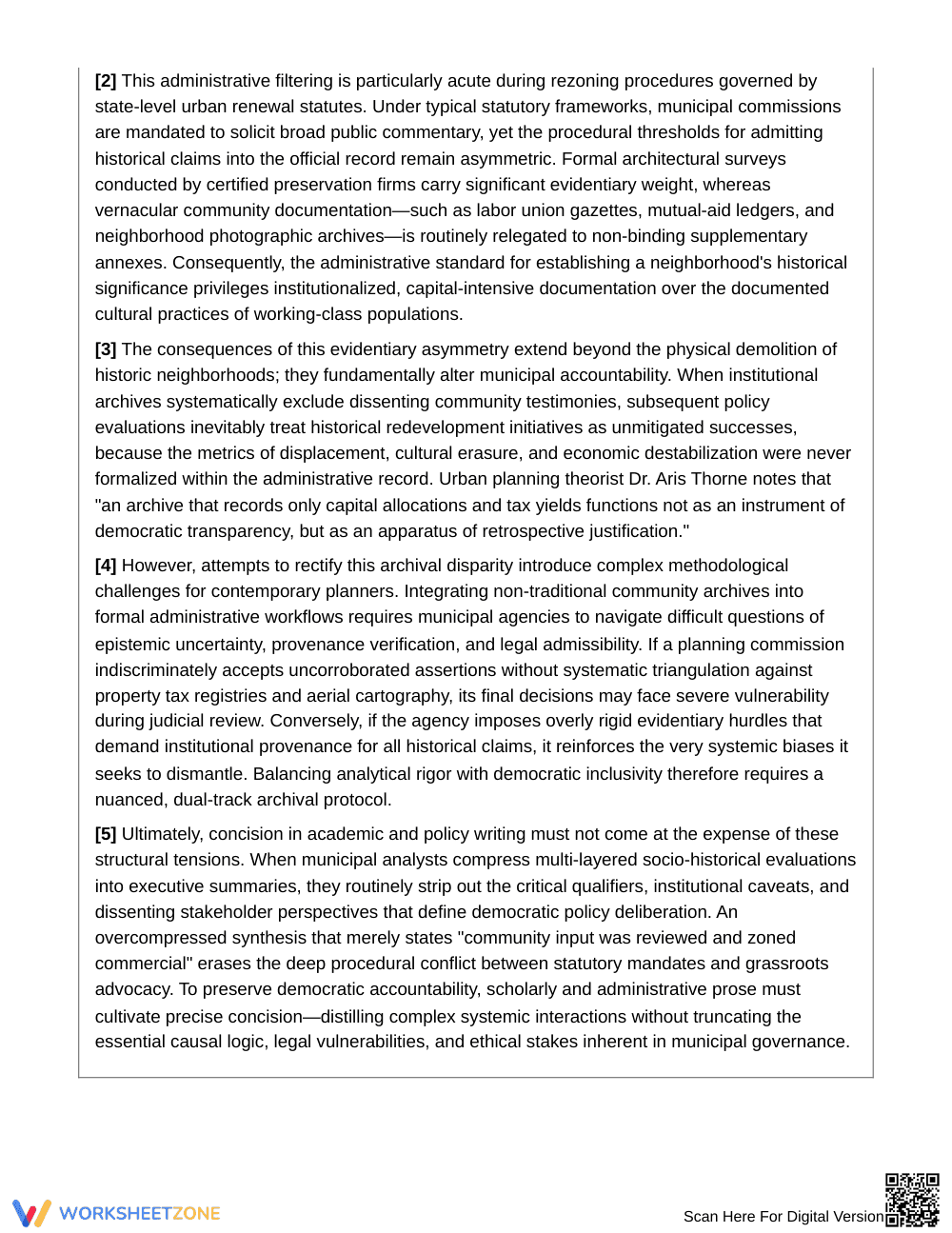
This Grade 12 English IV worksheet guides advanced writers to distinguish between functional concision and reductive overcompression in scholarly and policy prose. Students evaluate academic syntax to eliminate nominalizations and pleonasms while strictly maintaining institutional agency, causal mechanisms, and evidentiary hedging across complex texts.
At a Glance
- Grade: 12 · Subject: English IV
- Standard:
W.11-12.5— Develop and strengthen writing by planning, revising, editing, and rewriting- Skill Focus: Concision vs. Overcompression
- Format: 7 pages · 10 problems · Answer key included · PDF
- Best For: Advanced rhetorical revision and writing analysis
- Time: 45–60 minutes
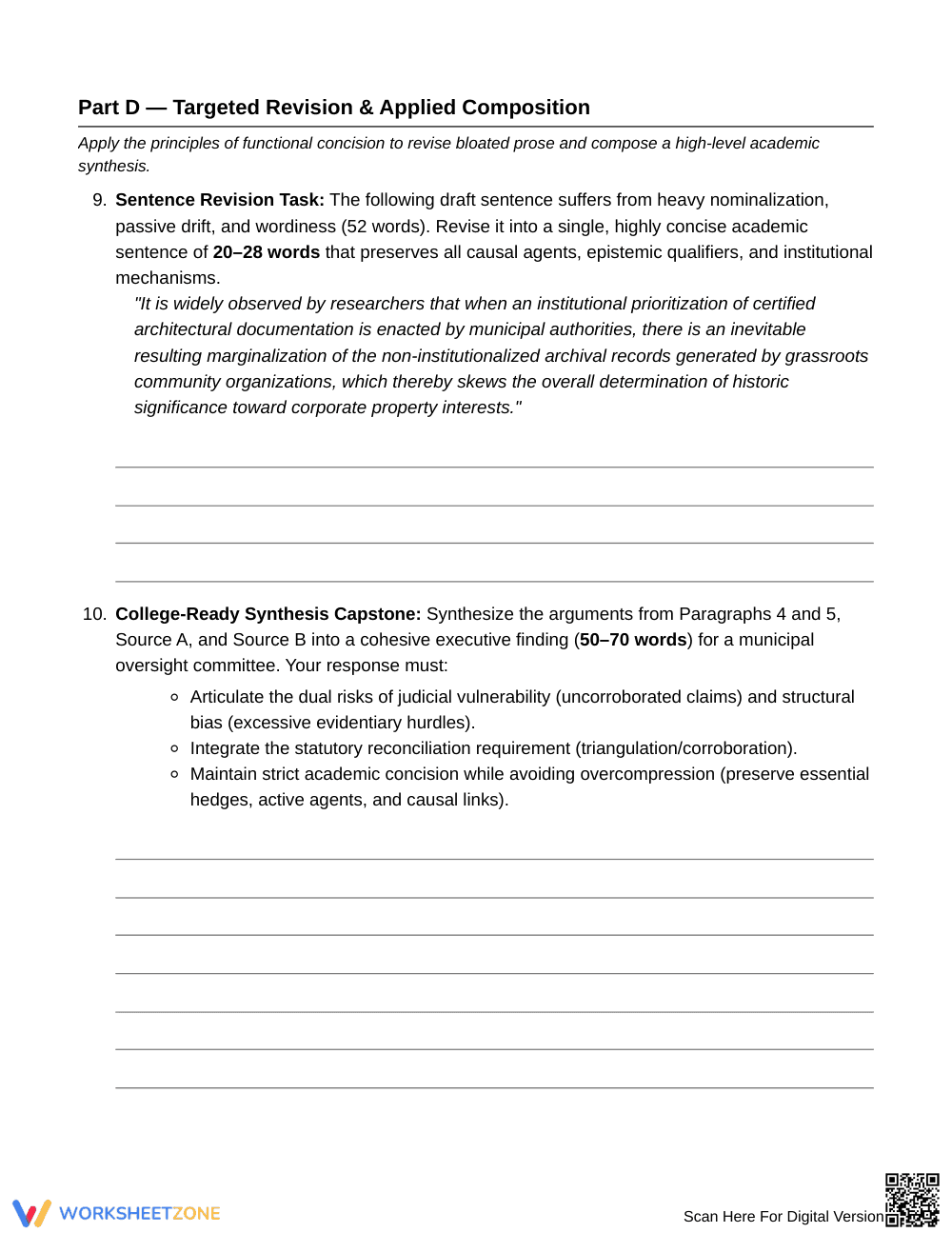
The 7-page printable resource includes a comprehensive 5-paragraph anchor text exploring urban governance and archival policy, accompanied by statutory reference excerpts. Students complete 10 rigorous analytical and applied tasks distributed across four progressive parts, supported by formal definition reference boxes and a detailed 5-page answer key featuring complete model rationales.
Skill Progression
- Guided Practice: Tasks 1 and 2 establish foundational criteria by requiring students to analyze theoretical definitions and explain how overcompressing syntax damages epistemic uncertainty and causal coherence.
- Supported Practice: Tasks 3 through 8 prompt students to evaluate competing sentence-level revisions and synthesize statutory excerpts, identifying where aggressive edits obscure institutional accountability or conditional logic.
- Independent Practice: Tasks 9 and 10 challenge students to apply functional concision autonomously by revising heavily nominalized draft sentences and composing precise academic summaries without losing critical qualifiers.
This sequence follows a structured gradual-release model, transitioning students from analytical critique to sophisticated independent composition.
Standards Alignment
This worksheet directly addresses W.11-12.5: Develop and strengthen writing as needed by planning, revising, editing, rewriting, or trying a new approach, focusing on addressing what is most significant for a specific purpose and audience. Students analyze how sentence condensing impacts rhetorical effectiveness and precision. Both standard codes can be copied directly into lesson plans, IEP goals, or district curriculum mapping tools.
How to Use It
Deploy this worksheet during a senior revision unit after introducing syntactic pruning and academic hedging. For formative assessment, examine student evaluations in Part B to verify whether learners identify stripped agency or false absolutes. The resource takes approximately 45 to 60 minutes to complete in an intensive writing workshop.
Who It's For
This activity is designed for Grade 12 English IV, AP Language, and advanced composition students preparing for college-level research writing. It provides structured analytical frames for emerging academic writers while challenging advanced scholars. Pair this resource with mentor text analysis or direct instruction on nominalization and active voice.
According to Fisher & Frey (2014), purposeful writing instruction requires explicit modeling of how syntactic choices alter meaning, rhetorical nuance, and conceptual clarity. This Grade 12 resource operationalizes standard W.11-12.5 by engaging students in rigorous revision tasks that differentiate functional concision from reductive overcompression. When advanced writers prune unnecessary verbiage without sacrificing epistemic hedging, institutional agency, or evidentiary conditions, they produce academic prose that maintains analytical integrity. By evaluating competing revisions of complex policy arguments and statutory excerpts, students develop the metacognitive discernment needed to refine their own research compositions effectively. Research confirms that structured comparative analysis of student-level syntax accelerates mastery of concise academic expression far more reliably than isolated grammar drills, establishing a solid foundation for post-secondary discourse and professional communication.


