


























Views
Downloads




Complete Complex Character Worksheet | Grade 9 English I
Paste this activity's link or code into your existing LMS (Google Classroom, Canvas, Teams, Schoology, Moodle, etc.).
Students can open and work on the activity right away, with no student login required.
You'll still be able to track student progress and results from your teacher account.
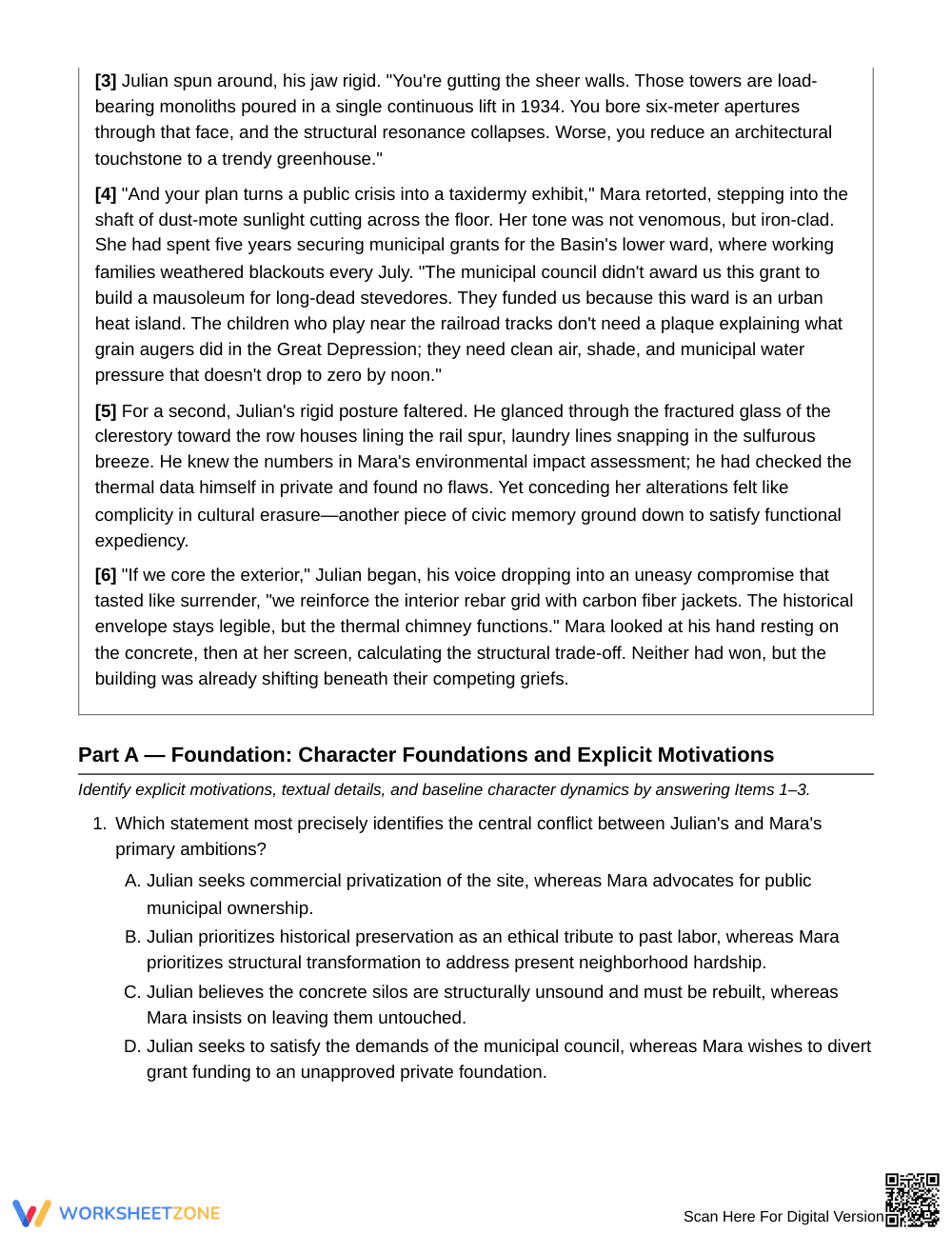
This Grade 9 English I worksheet trains high school students to analyze complex, multi-dimensional characters through structured text-dependent analysis. By examining conflicting motivations, symbolic dialogue, and ethical trade-offs in an original narrative, students learn how character development directly advances thematic tension and narrative resolution.
At a Glance
- Grade: 9 · Subject: English I
- Standard:
RL.9-10.3— Analyze how complex characters develop, interact, and advance the plot or theme- Skill Focus: Complex-Character Check
- Format: 6 pages · 12 problems · Answer key included · PDF
- Best For: High school literary analysis practice
- Time: 45–60 minutes
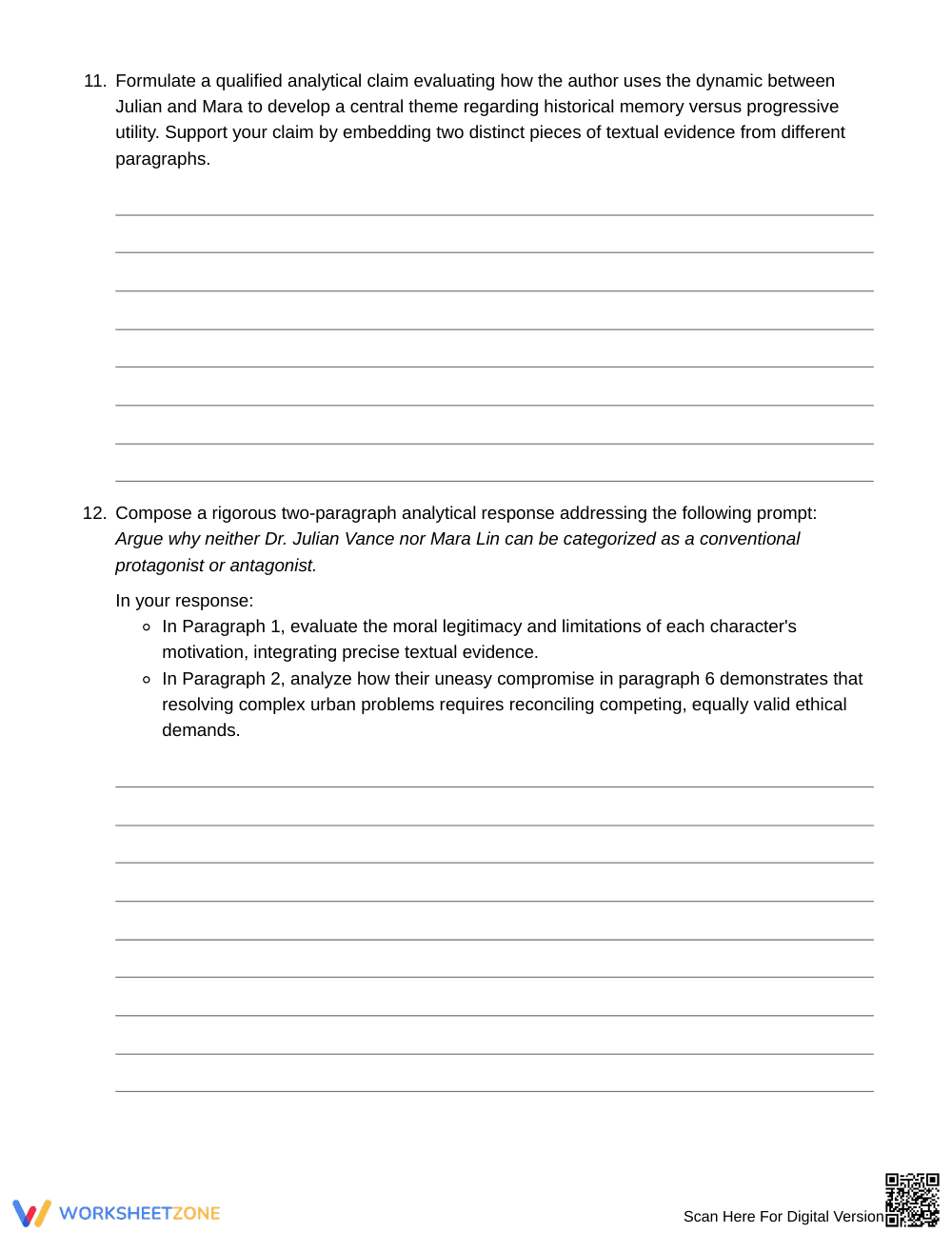
This 6-page resource includes an introductory theoretical framework defining round characters, an original short story titled "The Resonance of Concrete," 12 text-dependent tasks, and a 5-page answer key. Students complete multiple-choice items, text-evidence short responses, an evolution-tracking graphic organizer, and a two-paragraph evaluative essay comparing competing ethical stances.
Skill Progression
- Guided practice (Items 1–3): Identifies baseline character motivations and contrasting material symbolism through structured multiple-choice and short-answer prompts.
- Supported practice (Items 4–9): Analyzes internal conflicts, sociotechnical diction, and dynamic character interactions requiring embedded textual quotations.
- Independent practice (Items 10–12): Synthesizes full-text character development via an evolution chart, thematic claim creation, and an evaluative essay defending non-binary morality.
This gradual release of responsibility model systematically guides students from literal comprehension to independent evaluative writing.
Standards Alignment
This worksheet aligns directly to primary standard RL.9-10.3: "Analyze how complex characters develop over the course of a text, interact with other characters, and advance the plot or develop the theme." It also supports RL.9-10.1 through extensive text-based evidence requirements. Both standard codes can be copied directly into lesson plans, IEP goals, or district curriculum mapping tools.
How to Use It
Use this activity during or after direct instruction on character complexity and narrative arcs. Students can read the story and finish Parts A and B collaboratively before completing Part C individually as a formative assessment. During group work, verify that students recognize Julian's dilemma in paragraph 5 as a moral tension rather than stubbornness. Expected completion time is 45 to 60 minutes.
Who It's For
Ideal for Grade 9 English I general education and honors classrooms, this printable resource provides analytical frameworks and organizers to support diverse learners. Pair this worksheet with a mini-lesson on thematic development or an anchor chart on direct and indirect characterization.
Under standard RL.9-10.3, high school English language arts instruction requires students to analyze how complex characters develop conflicting motivations, interact dynamically, and advance central themes. According to research on structured secondary literacy frameworks by Fisher & Frey (2014), gradual-release instructional sequences that integrate explicit theoretical models, scaffolded text-dependent questioning, and synthesis writing produce measurable gains in student analytical comprehension. This Grade 9 worksheet operationalizes those pedagogical findings by grounding close reading in a multi-perspective narrative. Learners move systematically from identifying explicit motivations and contrasting metaphors to evaluating non-binary ethical frameworks and composing extended analytical arguments. The inclusion of structured graphic organizers, targeted quotation prompts, and a comprehensive five-page answer key equips educators to monitor student mastery of characterization standards efficiently while reinforcing rigorous evidentiary writing skills across secondary classroom settings.


