


























Views
Downloads



Complete Comparing Scaled Plans Worksheet | Grade 7 Math
Paste this activity's link or code into your existing LMS (Google Classroom, Canvas, Teams, Schoology, Moodle, etc.).
Students can open and work on the activity right away, with no student login required.
You'll still be able to track student progress and results from your teacher account.
This Grade 7 math worksheet prepares students to analyze, convert, and compare scale drawings across different scales. Learners compute real-world lengths, evaluate drawing area ratios, and address scale factor misconceptions across architectural blueprints and grid plans, building proportional reasoning skills.
At a Glance
- Grade: 7 · Subject: Math
- Standard:
7.G.A.1— Compute actual lengths and areas from scale drawings and reproduce drawings at different scales- Skill Focus: Compare Plans Using Different Scales
- Format: 5 pages · 12 problems · Answer key included · PDF
- Best For: Core instruction, small-group intervention, or review
- Time: 45–60 minutes
What's Inside
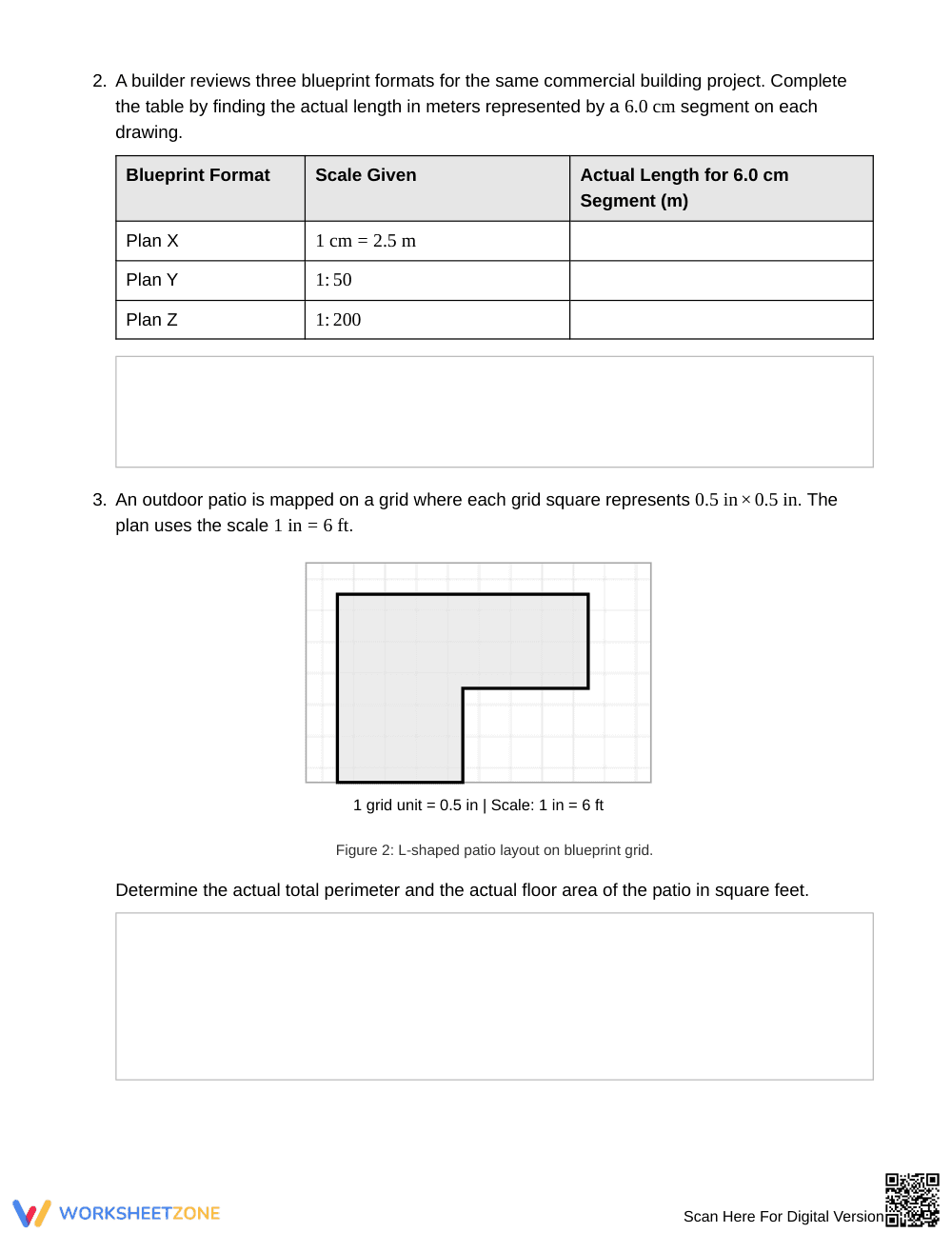
This 5-page printable resource includes a 3-page answer key and 12 multi-part problems. An opening reference box reviews linear scale formulas, unitless ratios, and area relationships. Students explore architectural plans, blueprint conversion tables, patio grid layouts, and multistep comparison problems.
Skill Progression
- Guided practice (Problems 1–3): Students use formulas and diagrams to calculate real lengths, perimeters, and patio areas.
- Supported practice (Problems 4–9): Learners convert measurements between scales and calculate area ratios across blueprints.
- Independent practice (Problems 10–12): Students evaluate scale claims, compare stage blueprints, and correct area calculation errors.
This sequence follows the gradual-release model from initial calculation to high-level error analysis.
Standards Alignment
Primary standard `7.G.A.1` focuses on solving problems with scale drawings of geometric figures, computing actual lengths and areas, and reproducing plans at different scales. Supporting standard `7.RP.A.2` reinforces proportional relationships across units. Both standard codes can be copied directly into lesson plans, IEP goals, or district curriculum mapping tools.
How to Use It
Assign this worksheet during mid-unit practice or as a partner activity after introducing scale factors. Monitor how students transition from linear scales to area scale factors in Part B, watching for students who forget to square the scale factor. Completion time is 45 to 60 minutes.
Who It's For
This worksheet is ideal for Grade 7 math classes, accelerated Grade 6 students, and Grade 8 intervention groups. Built-in formulas support English learners, while error-analysis tasks extend advanced students. Pair this activity with an introductory blueprint lesson or anchor chart.
Mastering standard 7.G.A.1 requires middle school students to move beyond rote multiplication by connecting linear scale factors directly to quadratic area changes across geometric representations. According to Fisher & Frey (2014), structured instructional progressions that guide learners from worked examples to collaborative application and independent critique build robust mathematical problem-solving capacity. This worksheet operationalizes that research framework by requiring students to compute actual lengths and areas, compare drawings produced at multiple scales, and evaluate authentic contractor claims. By systematically confronting common misconceptions—such as confusing linear scaling with two-dimensional area scaling—students firmly anchor their conceptual understanding of geometric proportionality. The embedded reference formulas and scaffolded blueprint scenarios support diverse learners while sustaining rigorous cognitive demand throughout every problem. Teachers can utilize this 12-task resource to gather actionable formative assessment data on student proportional reasoning before summative geometry evaluations.


