


























Views
Downloads



Complete Comparing Quotients Worksheet | Grade 6 Math
Paste this activity's link or code into your existing LMS (Google Classroom, Canvas, Teams, Schoology, Moodle, etc.).
Students can open and work on the activity right away, with no student login required.
You'll still be able to track student progress and results from your teacher account.
This Grade 6 math worksheet sharpens students' ability to interpret and compare quotients across measurement units during fraction division. By analyzing remainders as parts of a serving rather than base units, learners build conceptual precision. Students solve real-world problems, evaluate expressions, and critique mathematical reasoning to solidify mastery.
At a Glance
- Grade: 6 · Subject: Math
- Standard:
6.NS.A.1— Compute quotients of fractions to solve contextual word problems- Skill Focus: Compare Quotients with Different Units in word problems
- Format: 5 pages · 12 problems · 2-page answer key included · PDF
- Best For: Core instruction and targeted small-group intervention
- Time: 40–50 minutes of classroom practice
What's Inside
This 5-page printable resource features 12 contextual problems and a complete 2-page answer key. A foundational concept box clarifies that quotients measure groups rather than base units. Students complete structured comparison tables, multi-step word problems, and written error-analysis prompts.
Skill Progression
- Guided practice (Part A, Problems 1–3): Students examine visual division models and comparison tables, finding quotients and naming units with explicit conceptual support.
- Supported practice (Part B, Problems 4–9): Learners independently write division expressions, compute fractional quotients across fluid ounces and meters, and compare yields.
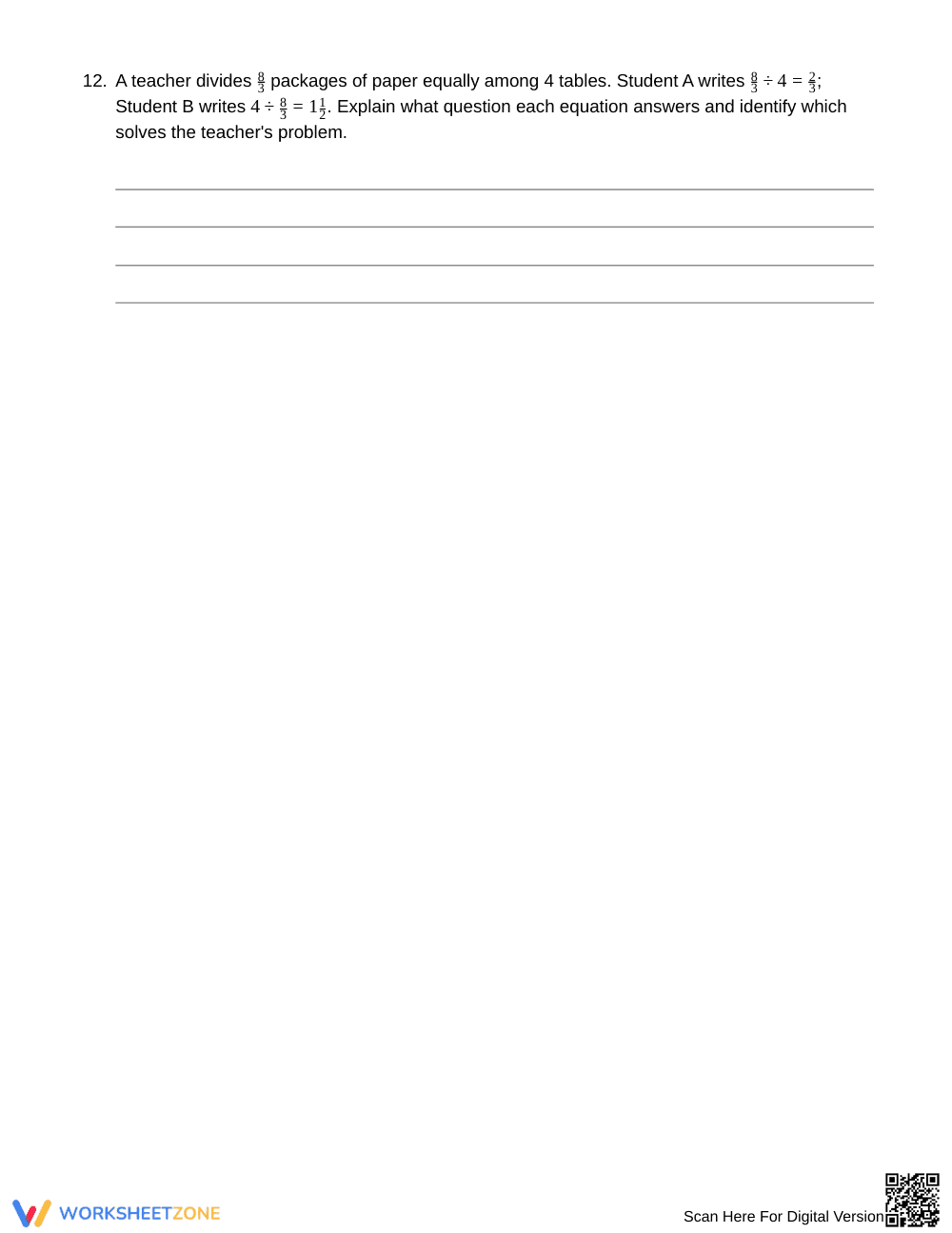
- Independent practice (Part C, Problems 10–12): Students evaluate mathematical claims, diagnose remainder unit errors, and explain reciprocal equations without prompts.
This sequence follows a gradual-release model, moving learners from guided interpretation to autonomous critique.
Standards Alignment
This worksheet aligns directly to `6.NS.A.1`, requiring students to interpret and compute quotients of fractions to solve contextual word problems. It also supports `6.RP.A.3.B` through unit-rate comparisons. Both standard codes can be copied directly into lesson plans, IEP goals, or district curriculum mapping tools.
How to Use It
Use this worksheet after direct instruction on fraction division algorithms. In pairs, students solve Part B to contrast dividend units with quotient units. For formative assessment, inspect Problem 10 to see whether students confuse a remainder fraction with original measurement units. Expect completion in 40 to 50 minutes.
Who It's For
This worksheet is designed for Grade 6 math students and Grade 7 intervention groups mastering rational number division. The explicit reference box supports English learners, while comparison tables aid visual thinkers. Pair this activity with fraction-strip manipulatives or tape diagrams during small-group review.
According to Fisher & Frey (2014), structured cognitive progressions that move systematically from guided modeling to independent error analysis significantly enhance student retention in middle school mathematics. This instructional worksheet operationalizes that framework to address standard 6.NS.A.1, targeting the complex skill of interpreting and comparing fraction division quotients across varying measurement units. Rather than treating fraction division as an isolated mechanical algorithm of inverting and multiplying, the 12 structured tasks require sixth-grade learners to define what fractional remainders represent in context. Students must explicitly differentiate between the measurement unit of the dividend and the group unit established by the divisor. By integrating guided contextual tables with rigorous student-reasoning evaluations, the resource provides an evidence-based pathway toward mathematical fluency. Educators can reliably implement these structured materials to verify conceptual mastery, identify persistent unit misconceptions, and fulfill rigorous curricular accountability standards across diverse classroom settings.


