




























Views
Downloads

Complete Coffee Additions Word Search | Grades 6–7 ELA

Paste this activity's link or code into your existing LMS (Google Classroom, Canvas, Teams, Schoology, Moodle, etc.).
Students can open and work on the activity right away, with no student login required.
You'll still be able to track student progress and results from your teacher account.
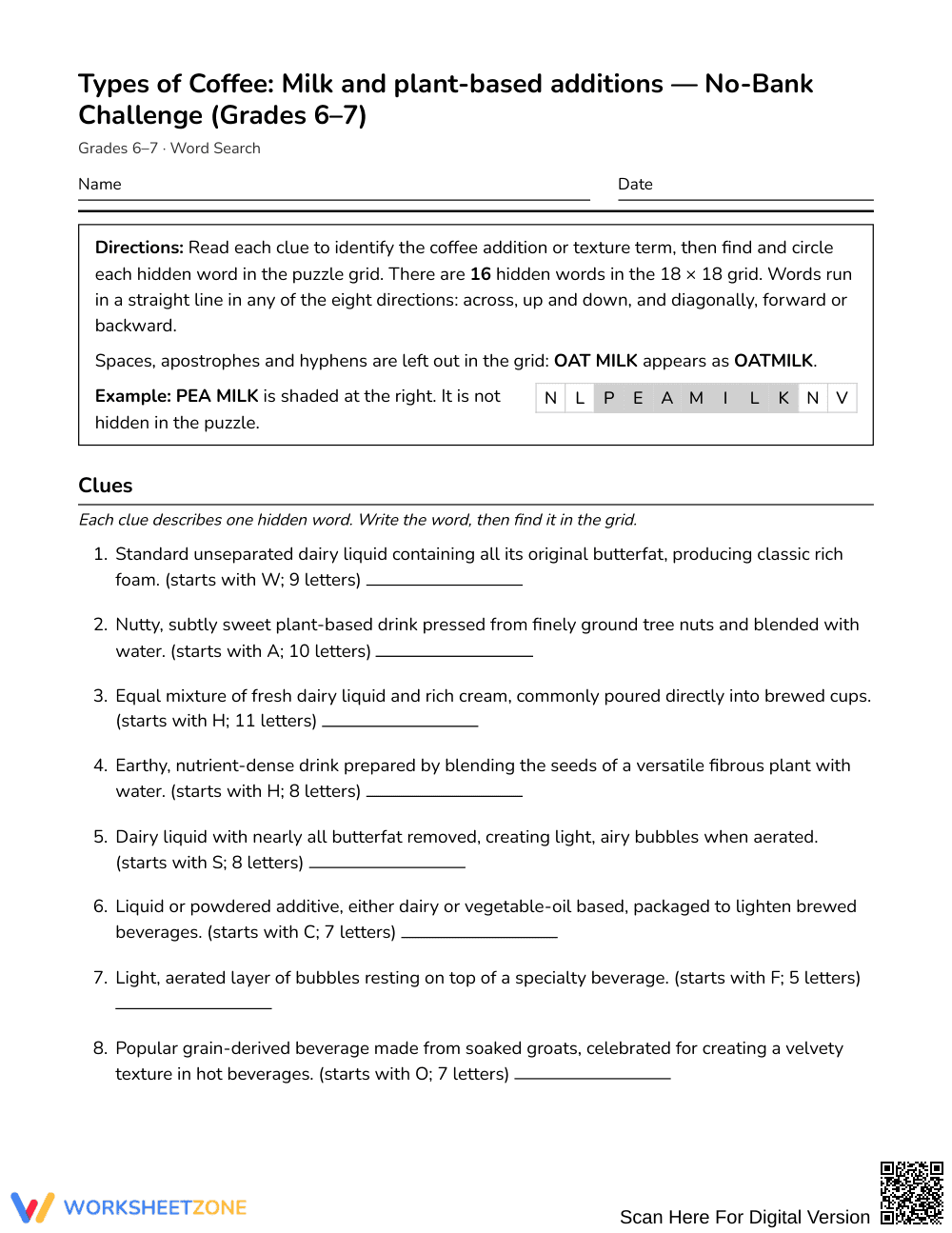
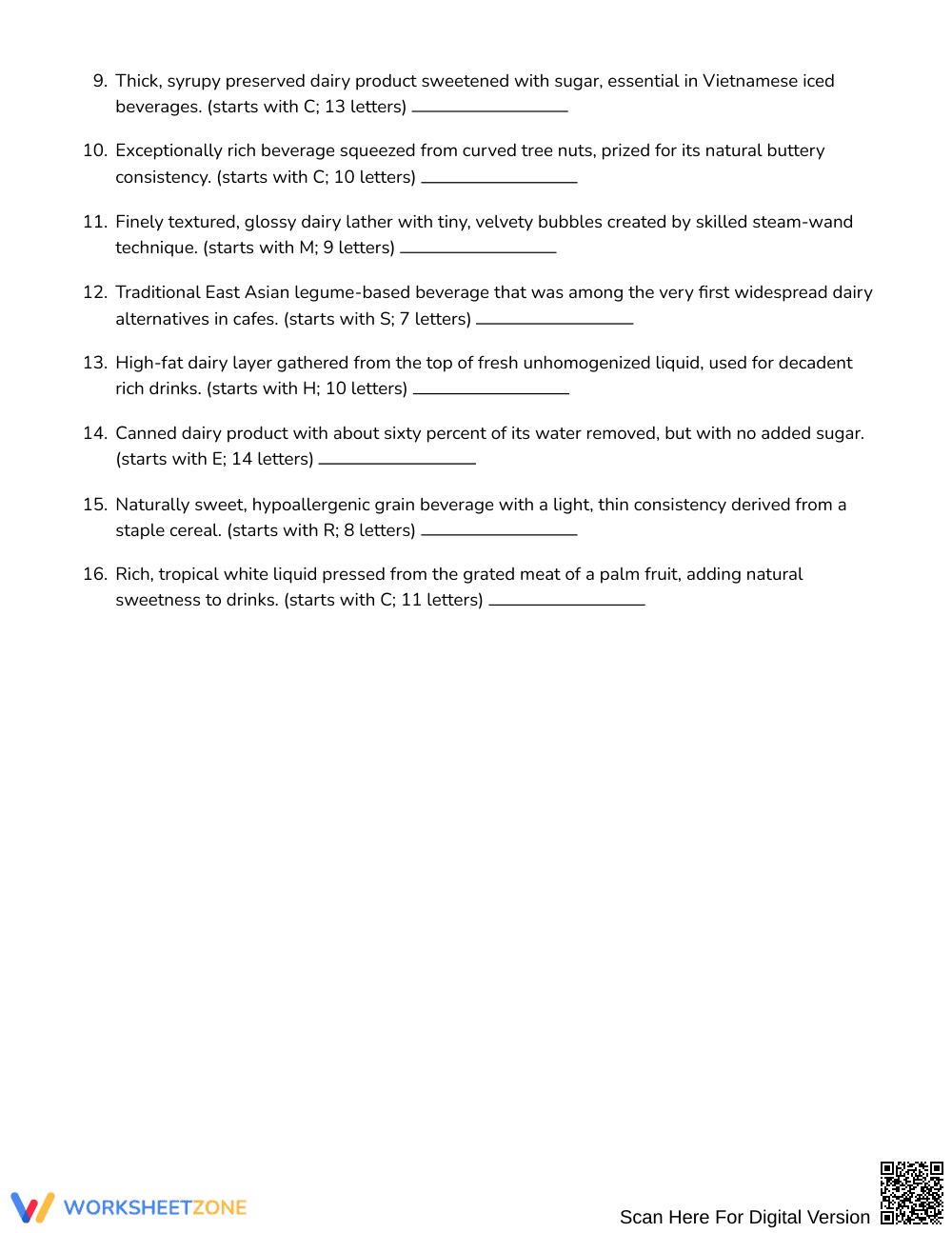
This educational word search challenges middle school students to expand descriptive food science vocabulary by identifying sixteen dairy and plant-based beverage additions. Students read detailed informational clues, deduce the target term, and locate each hidden word across the grid, strengthening culinary literacy, reading comprehension, and spelling precision through active context-clue analysis.
At a Glance
- Grade: Grades 6–7 · Subject: English Language Arts
- Standard: Not standards-assessed — vocabulary enrichment
- Skill Focus: Milk and plant-based additions vocabulary
- Format: 3 pages · 16 words · Answer key included · PDF
- Best For: Vocabulary enrichment, early finishers, sub plans
- Time: 25–35 minutes
What's Inside
This resource spans three printable student pages paired with an exhaustive four-page answer key that highlights exact grid coordinates. Instead of relying on a traditional word bank, the activity features sixteen descriptive definitions covering dairy staples, plant-based alternatives, and texturing terms. Students must analyze each clue to deduce terms such as oat milk, microfoam, and condensed milk before scanning the dense puzzle letter field.
Puzzle Mechanics and Structure
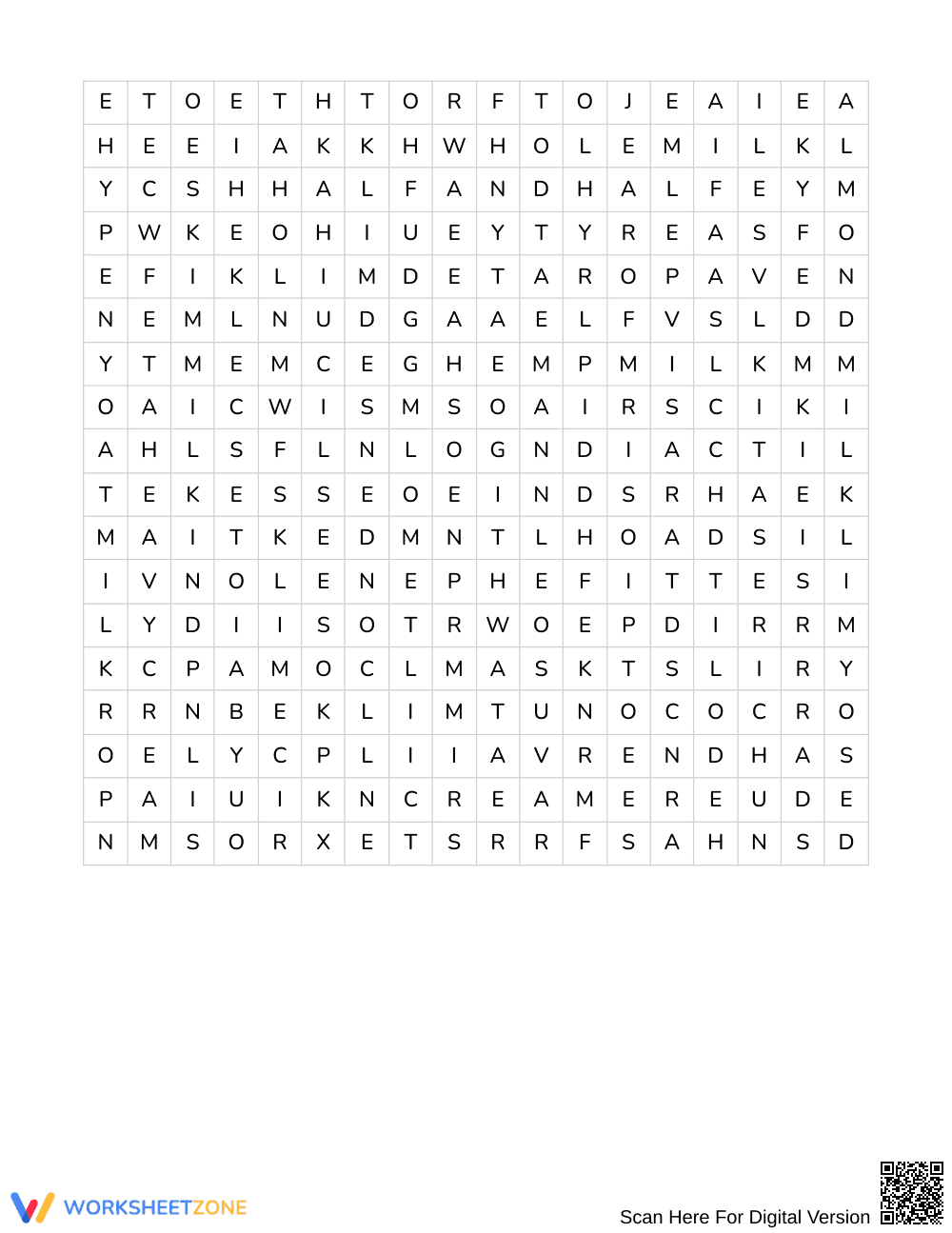
The activity utilizes an 18 by 18 letter grid engineered to provide a rigorous cognitive search task without visual clutter. Words run in all eight possible compass directions: North, Northeast, East, Southeast, South, Southwest, West, and Northwest. Because no overt word bank appears on the page, learners rely entirely on text clues to identify each addition, requiring deep processing of specialized definitions before scanning letter strings horizontally, vertically, or diagonally.
Standards Alignment
This activity serves strictly as vocabulary enrichment and informational reading practice; it is not formally aligned to an assessed state academic standard. The exercises reinforce domain-specific language acquisition, contextual inference, and orthographic recognition through engaging content exploration.
How to Use It
Deploy this activity during an informational text unit on food science, modern agriculture, or practical life skills after direct instruction on context clues. Alternatively, use it as a rigorous independent enrichment station for early finishers or an emergency sub plan. Circulate to observe whether students deduce terms directly from clue keywords before searching or attempt random letter scanning. Most middle schoolers complete the clue solving and grid search within 25 to 35 minutes.
Who It's For
Designed primarily for Grades 6–7 English Language Arts and family and consumer science classrooms, this puzzle offers an engaging, age-appropriate challenge for general education classes, culinary clubs, and gifted enrichment groups. Pair this worksheet naturally with an informational article detailing plant-based agriculture, a coffee brewing anchor chart, or a descriptive writing lesson on beverage terminology.
Targeted domain-specific vocabulary activities provide secondary learners with systematic opportunities to deepen contextual comprehension and lexical retrieval. According to Fisher & Frey (2014), intentional word study paired with definitional context clues significantly bolsters disciplinary literacy by moving students beyond passive recognition into conceptual understanding. By withholding a conventional word bank and requiring students to interpret detailed clues across sixteen culinary terms, this activity promotes sustained orthographic mapping and analytical deduction. When students navigate the complex 18 by 18 grid in eight compass directions, they build visual-spatial scanning stamina alongside academic vocabulary recall. The self-checking design of the included four-page answer key ensures teachers can quickly verify student accuracy while reinforcing independent learning routines across diverse classroom settings.


