


























Views
Downloads



Complete Codon Translation Worksheet | Grade 10 Biology
Paste this activity's link or code into your existing LMS (Google Classroom, Canvas, Teams, Schoology, Moodle, etc.).
Students can open and work on the activity right away, with no student login required.
You'll still be able to track student progress and results from your teacher account.
Mastering protein synthesis requires students to decode messenger RNA codons into functional polypeptides. This Grade 10 Biology worksheet guides learners through twelve systematic problems covering transcription, codon-anticodon pairing, reading frame identification, and mutation analysis. Students build sequence fluency by converting DNA and mRNA strands into amino acid chains using an authentic genetic code reference table.
At a Glance
- Grade: 10 · Subject: Biology
- Standard: Molecular Genetics — Transcribe and translate nucleotide sequences into functional amino acid polypeptide chains using codon charts
- Skill Focus: Codon Translation and Protein Synthesis
- Format: 4 pages · 12 problems · Comprehensive answer key included · PDF
- Best For: Independent sequence practice, review, and assessment
- Time: 35–45 minutes
What's Inside
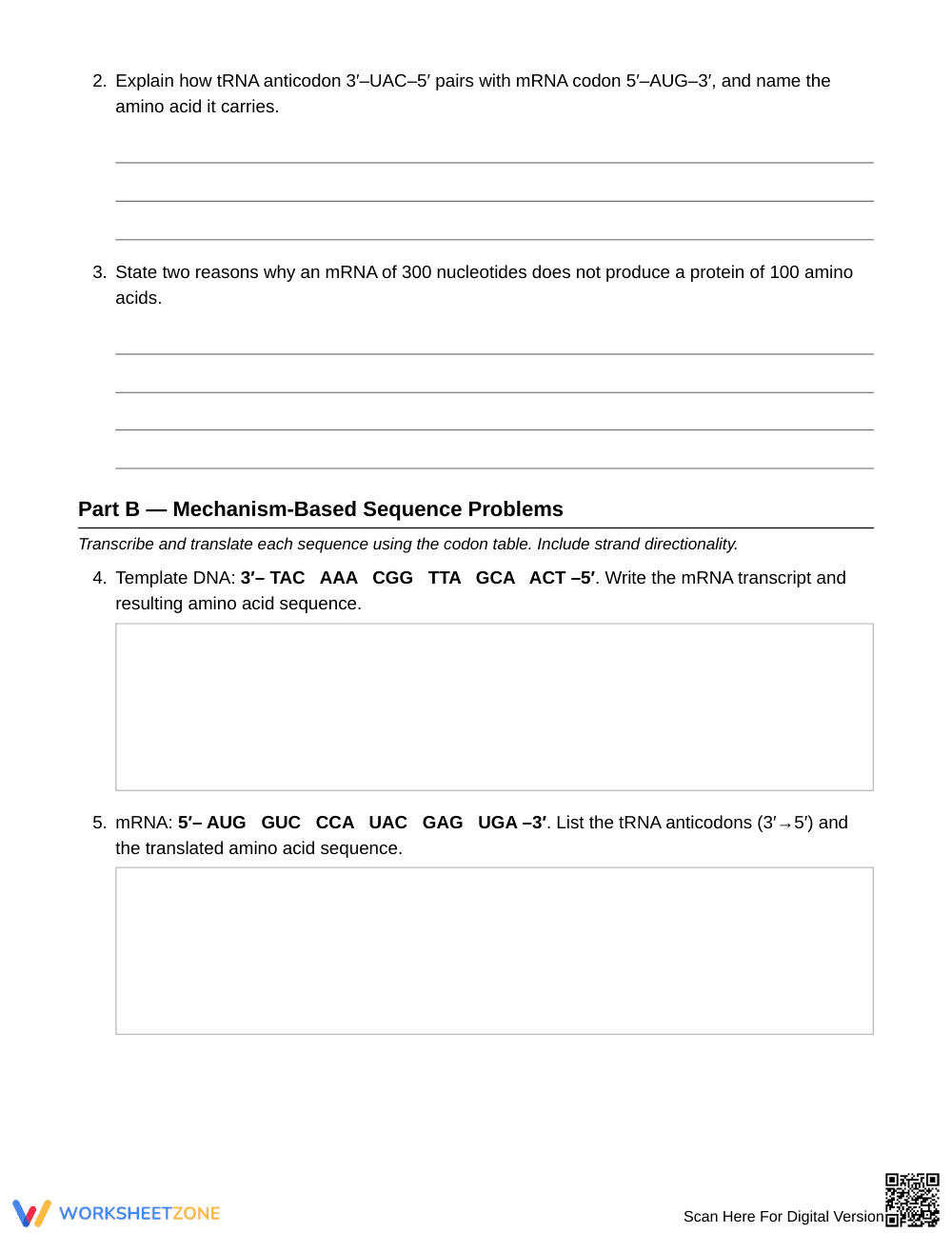
This four-page resource features a two-page student activity packet accompanied by a two-page teacher answer key. An integrated reference guide provides the standard genetic code table and directionality rules, including 3′ to 5′ DNA reading and 5′ to 3′ mRNA synthesis. The twelve tasks include multiple-choice conceptual checks, multi-step nucleotide conversions, reading frame puzzles, and comparative mutation analyses.
Skill Progression
- Guided practice (Part A, 3 problems): Students review RNA polymerase directionality, tRNA anticodon pairing, and untranslated mRNA regions with explicit reference prompts.
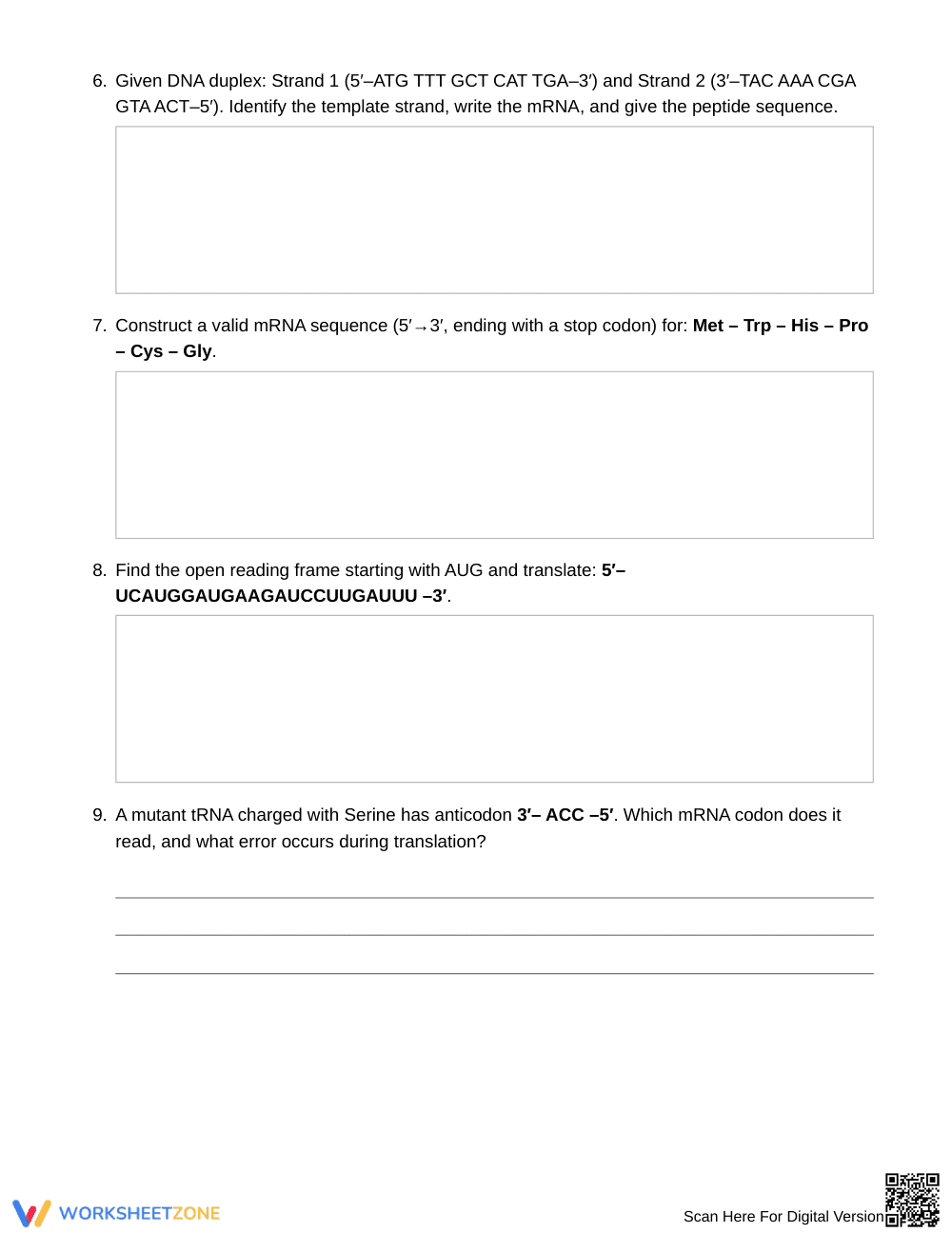
- Supported practice (Part B, 6 problems): Students transcribe DNA, list tRNA anticodons, isolate open reading frames, and analyze mutant tRNA errors.
- Independent practice (Part C, 3 problems): Students predict polypeptide products and classify point, missense, silent, and frameshift mutations without procedural hints.
This structure follows the gradual-release model, advancing from conceptual mechanics to direct decoding and complex mutation analysis.
Standards Alignment
This worksheet aligns with high school life science standards for molecular genetics, specifically modeling how DNA sequences determine protein structure. Students transcribe DNA into mRNA, match codons to amino acids, and examine how mutations alter polypeptides. Supporting standards address cellular transcription mechanisms. Both standard objectives can be copied directly into lesson plans, IEP goals, or district curriculum mapping tools.
How to Use It
Deploy this worksheet after direct instruction on transcription and translation to reinforce mechanical decoding skills, or use it as a mid-unit checkpoint. During classwork, verify that students correctly identify the 3′ to 5′ DNA template strand rather than transcribing the coding strand. Most students complete all twelve problems within 35 to 45 minutes.
Who It's For
This practice set serves Grade 10 Biology students studying the central dogma. The integrated codon table supports learners who need direct visual reference, while Part C provides analytical challenge for advanced students evaluating frameshift consequences. Pair this activity with a physical codon wheel anchor chart or a hands-on molecular modeling lab.
Translating codons into polypeptide sequences requires high school biology students to navigate abstract spatial and directional relationships across multiple molecular systems. According to Fisher & Frey (2014), structured sequence tasks that transition from guided conceptual questions to independent procedural execution produce measurable gains in scientific problem-solving. This Grade 10 Biology worksheet delivers 12 focused problems aligned with molecular genetics curriculum goals, challenging learners to transcribe template DNA, map tRNA anticodons, and decode amino acid sequences with an authentic codon reference guide. By culminating in comparative mutation analysis, the resource ensures students do not merely memorize nitrogenous base pairings but actively evaluate how frameshifts and substitutions alter protein structure. The complete four-page PDF includes a two-page worked answer key with directionality markers, making it a reliable diagnostic measure of student mastery in foundational protein synthesis mechanics.


