


























Views
Downloads

Complete Characterization Worksheet | Grade 7 ELA
Paste this activity's link or code into your existing LMS (Google Classroom, Canvas, Teams, Schoology, Moodle, etc.).
Students can open and work on the activity right away, with no student login required.
You'll still be able to track student progress and results from your teacher account.
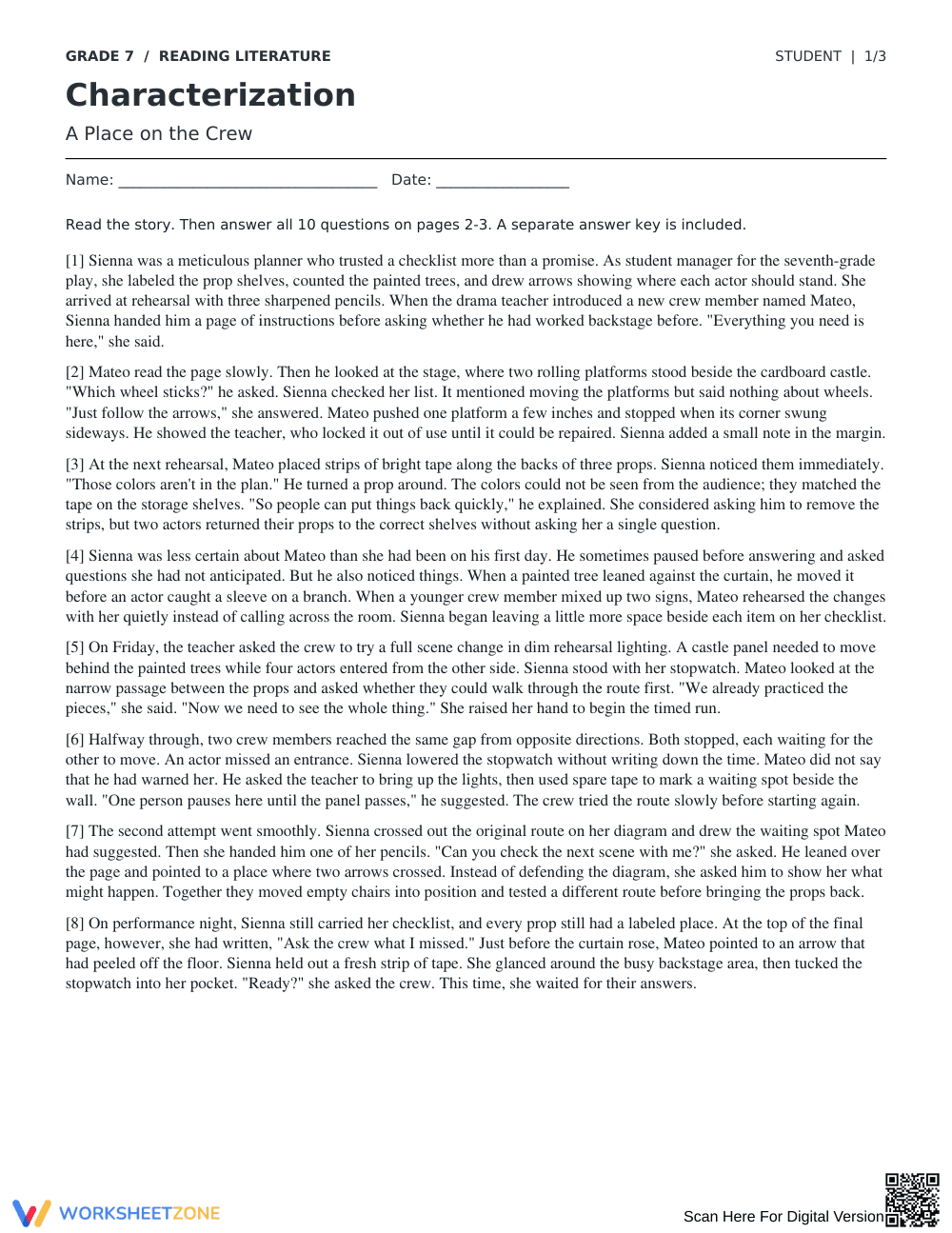
This complete reading literature worksheet guides middle school students through analyzing direct and indirect characterization in a realistic fiction story. Students read an engaging original narrative, examine how characters evolve through conflict, and provide text-based evidence to justify their literary claims across four tiered sections.
At a Glance
- Grade: 7 · Subject: English Language Arts
- Standard:
CCSS.ELA-LITERACY.RL.7.3— Analyze how story elements interact and shape character growth- Skill Focus: Direct vs. indirect characterization
- Format: 3 pages · 10 problems · Answer key included · PDF
- Best For: Literary analysis practice and assessment
- Time: 35–45 minutes
What's Inside
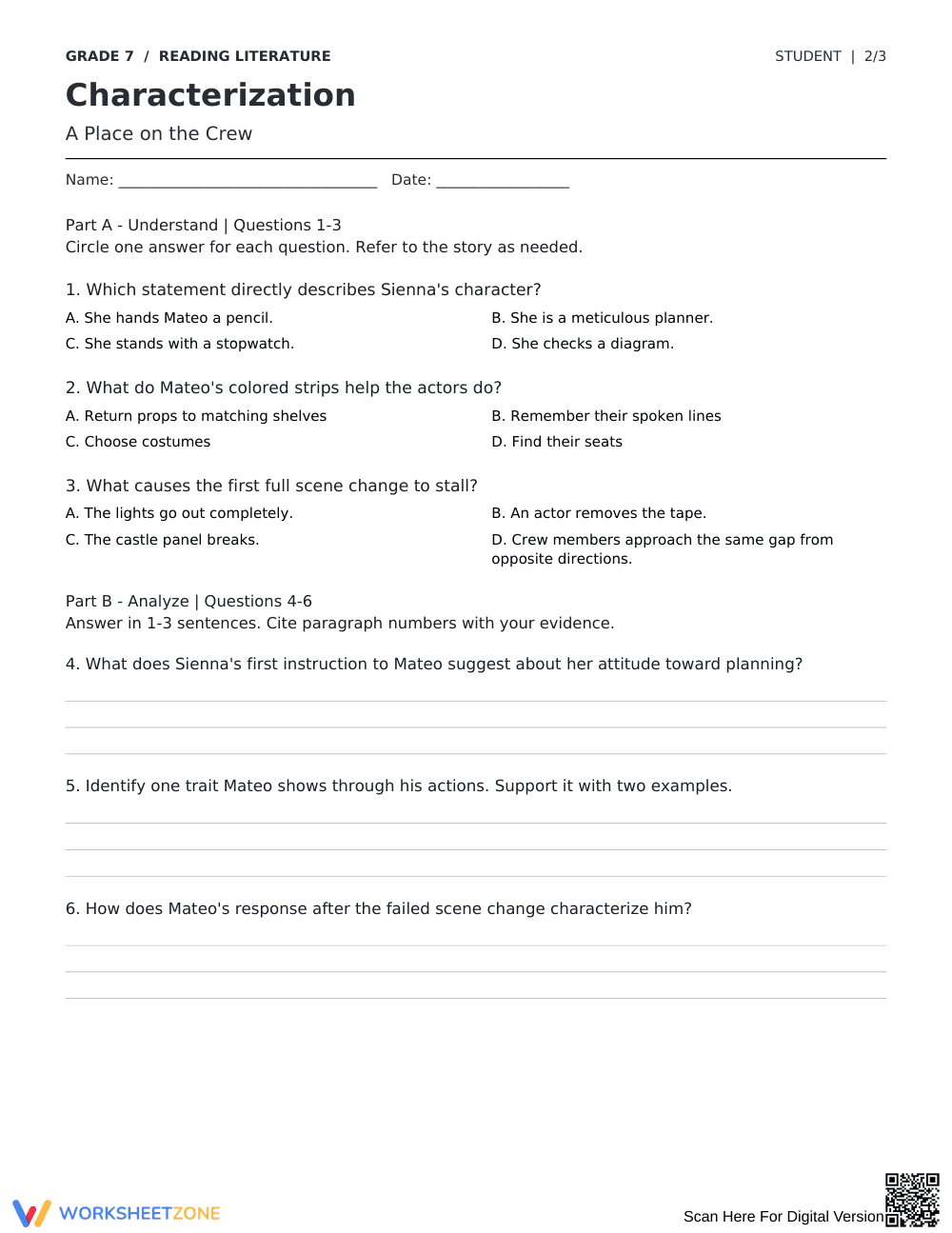
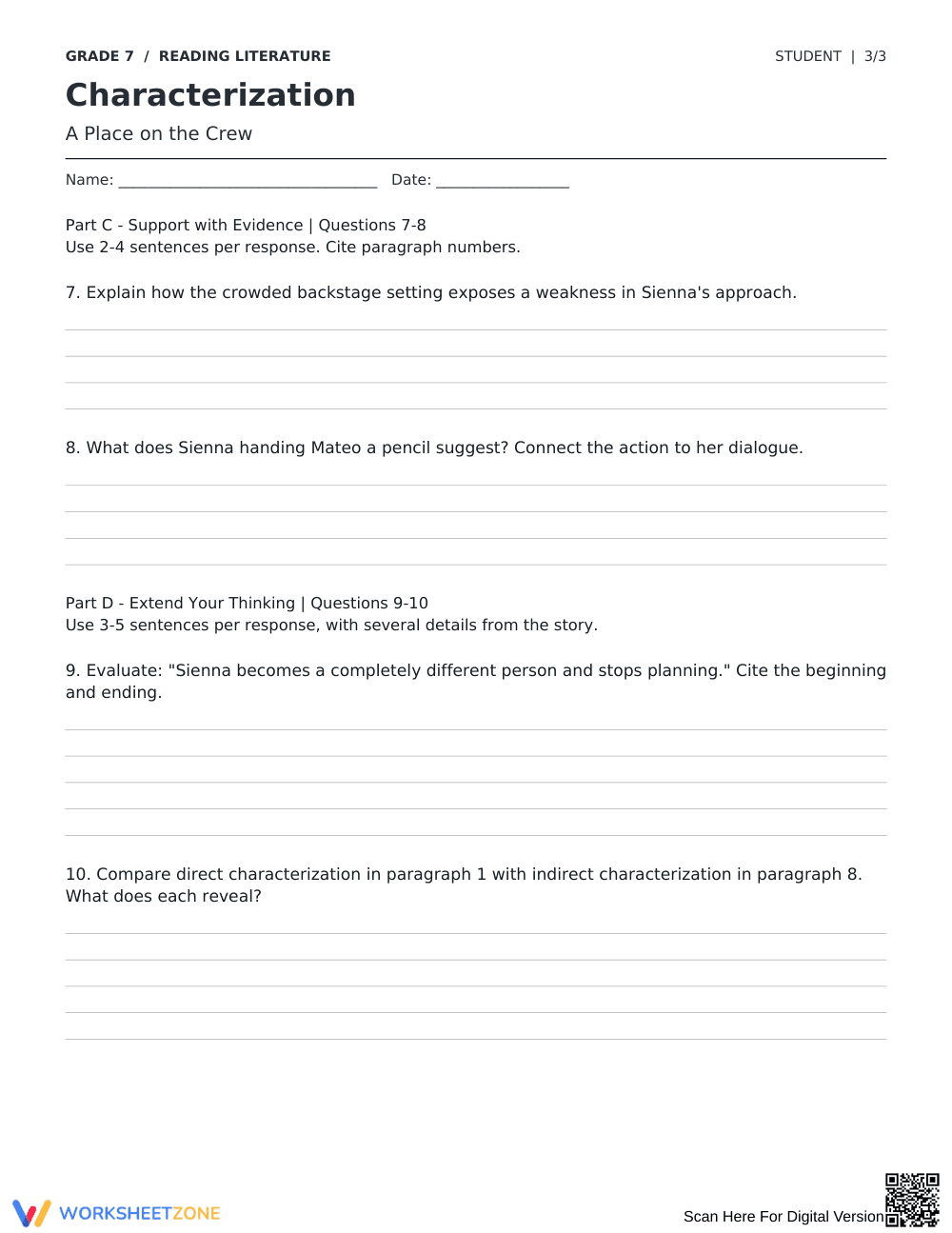
The 3-page student printable opens with "A Place on the Crew," a backstage theater narrative broken into 8 numbered paragraphs. Following the text, students complete 10 structured questions spanning multiple-choice comprehension, short-response trait identification, paragraph-cited evidence synthesis, and extended evaluative analysis. A complete 2-page teacher answer key provides sample model responses, paragraph citations, and a suggested 30-point scoring breakdown.
Skill Progression
- Guided practice (Part A, Q1–3): Multiple-choice foundational questions prompt students to identify explicit story details and distinguish between direct descriptions and plot actions.
- Supported practice (Part B & C, Q4–8): Short-response prompts require students to analyze dialogue, evaluate how setting reveals character weaknesses, and cite paragraph numbers as proof.
- Independent practice (Part D, Q9–10): Extended constructed-response tasks challenge learners to evaluate overall character arcs and contrast direct versus indirect methods across the beginning and resolution.
This sequence follows the gradual-release model, shifting students from identifying stated facts to synthesizing complex character motives.
Standards Alignment
Primary standard: `CCSS.ELA-LITERACY.RL.7.3` — Analyze how particular elements of a story or drama interact (e.g., how setting shapes the characters or plot). Supporting standard: `CCSS.ELA-LITERACY.RL.7.1` requires citing several pieces of textual evidence to support inferences drawn from the text. Both standard codes can be copied directly into lesson plans, IEP goals, or district curriculum mapping tools.
How to Use It
Use this resource after direct instruction on characterization strategies such as STEAL (speech, thoughts, effect on others, actions, looks). During independent work time, circulate to observe whether students quote specific actions from the text rather than relying on generalized summaries. Anticipate a completion time of 35 to 45 minutes for reading and written responses.
Who It's For
This resource serves general education seventh-grade classrooms, reading intervention groups, and homeschool settings. Teachers can pair this printable with an introductory anchor chart on character traits or use it as a mid-unit benchmark assessment before a major literary essay.
According to Fisher & Frey (2014), purposeful close reading coupled with text-dependent questioning enhances adolescent reading comprehension and analytical writing. This Grade 7 literature resource operationalizes `CCSS.ELA-LITERACY.RL.7.3` by asking students to analyze character interactions, evaluate motivation, and synthesize explicit and implicit details from narrative text. The structured 10-question sequence scaffolds reading development by moving from basic comprehension checks to multi-sentence textual justifications. Each task directs learners back into the numbered paragraphs to gather concrete evidence, reinforcing critical literacy habits necessary for standardized assessments and advanced literary discourse. Teachers gain clear diagnostic insight into student mastery of direct and indirect characterization through the included scoring guide and model responses, making it an effective instructional tool for rigorous middle school English Language Arts curricula.


