




























Views
Downloads



Complete Camping Gear Word Search | Grades 7–8 ELA

Paste this activity's link or code into your existing LMS (Google Classroom, Canvas, Teams, Schoology, Moodle, etc.).
Students can open and work on the activity right away, with no student login required.
You'll still be able to track student progress and results from your teacher account.
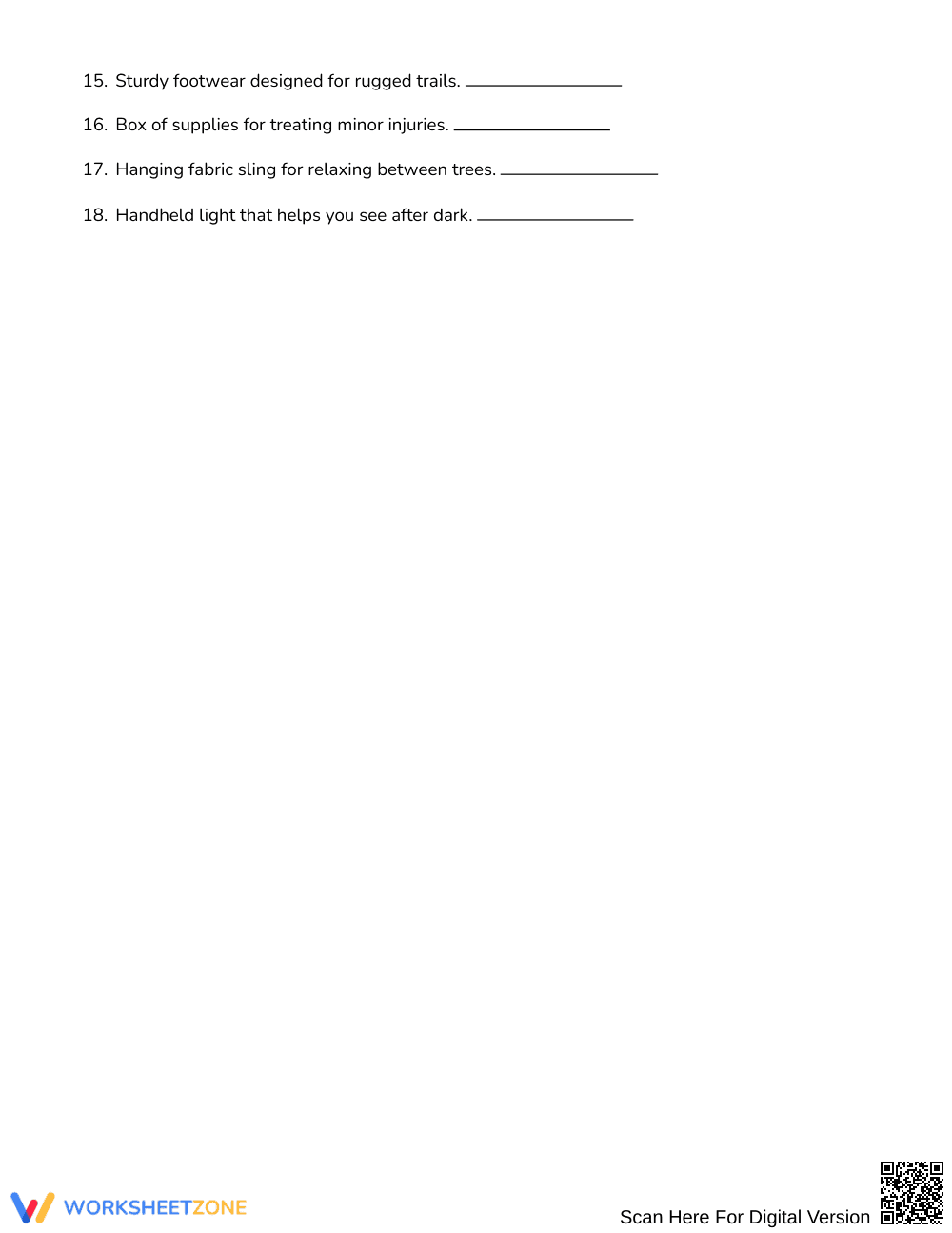
This vocabulary word search reinforces essential outdoor and camping terminology for middle school students by pairing equipment with functional definitions. Students locate 18 camping gear terms across an engaging puzzle format while reviewing how tools like water filters, compasses, and multi-tools operate. The activity builds context-rich vocabulary recall through active problem solving.
At a Glance
- Grade: Grades 7–8 · Subject: English Language Arts
- Standard: Not standards-assessed — vocabulary enrichment connecting equipment to practical use
- Skill Focus: Outdoor camping gear matched to its functional use
- Format: 3 pages · 18 hidden words · Complete answer key included · PDF
- Best For: Vocabulary review, sub plans, and fast finisher enrichment
- Time: 20–30 minutes of focused student work
Across 3 printable pages, this resource delivers an 18-word puzzle accompanied by complete descriptive clues for every item. Rather than merely scanning a basic list, students read functional descriptions for equipment like camp stoves, sleeping bags, and trail markers before finding each term. A complete 3-page answer key provides letter highlighting for every target word, allowing effortless verification.
Puzzle Mechanics and Structure
The activity is built around a rigorous 20 by 20 grid designed for secondary learners:
- Grid Dimensions: A 20 × 20 letter matrix provides substantial visual search challenge.
- Search Directions: Words run in all 8 orientations: North, Northeast, East, Southeast, South, Southwest, West, and Northwest.
- Shuffled Bank and Clues: A shuffled word bank pairs with 18 functional clues defining each tool.
Standards Alignment
This resource serves as targeted vocabulary enrichment rather than formal standards-based assessment. Because the focus centers on equipment terminology through contextual clues, it is not aligned to an individual standard. Teachers can integrate this activity flexibly into informational reading units, outdoor science studies, or general language development lessons.
How to Use It
Deploy this word search during an informational text unit on wilderness recreation to activate background knowledge before reading. Alternatively, distribute the puzzle after direct instruction as a low-stress review. While students work, circulate to observe whether they read the clue definitions or rely solely on letter hunting, prompting them to explain each tool's utility. Completion takes approximately 20 to 30 minutes.
Who It's For
Designed for Grades 7–8 learners, this puzzle offers mature complexity without childish graphics. For students needing support, pair them with a partner or highlight the first letter of multisyllabic terms like WATERFILTER. This activity pairs naturally with a technical camping guide or informational outdoor survival passage.
As an enrichment resource developed without a restrictive standard code, this Grades 7–8 camping gear word search strengthens secondary vocabulary acquisition by linking domain-specific equipment terms to clear functional definitions. According to Fisher & Frey (2014), intentional word exposure embedded within engaging, low-stakes language tasks promotes long-term retention of technical vocabulary across secondary literacy domains. By locating 18 hidden terms across a dense 20 by 20 grid in all eight compass directions, middle school learners practice orthographic mapping, letter-sequence recognition, and semantic processing simultaneously. The inclusion of descriptive clues transforms a traditional letter hunt into an active cognitive exercise, requiring students to associate tools such as water filters, camp stoves, and compasses with their practical outdoor applications. This balanced structure provides educators with an accessible, high-engagement supplemental tool that supports literacy fluency and domain knowledge without unnecessary instructional overhead.


