


























Views
Downloads




Complete Arc & Central Angles Worksheet | Grade 10 Geometry
Paste this activity's link or code into your existing LMS (Google Classroom, Canvas, Teams, Schoology, Moodle, etc.).
Students can open and work on the activity right away, with no student login required.
You'll still be able to track student progress and results from your teacher account.
This comprehensive Grade 10 Geometry worksheet strengthens student understanding of arc and central-angle relationships within circles. Students calculate arc degree measures, establish relationships between central and inscribed angles, apply tangent-radius perpendicularity, and construct geometric proofs. With rigorous multi-step problem solving, learners build conceptual precision and procedural fluency across circle theorems.
At a Glance
- Grade: 10 · Subject: Geometry
- Standard:
HSG-C.A.2— Identify and describe relationships among central, inscribed, and circumscribed angles and arcs- Skill Focus: Arc and Central-Angle Relationships
- Format: 5 pages · 16 problems · Answer key included · PDF
- Best For: Circle theorem practice and proof preparation
- Time: 45–60 minutes
What's Inside
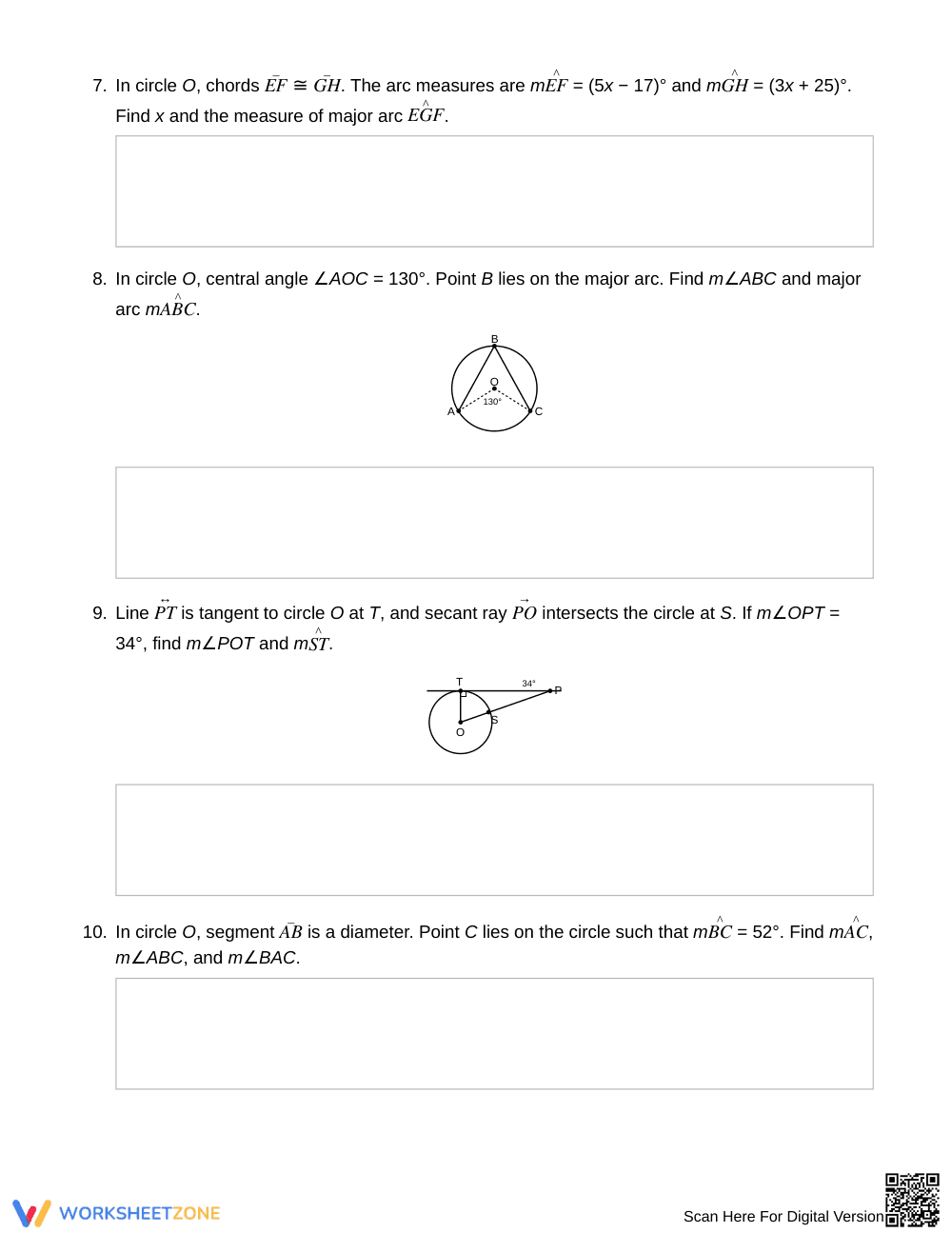
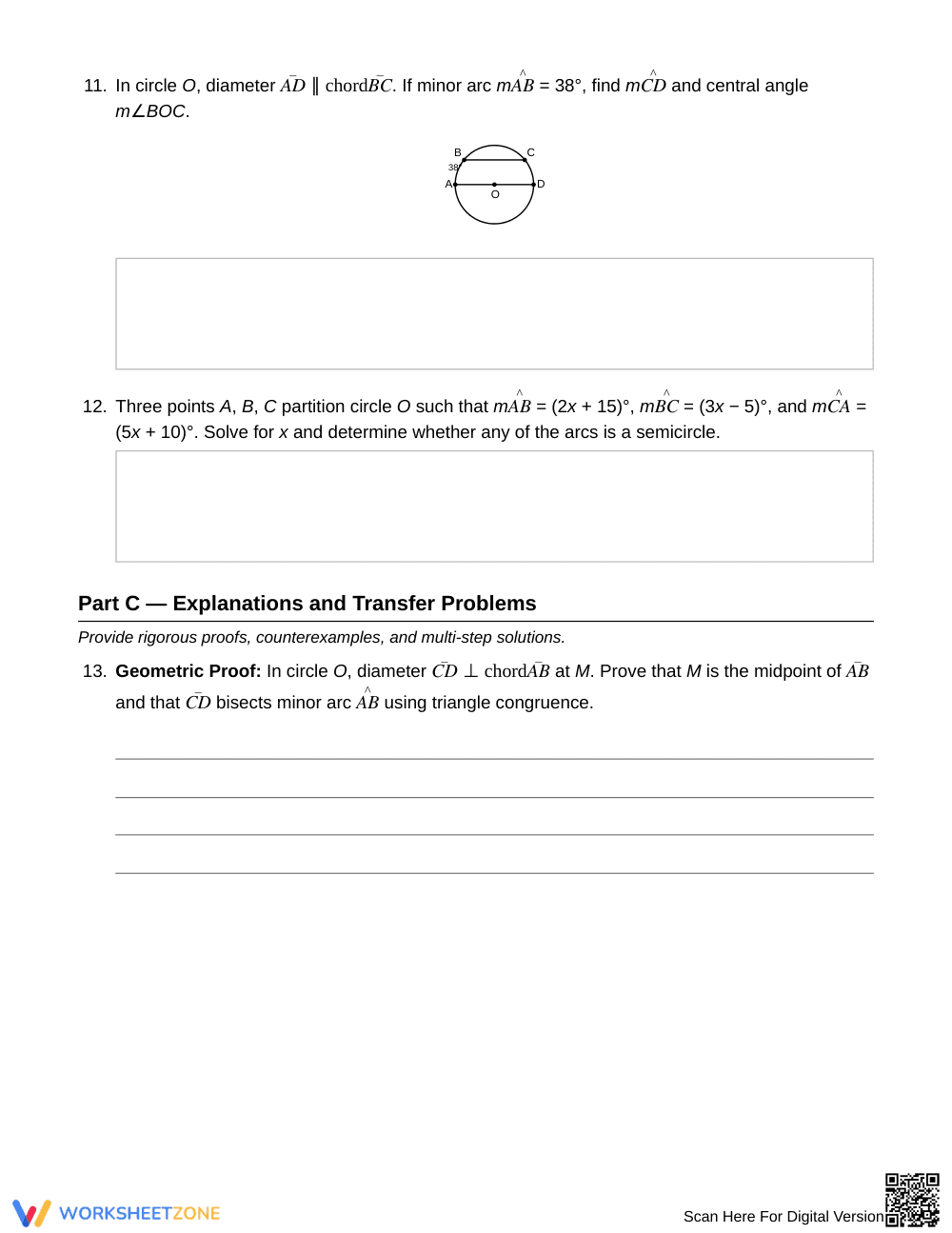
The 5-page printable packet features 16 structured tasks organized into three distinct sections, accompanied by a reference box outlining core circle theorems and a 2-page complete answer key with worked solutions. Students engage with multiple-choice conceptual distinctions, algebraic circle equations, geometric diagrams, formal proofs, and real-world modeling tasks involving theater seating and satellite sightlines.
Skill Progression
- Guided Practice (Part A, Problems 1–4): Scaffolds core conceptual distinctions between central and inscribed angles, arc notation, chord-arc theorems, and tangent line perpendicularity.
- Supported Practice (Part B, Problems 5–12): Challenges students to solve single- and multi-step algebraic problems using intercepted arcs, parallel chords, tangents, and diameters.
- Independent Practice (Part C, Problems 13–16): Requires students to construct two-column proofs, evaluate seating viewing angles, disprove chord-length claims with counterexamples, and model satellite tangent horizons.
This structured progression utilizes a gradual-release framework to move learners from foundational conceptual knowledge to rigorous proof construction and transfer.
Standards Alignment
This worksheet is aligned to primary standard HSG-C.A.2: Identify and describe relationships among inscribed angles, radii, and chords, including the relationship between central, inscribed, and circumscribed angles. It also supports geometric reasoning under HSG-CO.C.9. Both standard codes can be copied directly into lesson plans, IEP goals, or district curriculum mapping tools.
How to Use It
Deploy this worksheet immediately following direct instruction on central angles and intercepted arcs as paired collaborative practice, or assign Parts B and C as independent homework. During classwork, formatively assess whether students confuse arc degree measures with arc lengths or misuse the inscribed angle theorem. The resource requires approximately 45 to 60 minutes for full completion.
Who It's For
Designed for tenth-grade high school Geometry students, this resource includes built-in theorem references for struggling learners while offering non-routine proof and modeling problems for advanced learners. It pairs naturally with an interactive circle angle demonstration or compass-and-straightedge geometric construction activity.
According to research highlighted in Fisher & Frey (2014), structured instructional sequences that move intentionally from foundational concept identification to independent proof construction significantly enhance student retention of complex geometric theorems. This Grade 10 resource operationalizes standard HSG-C.A.2 by providing 16 targeted tasks focused on arc and central-angle relationships. Students analyze chord properties, calculate minor and major arc measures, apply algebraic expressions to geometric figures, and construct deductive proofs using triangle congruence. By engaging with both algebraic problem solving and transfer tasks such as architectural sightlines, high school learners solidify their understanding of the proportional and geometric dependencies governing circles. Educational practitioners can utilize this 5-page curriculum-aligned packet to establish measurable mastery of angle-arc relationships in secondary mathematics classrooms while systematically tracking student progress toward state geometry benchmarks.


