




























Views
Downloads


Complete Acid Naming Worksheet | Grades 9–12 Science

Paste this activity's link or code into your existing LMS (Google Classroom, Canvas, Teams, Schoology, Moodle, etc.).
Students can open and work on the activity right away, with no student login required.
You'll still be able to track student progress and results from your teacher account.
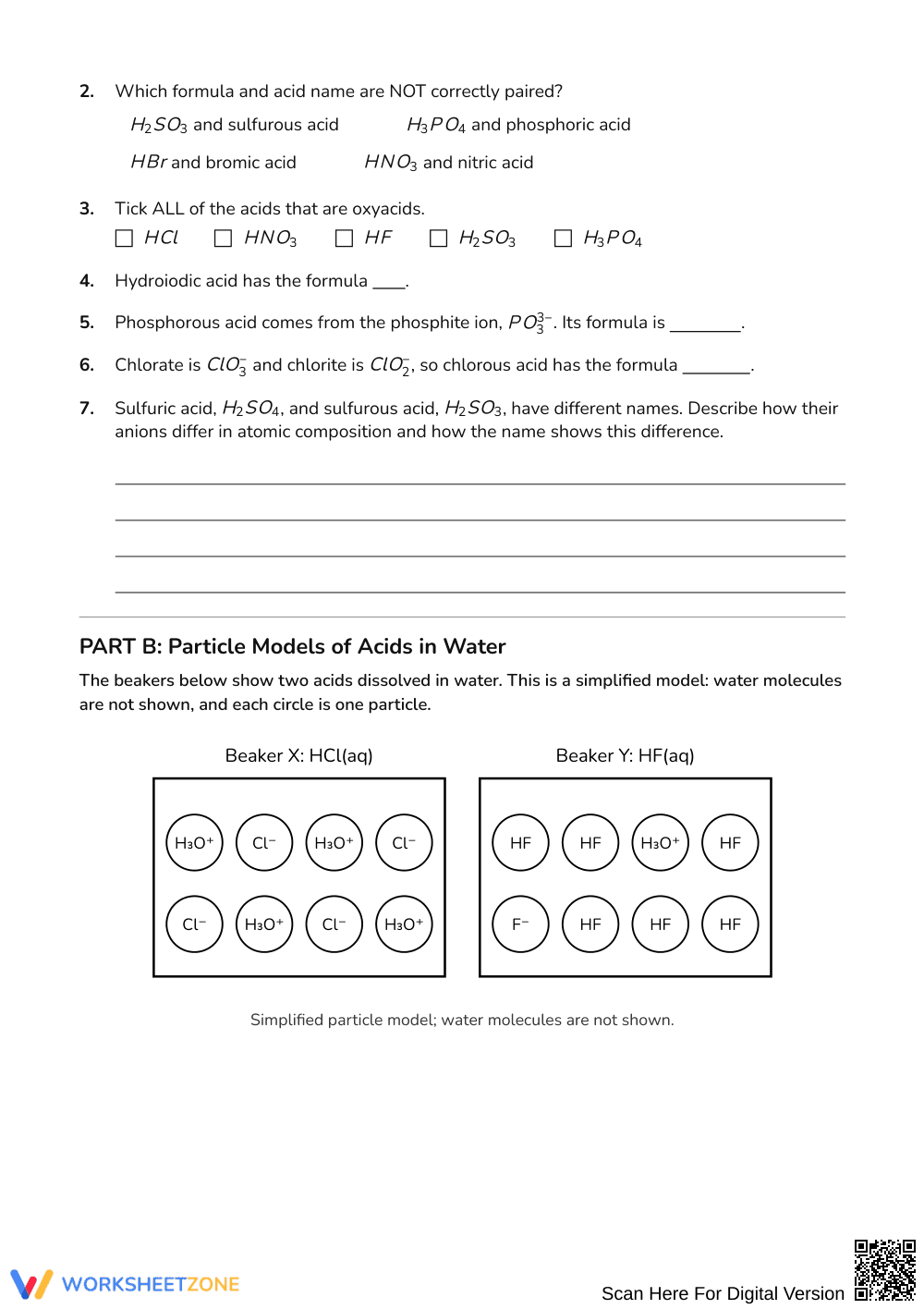
Mastering chemical nomenclature requires students to connect molecular formulas to systematic naming conventions. This four-page worksheet guides high school learners through 31 targeted problems, reinforcing differences between binary acids and oxyacids. Students analyze composition flowcharts, interpret particle models, evaluate calorimetry data, and critique common misconceptions with precision.
At a Glance
- Grade: Grades 9–12 · Course: High School Chemistry
- Standard: Identify acid types, name acids systematically, and determine chemical formulas from anion composition
- Skill Focus: Acid Naming and Formula Writing
- Format: 4 student pages · 31 problems · Full answer key included · PDF
- Best For: Cumulative unit review, formal assessment, or lab debrief
- Time: 45–60 minutes of instructional class time
What's Inside
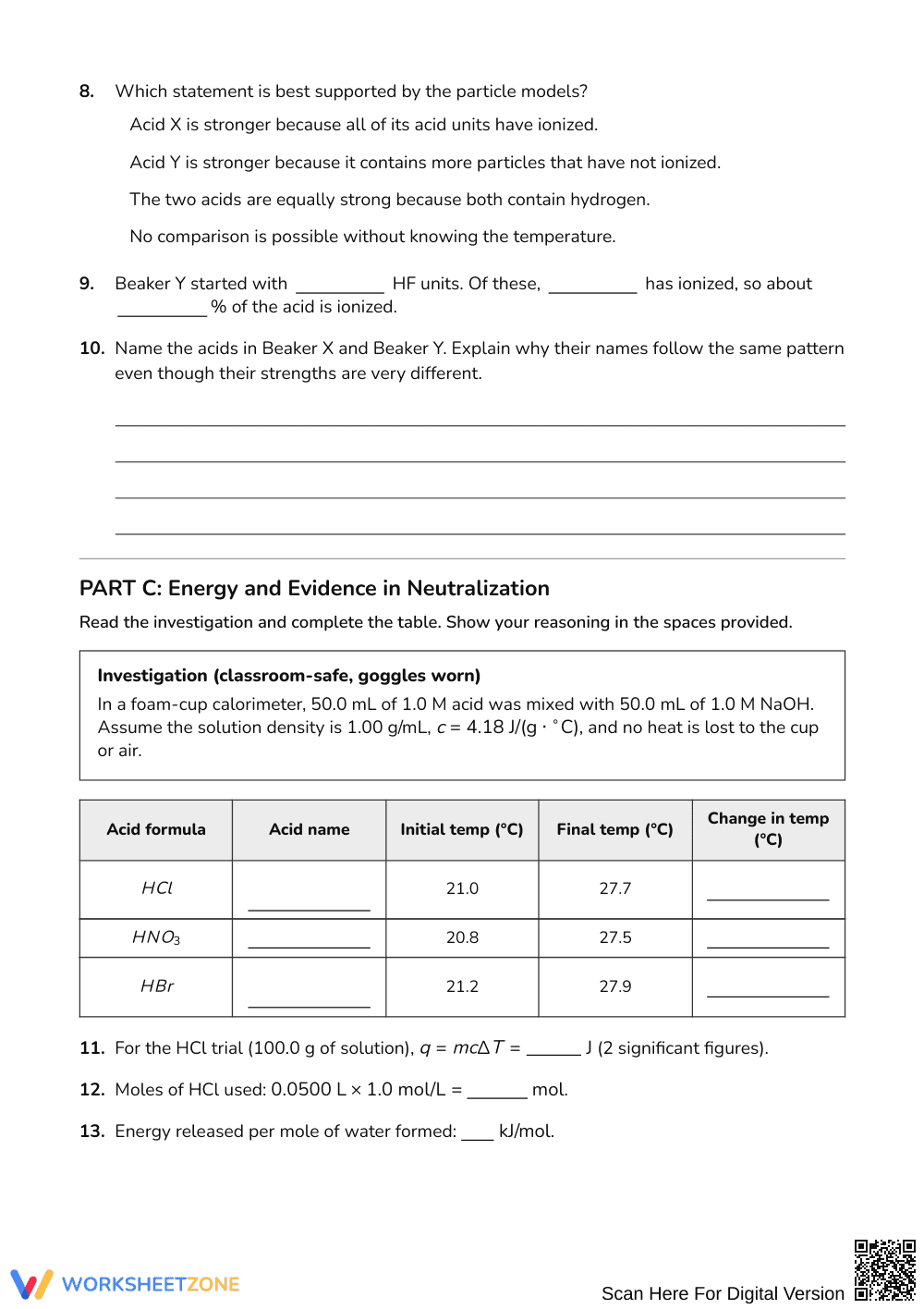
This four-page assessment includes a visual nomenclature flowchart, classification charts, multiple-choice items, particulate diagrams, and neutralization calorimetry problems. Students identify polyatomic ions, contrast binary acids with oxyacids, and calculate reaction enthalpy. A complete four-page answer key provides worked-out solutions and model scientific explanations.
Skill Progression
- Guided practice: Tasks 1–10 use a decision flowchart and guided table to help students identify anions and apply binary and oxyacid naming rules.
- Supported practice: Tasks 11–22 connect nomenclature to submicroscopic particle models and neutralization data, examining ionization strength and reaction enthalpy.
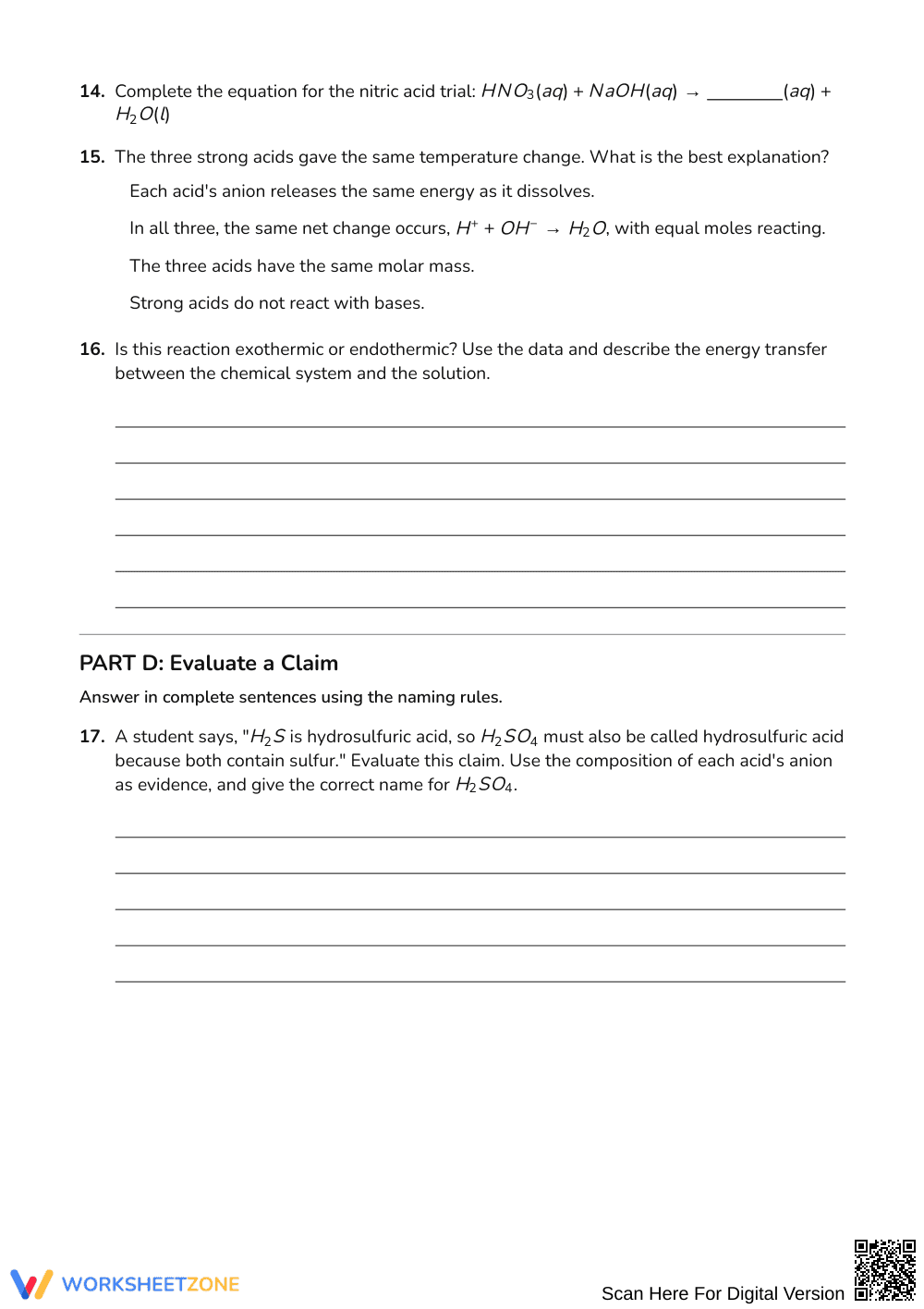
- Independent practice: Tasks 23–31 require students to evaluate misconceptions, critique incorrect names, and articulate how oxygen atoms change acid nomenclature.
This structure follows the gradual release model (I Do, We Do, You Do) to build confidence from guided identification to autonomous analysis.
Standards Alignment
Aligned with high school chemistry expectations, this worksheet reinforces chemical nomenclature, ionic bonding, and thermodynamic energy transfer in neutralization reactions. Students examine how particle composition determines systematic naming conventions. Both standard codes can be copied directly into lesson plans, IEP goals, or district curriculum mapping tools.
How to Use It
Assign this worksheet as a post-instruction review or summative assessment following lessons on acid nomenclature and thermochemistry. During class, monitor whether students inappropriately apply the hydro- prefix to oxyacids. Expect students to complete the 31 problems in approximately 45 to 60 minutes.
Who It's For
This worksheet serves Grades 9–12 chemistry students in standard or honors courses. Flowcharts support learners needing visual scaffolding, while calorimetry questions stretch advanced students. Pair this activity with an acid-base titration investigation or an ion reference chart for maximum impact.
Grounded in explicit nomenclature conventions, this worksheet develops core high school chemistry skills where students name acids and determine formulas from anion composition. By integrating flowchart-guided nomenclature with particle-level models and quantitative calorimetry, the resource bridges procedural naming and conceptual comprehension. According to Fisher & Frey (2014), gradual release instructional designs substantially improve long-term retention of multi-step academic skills by systematically transitioning students from teacher-guided models to autonomous analytical practice. Here, learners apply consistent decision-making rules to 31 distinct tasks, culminating in an evidence-based claim evaluation that requires deep structural reasoning rather than rote recall. The structured 4-page layout ensures high school chemistry students successfully decode chemical formulas, differentiate binary acids from oxyacids, and connect thermodynamic data to molecular bonding. This deliberate instructional scaffolding equips students with the chemical literacy necessary for advanced STEM coursework and standards-based performance assessments.


