




























Views
Downloads



Complete Acid Naming Worksheet | Grades 9-12 Science

Paste this activity's link or code into your existing LMS (Google Classroom, Canvas, Teams, Schoology, Moodle, etc.).
Students can open and work on the activity right away, with no student login required.
You'll still be able to track student progress and results from your teacher account.
This comprehensive science worksheet guides high school chemistry students through naming binary acids and oxyacids using structured IUPAC nomenclature rules. Students connect chemical formulas to practical applications, examining stomach acid, battery acid, atmospheric acid rain, and thermochemical neutralization in a foam-cup calorimeter to build lasting procedural fluency and conceptual understanding.
At a Glance
- Grade: Grades 9–12 · Subject: Science
- Standard: High School Chemistry — Name acids using anion rules and apply stoichiometry to real-world reactions
- Skill Focus: Acid Naming: Real-World Application
- Format: 4 pages · 22 problems · Answer key included · PDF
- Best For: Guided practice and real-world chemistry application
- Time: 45–60 minutes
What's Inside
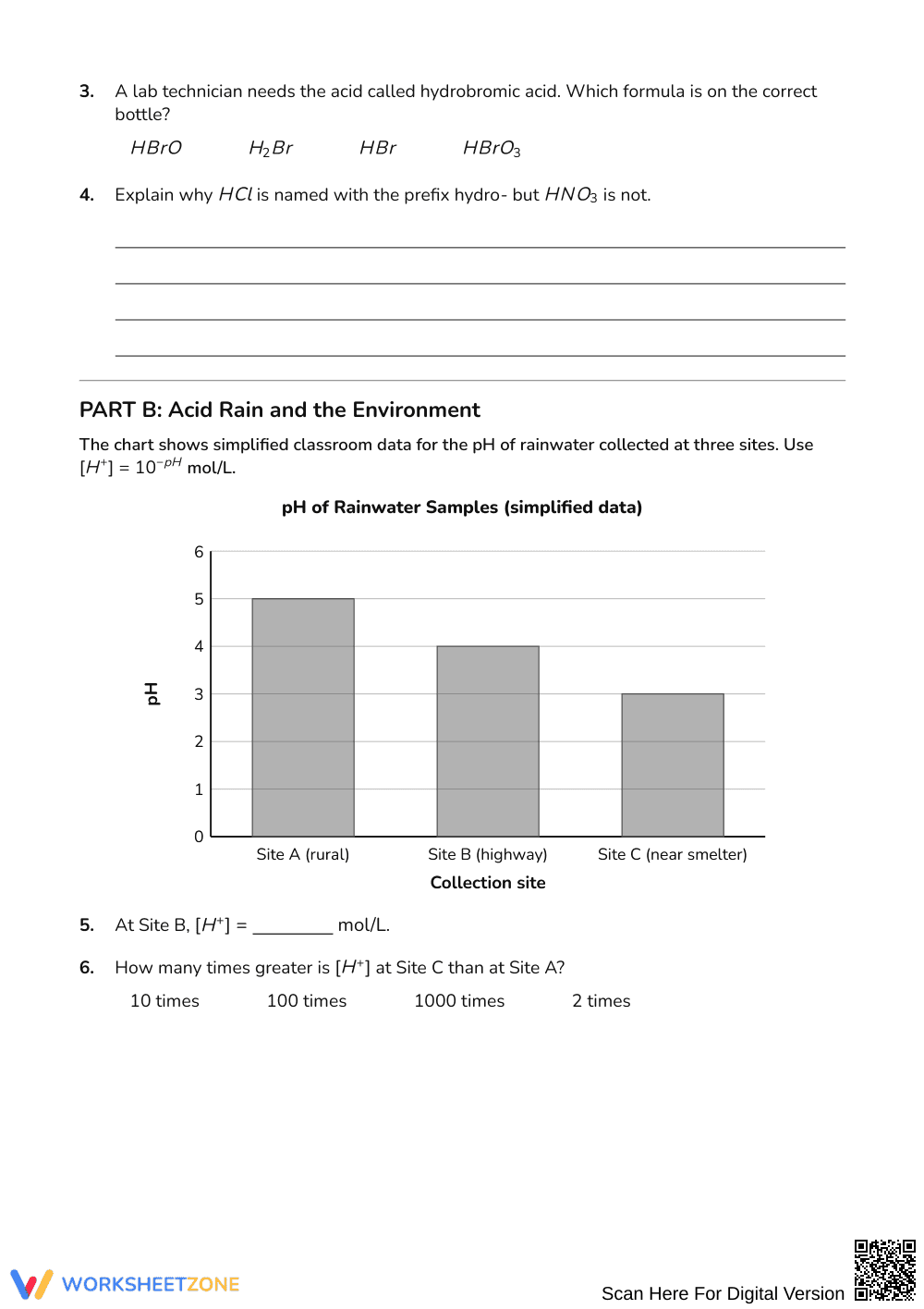
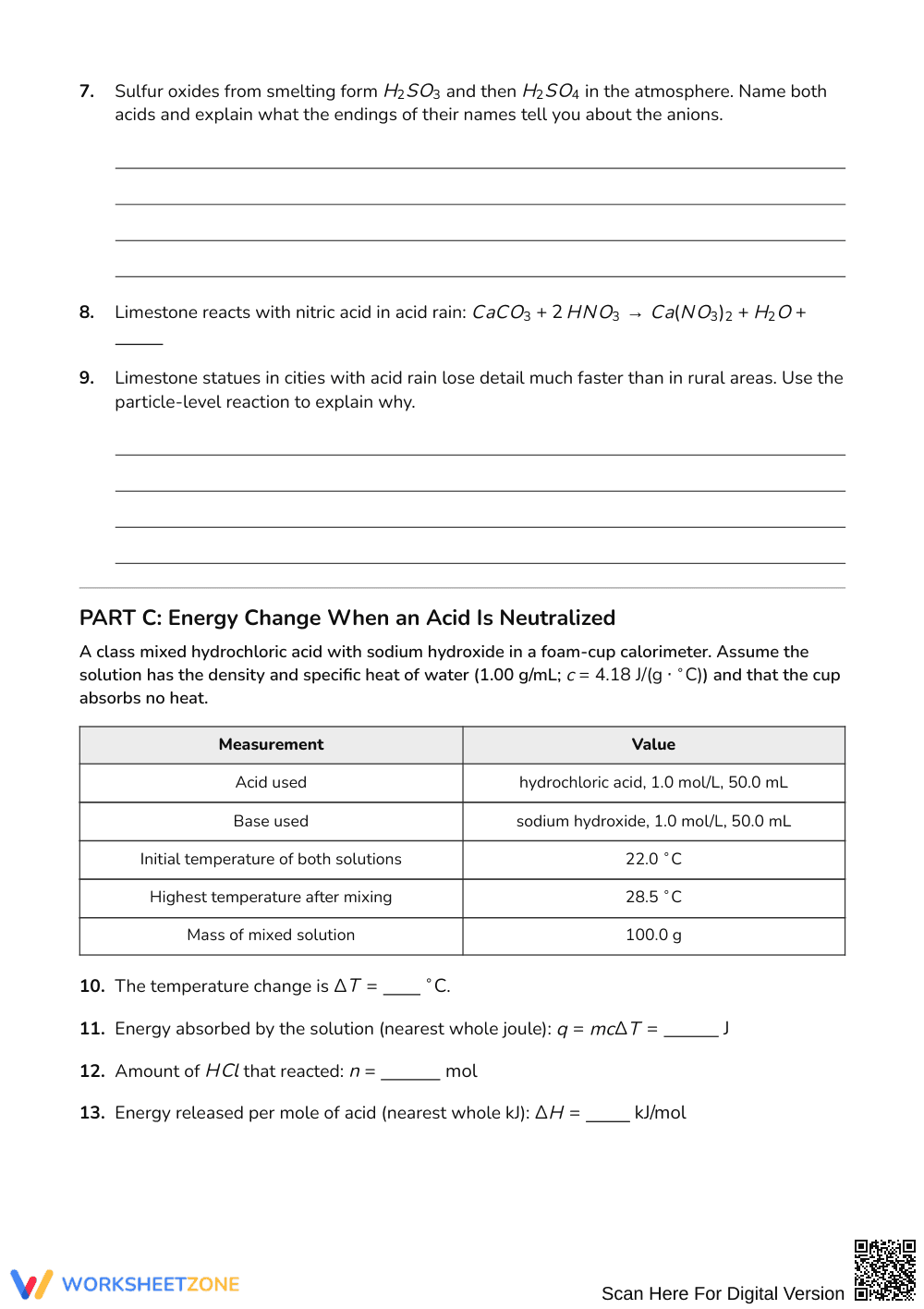
This 4-page resource features 22 authentic analytical tasks divided across three focused parts. Students work with a built-in nomenclature flowchart, tabular data on household and industrial acids, rainwater pH data sets, and calorimetry experimental tables. The document includes complete particle-level equation prompts, calculation tasks, and a full 4-page teacher answer key with worked solutions.
Skill Progression
- Guided Practice (Part A): Students use a step-by-step nomenclature flowchart to identify anions, apply prefix and suffix rules, and complete 8 structured identification tasks matching chemical formulas to common substances like stomach fluid and car batteries.
- Supported Practice (Part B): Learners analyze environmental monitoring data, calculating hydronium ion concentration across 3 field sites and connecting sulfur oxide formulas to weathering reactions on urban limestone statues.
- Independent Practice (Part C): Students independently evaluate calorimetry data from a neutralization reaction, calculate molar enthalpy changes, identify experimental errors, and write chemical explanations distinguishing between related oxyacids.
This sequence mirrors the gradual-release model, shifting students from rule-based formula decoding to independent evaluation of quantitative thermochemical laboratory data.
Standards Alignment
This worksheet aligns with state and national standards for High School Physical Science and Chemistry. Students construct chemical formulas, name binary and ternary acids based on anion suffixes, and explain how acid concentration governs environmental degradation and thermal energy release during neutralization. Both standard descriptions can be copied directly into lesson plans, IEP goals, or district curriculum mapping tools.
How to Use It
Administer this worksheet directly after direct instruction on acid nomenclature rules and polyatomic ions. For an effective mid-unit formative assessment, collect Part A to verify whether students accurately distinguish between binary acids and oxyacids before they attempt the quantitative data analysis in Parts B and C. Expected completion time is 45 to 60 minutes.
Who It's For
This resource supports on-level high school chemistry students, Advanced Placement Chemistry learners reviewing basic nomenclature, and physical science classes exploring environmental systems. Pair this practice set with an interactive laboratory demonstration on neutralization or an anchor chart displaying common polyatomic ions.
High school chemistry learners require systematic instruction to master chemical nomenclature and connect symbolic formulas to particulate phenomena. Fisher & Frey (2014) demonstrate that structured practice sets using explicit gradual-release frameworks significantly increase academic retention and procedural accuracy in secondary science classrooms. By moving from guided anion flowcharts to complex environmental pH comparisons and calorimetry error analysis, this 22-task worksheet bridges fundamental nomenclature with higher-order thermochemical reasoning. The contextual integration of real-world phenomena—including acid rain damage on calcium carbonate architecture and calorimeter enthalpy calculations—ensures students contextualize chemical formulas within tangible physical systems. Complete with a 4-page detailed answer key, this resource provides secondary science educators with a verifiable, rigorous tool for strengthening chemistry literacy and quantitative laboratory interpretation.


