




























Views
Downloads


Complete Acid Naming Worksheet | Grades 9–12 Science

Paste this activity's link or code into your existing LMS (Google Classroom, Canvas, Teams, Schoology, Moodle, etc.).
Students can open and work on the activity right away, with no student login required.
You'll still be able to track student progress and results from your teacher account.
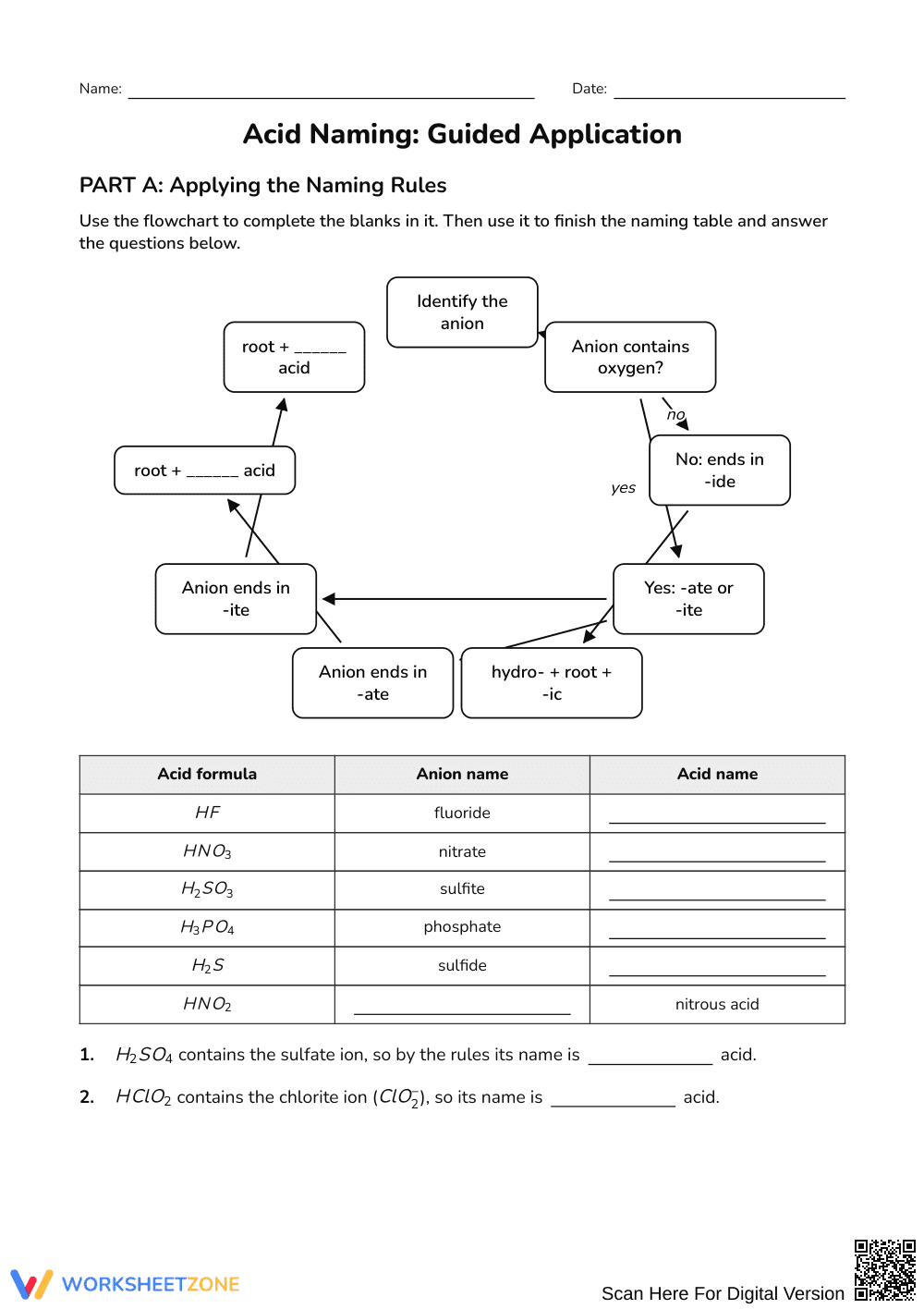
This 4-page chemistry worksheet provides systematic practice with acid nomenclature and aqueous acid behavior. Students learn to differentiate binary acids from oxyacids, translate chemical formulas into IUPAC names, analyze ionization and electrical conductivity data, and calculate thermochemical changes during acid-base neutralization reactions across 30 scaffolded tasks.
At a Glance
- Grade: Grades 9–12 · Subject: Science
- Standard: Chemistry Nomenclature — Name inorganic acids and analyze ion concentrations in aqueous solutions
- Skill Focus: Acid Naming
- Format: 4 pages · 30 problems · Answer key included · PDF
- Best For: High school chemistry nomenclature review
- Time: 45–60 minutes
What's Inside
This resource spans four focused pages that integrate systematic nomenclature rules with experimental chemical evidence. Students engage with a complete decision flowchart, fill-in reference tables, multiple-choice classification items, error-correction prompts, and multi-step quantitative calorimetry problems. A full four-page answer key provides complete model explanations and step-by-step mathematical calculations for every question.
Skill Progression
- Guided practice (Part A): Students use an explicit anion flowchart and structured data tables to name binary and oxyacids such as HF, HNO3, and H2SO4.
- Supported practice (Part B): Learners predict names for unfamiliar acids, identify misconceptions in student work, and explain the structural relationship between polyatomic suffix endings and oxygen content.
- Independent practice (Parts C & D): Students evaluate solution conductivity, calculate percent ionization from pH data, and determine molar neutralization enthalpy using calorimetry values.
This structured sequence follows a gradual-release instructional model that transitions students from visual flowchart scaffolding to unassisted quantitative analysis.
Standards Alignment
This resource aligns with high school physical science standards requiring students to formulate chemical names and formulas according to IUPAC conventions and relate microscopic ion dissociation to macroscopic system behavior. Both standard objectives can be copied directly into lesson plans, IEP goals, or district curriculum mapping tools.
How to Use It
Use this worksheet directly after introducing polyatomic ion conventions during your nomenclature unit. As a mid-unit check, examine student explanations in Part B to verify that students differentiate between binary acids and oxyacids rather than guessing. Most high school chemistry classes will complete all four parts within 45 to 60 minutes.
Who It's For
This activity is designed for general and honors high school chemistry students mastering formula writing and aqueous reactions. Teachers can provide the flowchart in Part A as an ongoing reference for striving learners, and pair the assignment with an aqueous conductivity demonstration or titration laboratory experiment.
According to Fisher & Frey (2014), the gradual release of responsibility framework accelerates academic vocabulary and conceptual mastery when direct instructional aids progressively yield to independent synthesis. This acid nomenclature worksheet applies that instructional design by moving secondary chemistry students through 30 structured tasks spanning four sequential learning stages. High school chemistry standards require students to master inorganic chemical nomenclature and connect particulate ionization states to observable solution properties like conductivity and enthalpy. By opening with a visual flowchart for binary and oxyacid naming conventions, transitioning to error analysis, and culminating in quantitative thermochemical stoichiometry, this worksheet ensures students build enduring mental models of acid-base behavior. The complete four-page structure and paired answer explanations give educators a validated instrument for both formative diagnostics and standards-aligned chemistry review across secondary physical science classrooms.


