


























Views
Downloads



Complementary & Supplementary Angles | Grade 9 Ready
Paste this activity's link or code into your existing LMS (Google Classroom, Canvas, Teams, Schoology, Moodle, etc.).
Students can open and work on the activity right away, with no student login required.
You'll still be able to track student progress and results from your teacher account.
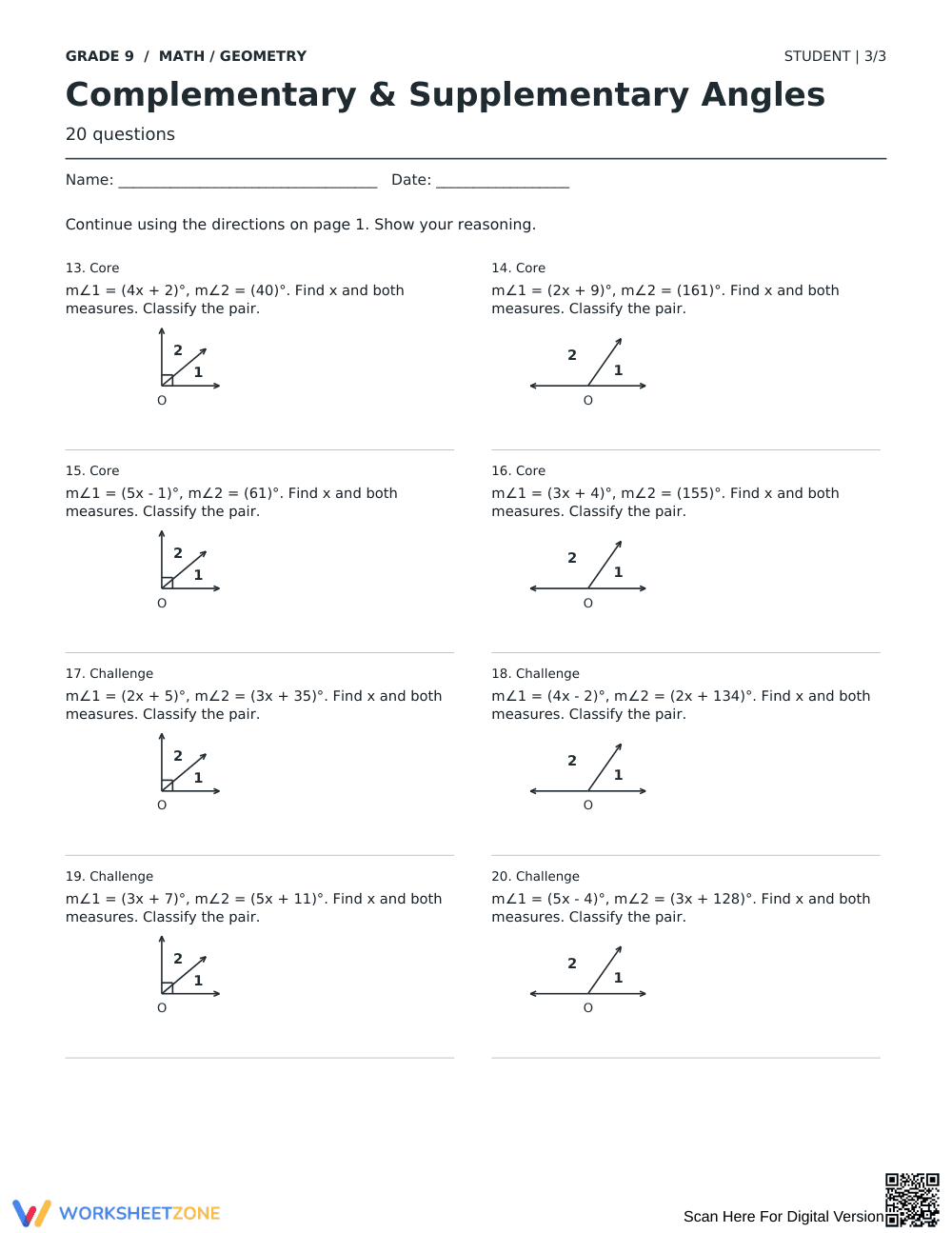
This Grade 9 geometry worksheet develops mastery in setting up and solving linear equations from complementary and supplementary angle relationships. High school students identify whether paired angles form right angles or linear pairs, write algebraic equations, calculate the variable x, and determine exact angle measures across 20 targeted geometric problems.
At a Glance
- Grade: 9 · Subject: Geometry
- Standard:
HSG-CO.A.1— Apply precise geometric definitions of angles and linear pairs to solve problems- Skill Focus: Complementary and supplementary angle equations
- Format: 3 pages · 20 problems · Answer key included · PDF
- Best For: Geometry skill practice and equation review
- Time: 30–45 minutes
What's Inside
This three-page printable resource includes 20 diagram-based problems arranged across three difficulty tiers: Foundation, Core, and Challenge. Every item features a geometric figure showing adjacent angles at a vertex along with given angle measures or algebraic expressions. The complete two-page answer key provides step-by-step equations, solved x-values, final angle measures, and suggested two-point scoring guidance.
Skill Progression
- Guided practice (Problems 1–6): Foundation items pair a constant numerical angle with a single variable term, reinforcing fundamental 90-degree and 180-degree relationships with minimal algebraic manipulation.
- Supported practice (Problems 7–16): Core exercises introduce binomial linear expressions such as
(2x + 3)°adjacent to known measures, prompting two-step equation modeling and angle evaluation. - Independent practice (Problems 17–20): Challenge problems present algebraic expressions for both adjacent angles, requiring multi-step variable isolation and back-substitution to calculate each measure.
This structured sequence reflects the gradual-release model, moving high school learners methodically from conceptual definitions toward independent algebraic problem-solving.
Standards Alignment
The primary focus aligns with `HSG-CO.A.1`, which requires students to utilize precise definitions of angles, perpendicular lines, and lines to solve geometric problems. As a supporting standard, `HSG-CO.C.9` applies angle pair theorems to establish linear pair and right angle relationships algebraically. Both standard codes can be copied directly into lesson plans, IEP goals, or district curriculum mapping tools.
How to Use It
Administer this worksheet immediately after direct instruction on angle pair theorems to reinforce linear equation modeling during a 30- to 45-minute practice block. Alternatively, assign individual pages as targeted warm-ups across consecutive instructional days. As a formative assessment checkpoint, monitor whether students correctly distinguish 90-degree complementary pairs from 180-degree supplementary pairs before establishing their algebraic setup.
Who It's For
Designed for Grade 9 geometry students, this activity accommodates standard high school classes, integrated algebra-geometry courses, and intervention settings needing targeted equation-modeling remediation. Pair this resource with an anchor chart illustrating complementary right angles and supplementary straight lines to scaffold initial classification for developing learners.
Mastering complementary and supplementary angle relationships under standard HSG-CO.A.1 bridges foundational algebraic equation solving with high school geometric reasoning. High school students learn to calculate unknown variables and verify angle measures by classifying adjacent pairs as 90-degree complementary angles or 180-degree supplementary linear pairs. According to Fisher & Frey (2014), purposeful gradual-release learning progressions that scaffold instructional tasks from single-variable identification to multi-step expressions significantly reduce cognitive overload and accelerate mathematical proficiency. This rigorous 20-problem resource structures practice across sequential Foundation, Core, and Challenge tiers, providing explicit training in geometric diagram interpretation, linear equation formulation, and algebraic substitution. By calculating angle values and systematically verifying their work against visual geometric models, Grade 9 learners establish the structural fluency, conceptual understanding, and analytical precision essential for formal geometric proof writing and secondary curriculum benchmarks.


