


























Views
Downloads



Complementary Angles Worksheet | Grade 7 Essential
Paste this activity's link or code into your existing LMS (Google Classroom, Canvas, Teams, Schoology, Moodle, etc.).
Students can open and work on the activity right away, with no student login required.
You'll still be able to track student progress and results from your teacher account.
This Grade 7 geometry worksheet provides targeted practice for students learning to identify and calculate missing measurements within complementary angle pairs. By applying the fundamental rule that complementary angles sum to 90 degrees, learners develop the algebraic reasoning necessary for advanced geometric proofs and spatial analysis.
At a Glance
- Grade: 7 · Subject: Math
- Standard:
CCSS.MATH.CONTENT.7.G.B.5— Use angle facts to write and solve equations for unknown angles- Skill Focus: Complementary angle calculations
- Format: 4 pages · 12 problems · Answer key included · PDF
- Best For: Independent practice or homework
- Time: 20–30 minutes
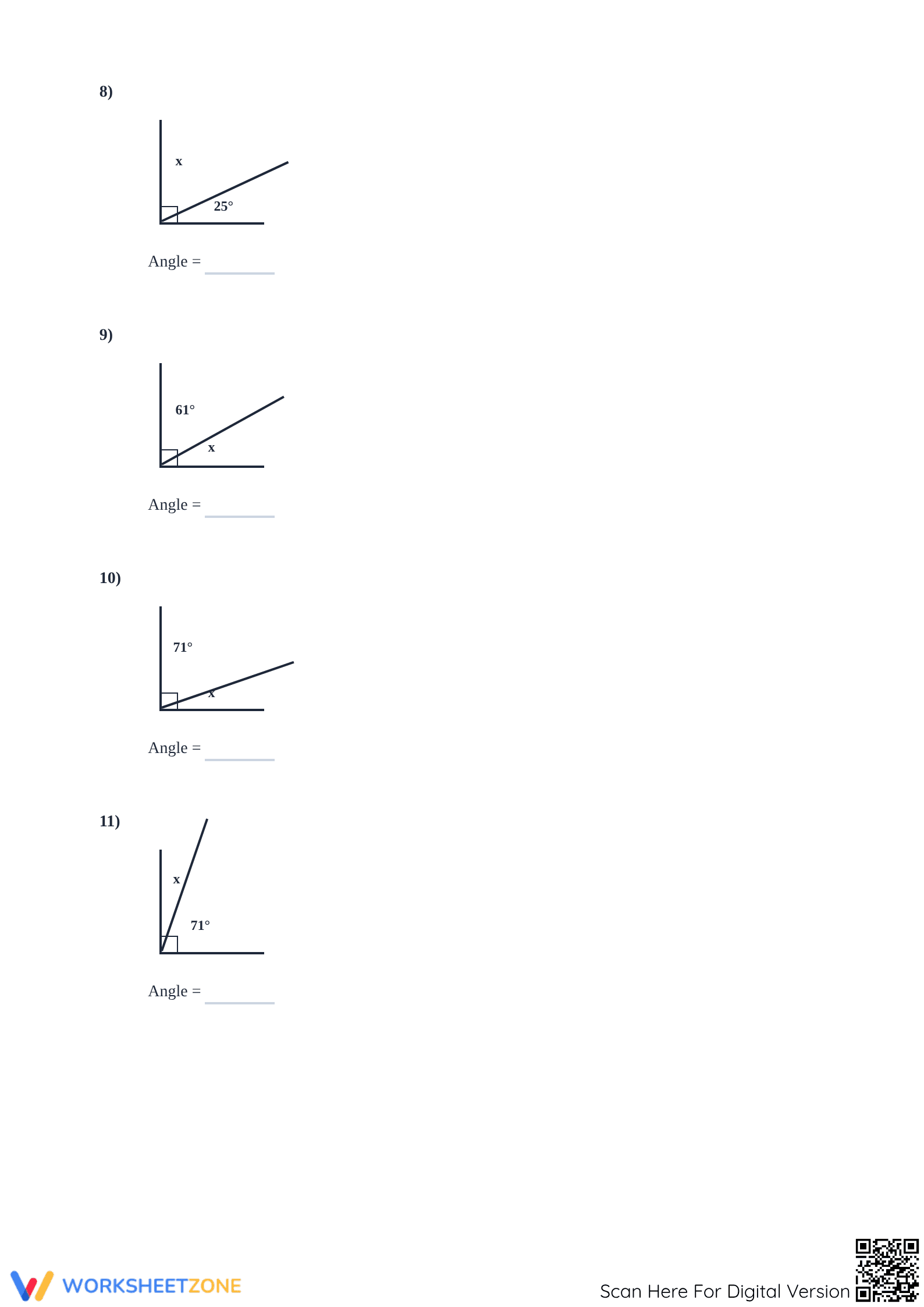
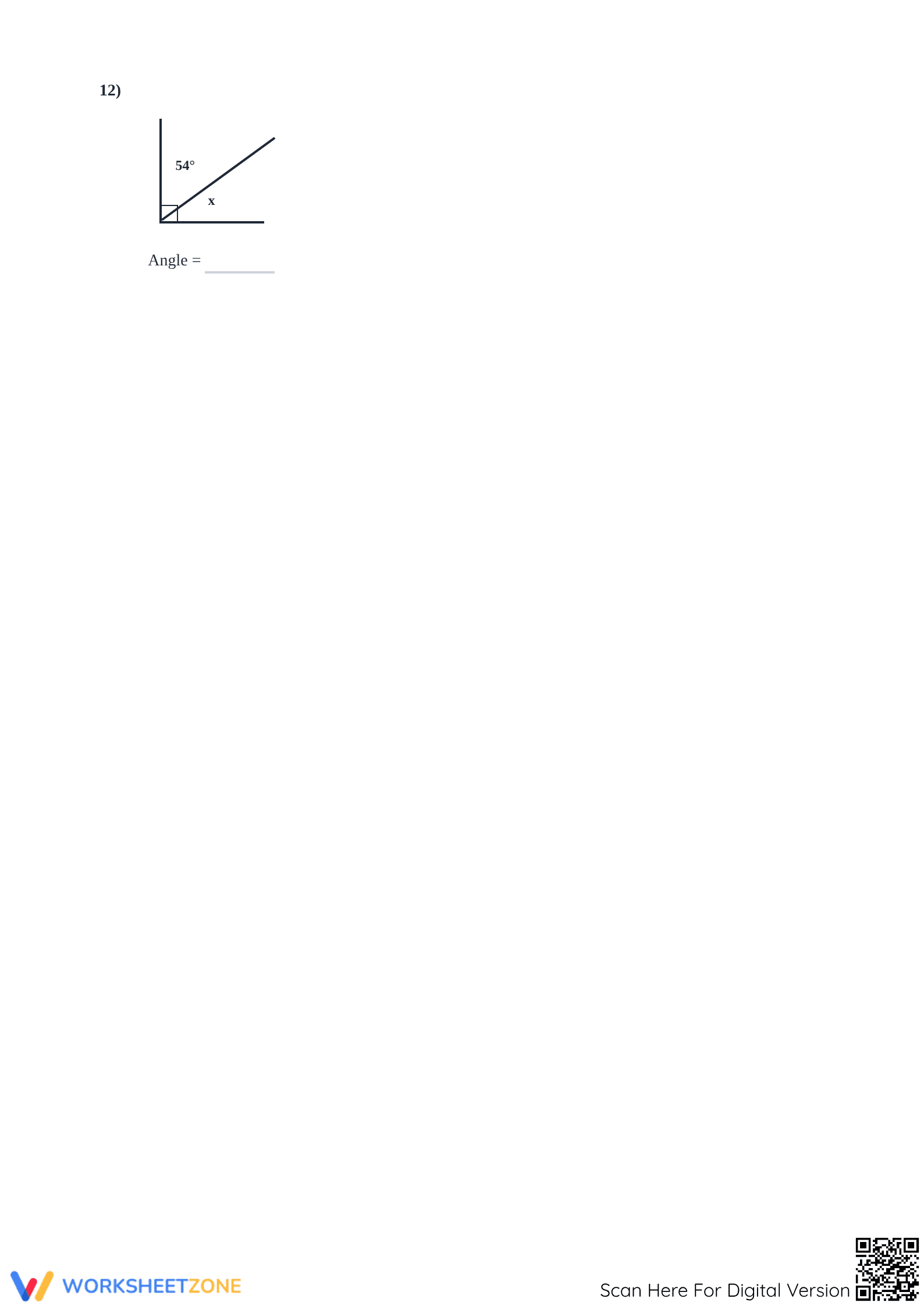
The resource contains 12 visual geometry problems spread across 4 pages. Each problem features a right angle bisected by a ray, creating two adjacent angles. Students are provided with one numerical degree measurement and must solve for the variable "x." A comprehensive answer key is included for rapid grading or student self-correction.
The worksheet follows a structured progression to ensure student success. First, students engage in guided practice by reviewing the provided definition that complementary sums always equal 90 degrees. Next, supported practice involves 12 visual diagrams with clear vertex indicators. Finally, independent practice is achieved as students solve for the unknown variable without additional prompts, reinforcing the subtraction-based relationship between the two angles. This gradual release model ensures students internalize the geometric property before moving to multi-step equations.
This resource is directly aligned with CCSS.MATH.CONTENT.7.G.B.5, which requires students to use facts about complementary angles to solve for unknown values. It also supports Grade 6 geometry foundations regarding angle relationships and algebraic substitution. Both standard codes can be copied directly into lesson plans, IEP goals, or district curriculum mapping tools.
Assign this worksheet during the "You Do" phase of a gradual release lesson on angle relationships. It serves as an excellent formative assessment tool; teachers should observe if students are correctly identifying the 90-degree total or mistakenly using 180 degrees. Expect completion within 20 to 30 minutes depending on student proficiency. For students who finish early, ask them to create their own complementary angle pair for a peer to solve.
This practice set is designed for Grade 7 students mastering geometry standards, though it is also suitable for Grade 6 enrichment or Grade 8 review. It pairs naturally with a protractor demonstration or an anchor chart illustrating the difference between complementary and supplementary angles. The clear, uncluttered layout is particularly helpful for students who require visual clarity in mathematical diagrams.
According to the Fisher & Frey (2014) framework for intentional interest and engagement, providing students with clear visual representations of geometric concepts significantly improves the retention of mathematical properties. This worksheet addresses CCSS.MATH.CONTENT.7.G.B.5 by requiring students to apply the 90-degree sum property of complementary angles to solve for unknown variables. Research from EdReports 2024 emphasizes that high-quality, focused practice on specific geometric relationships is essential for building the procedural fluency required for high school trigonometry. By isolating the concept of complementary angles across 12 distinct problems, this resource ensures that students move beyond rote memorization toward a functional understanding of how adjacent angles interact within a right-angle framework. The inclusion of a clear answer key supports immediate feedback loops, a critical component in reducing mathematical anxiety and correcting misconceptions in real-time.


