


























Views
Downloads

Essential Natural vs. Factory Materials Worksheet | Grade 2
Paste this activity's link or code into your existing LMS (Google Classroom, Canvas, Teams, Schoology, Moodle, etc.).
Students can open and work on the activity right away, with no student login required.
You'll still be able to track student progress and results from your teacher account.
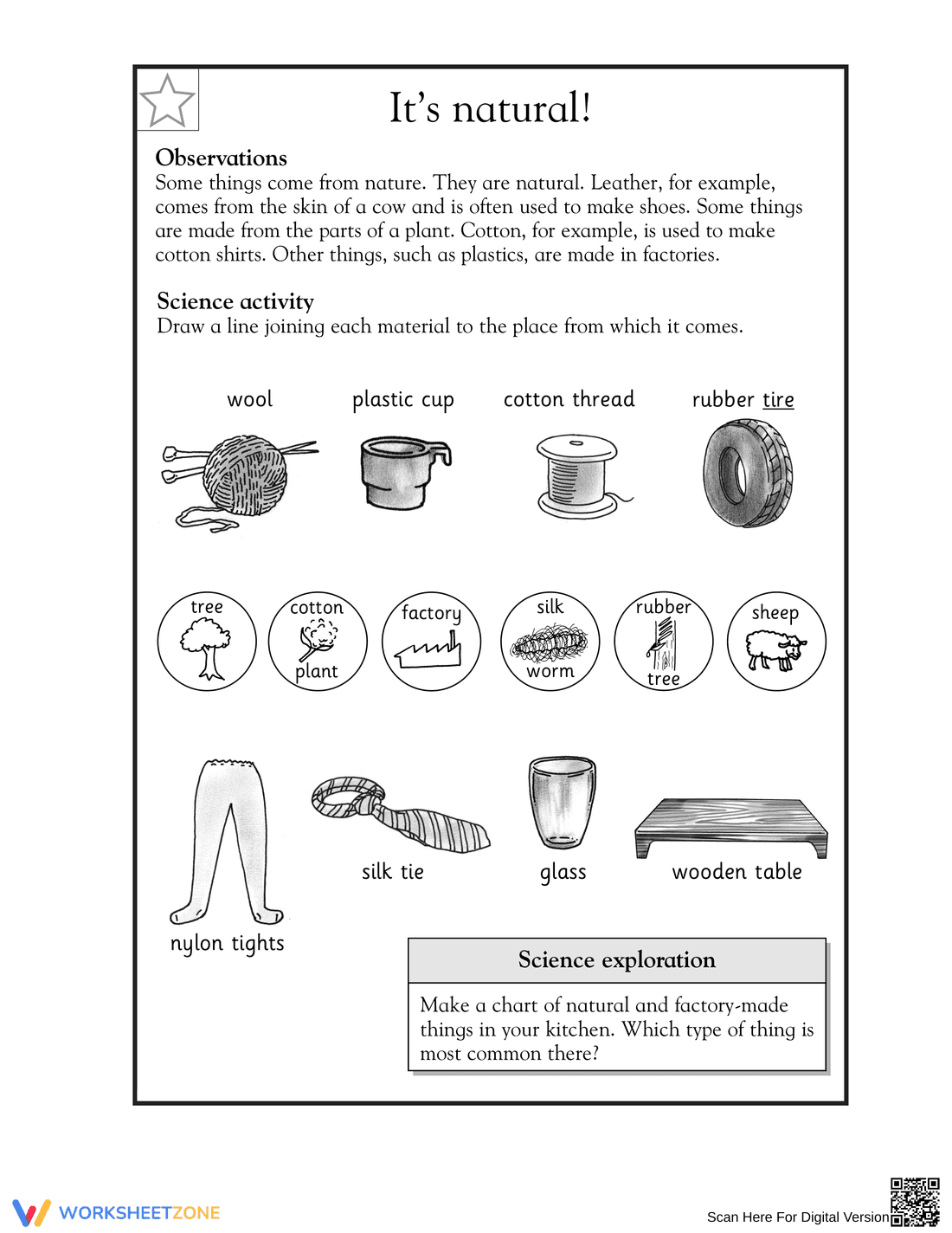
Students investigate the origins of everyday objects in this focused science activity. By distinguishing between items harvested from nature and those manufactured in factories, learners build a foundational understanding of material properties and resource management. This worksheet facilitates critical thinking as children trace the journey from raw source to finished product.
At a Glance
- Grade: 2 · Subject: Science
- Standard:
2-PS1-1— Classify different kinds of materials by their observable properties and origins- Skill Focus: Natural vs. Synthetic Material Identification
- Format: 1 page · 9 problems · Answer key included · PDF
- Best For: Introduction to Earth's resources and manufacturing
- Time: 15–20 minutes
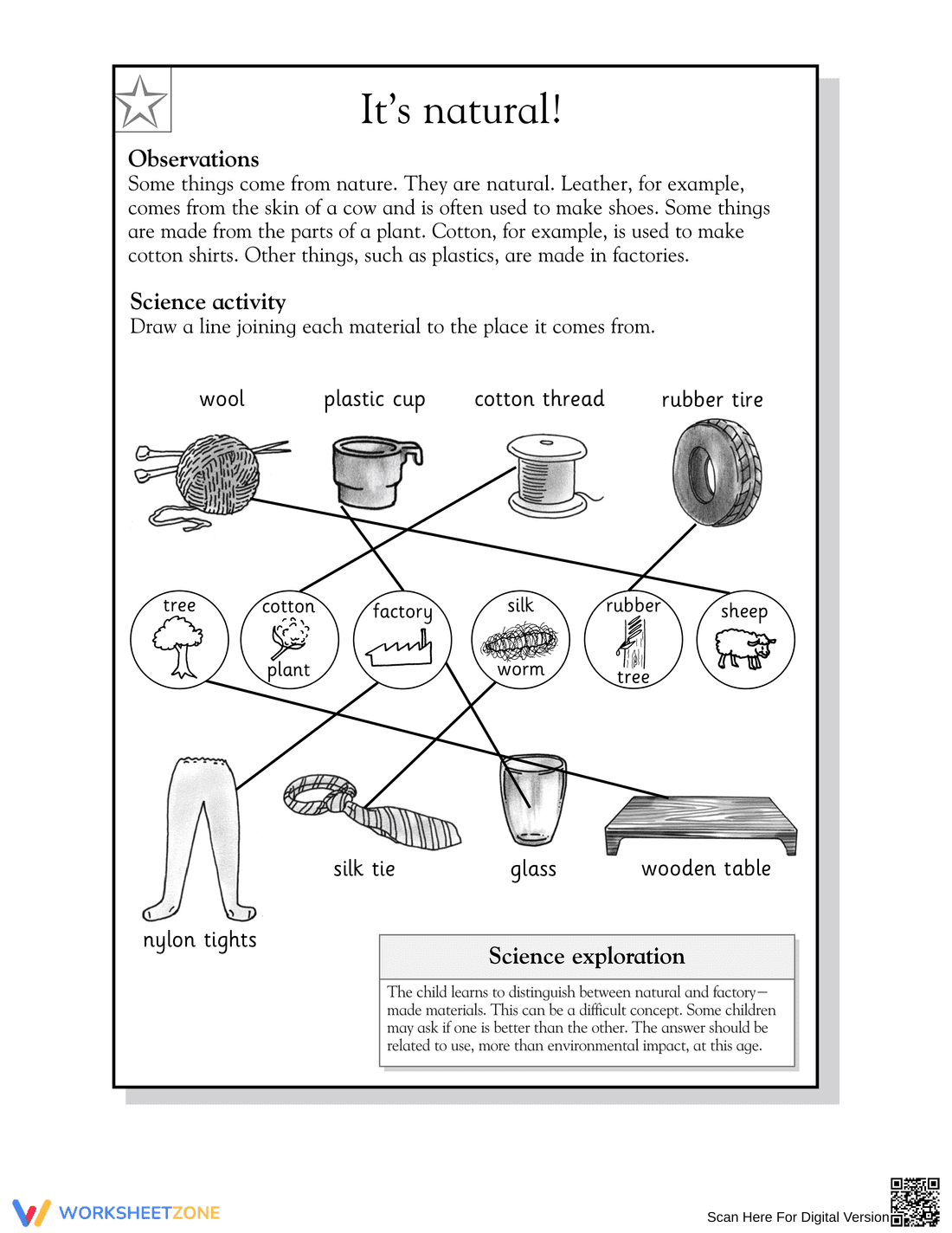
This comprehensive one-page PDF features a clear "Observations" section that provides context for the upcoming activity. The "Science activity" contains eight high-quality illustrations of common items like wool, plastic cups, and silk ties. Students are tasked with matching these items to six distinct origins, including trees, sheep, and factories. A bonus "Science exploration" box encourages students to apply their knowledge at home.
The zero-prep workflow for this resource is designed for maximum efficiency in busy classrooms. First, print the single-page document in under 30 seconds. Second, distribute the worksheet to students for independent or small-group matching for approximately 15 minutes. Third, review the answers collectively to address misconceptions about synthesized materials like plastic and nylon for about 5 minutes. This structured approach requires less than 2 minutes of teacher preparation.
The primary alignment for this resource is 2-PS1-1. This standard requires students to plan and conduct investigations to describe and classify different kinds of materials by their observable properties. By identifying the origins of materials, students gain insight into the physical properties that make certain resources suitable for specific uses. This standard code can be copied directly into lesson plans, IEP goals, or district curriculum mapping tools.
Use this worksheet as a formative assessment during a unit on Earth's resources. Observe students as they match items to check for a clear understanding of animal-derived versus plant-derived materials. Alternatively, assign it as a high-quality homework task to stimulate family discussion about the materials found in a typical kitchen. The "Science exploration" box serves as a bridge between classroom learning and real-world application.
This activity is perfectly suited for Grade 2 students but can be adapted for Grade 1 enrichment or Grade 3 review. The visual nature of the matching task provides excellent support for English Language Learners and students with IEPs. For an enhanced lesson, pair this worksheet with an anchor chart showing the life cycle of a product from raw material to factory floor.
According to RAND AIRS 2024, utilizing structured classification tasks in early elementary science significantly improves long-term retention of material science concepts. This worksheet addresses the essential skill of identifying material origins, allowing students to differentiate between biological resources and industrial synthesis. Research by Fisher & Frey (2014) highlights the importance of visual scaffolding in science literacy, suggesting that connecting images of finished goods to their raw sources builds complex cognitive maps. By engaging with 9 specific tasks, learners move beyond simple observation toward a systemic understanding of how human society utilizes natural inputs. This data-driven approach ensures that students meet rigorous benchmarks for Grade 2 science while developing the analytical skills necessary for future STEM success. The inclusion of an extension task further solidifies the learning objectives by encouraging domestic observation and data collection.


