Styles and Details in the Shirt Collection
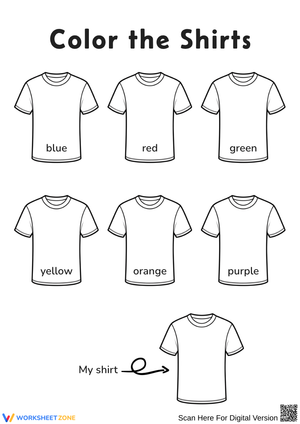
The shirt coloring pages at Worksheetzone cover a broad range of garment types — crew-neck tees, button-down dress shirts, polo shirts, plaid flannels, and Hawaiian-style prints with floral motifs. Each design captures fabric-specific details like collar structure, chest pockets, button plackets, and rolled cuffs, giving colorers real visual interest beyond plain outlines.
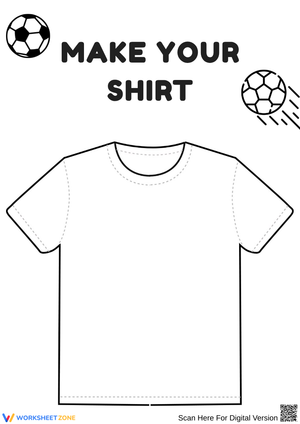
Some sheets present shirts in a flat-lay composition — the bird's-eye view style common in fashion photography — while others display shirts on simple mannequin forms or hanging on a hanger. A handful of designs include blank chest panels where kids can draw their own graphic or slogan, adding a personalized creative layer to the activity.
Coloring Tips for Fabric and Patterns
Fabric is one of the most satisfying subjects to shade because it bunches and folds naturally. Start with a light base color across the entire shirt, then deepen the tone along fold lines, under the collar, and in the areas where fabric gathers at the shoulders or waist. Colored pencils offer the most control for this kind of layered shading — they blend gradually and work well around fine details like seams and button plackets.
For plaid or striped shirts, use two colors and alternate them in perpendicular rows to build the classic crosshatch look; a ruler keeps the lines consistent. Bold markers are better suited to Hawaiian-style designs, where high-contrast, saturated color is the goal. Gel pens or white paint markers work well as a finishing step to add button dots, stitch texture, or pattern accents on top of dried color.
Who Uses These Pages and How
Kids ages 5 to 8 do well with the open tee outlines that have large color zones and minimal interior detail — quick to finish and easy to approach with crayons or thick washable markers. Older kids and teens tend to gravitate toward button-down and patterned designs, where planning a plaid color scheme or filling in a chest graphic becomes part of the creative process. Adult colorers sometimes use the fashion illustration–style sheets as a low-pressure garment-rendering exercise.
Teachers have used shirt printables as a cross-subject activity — students design a shirt for a character from a book they're reading, then write a short paragraph explaining the design choices. It connects visual art and reading comprehension in one task.
Frequently Asked Questions
What age group are shirt coloring pages best suited for?
Simple tee outlines work well for kids ages 5 and up, while detailed designs — plaid button-downs, polos with collar stitching, or shirts with pattern fills — are better matched to ages 8 and older who can manage finer detail and enjoy making deliberate color decisions.
What colors work well on a classic white button-down shirt design?
A soft blue or pale lavender reads naturally as a light dress shirt, and adding thin gray pencil lines along major fold areas creates a realistic shadow effect without darkening the overall look.
What paper size and settings should I use when printing shirt coloring pages?
Print at 100% scale on standard 8.5×11 paper for pencil or crayon work; if you plan to use markers or liquid watercolors, switch to 65–80 lb cardstock to prevent bleed-through and keep the linework sharp after coloring.
What's the origin of the graphic T-shirt?
The first commercially screen-printed T-shirt is widely credited to a 1948 U.S. presidential campaign for Thomas Dewey, featuring the slogan "Dew it with Dewey" — making the graphic tee over 75 years old as a form of wearable self-expression, long before band tees and souvenir shirts became mainstream.












 Interactive Worksheet Maker
 Quiz Maker
 Word Search Maker
 Crossword Puzzle Maker
 Word Scramble Generator
 Sentence Scramble Generator
 Handwriting Worksheet Generator
 Name Tracing Generator
 Fill In The Blank Generator