


























0
Views
0
Downloads

0.0
0
Save
0 Likes
Share
Color by Sum: Desert Theme Addition
0 Views
0 Downloads
Paste this activity's link or code into your existing LMS (Google Classroom, Canvas, Teams, Schoology, Moodle, etc.).
Students can open and work on the activity right away, with no student login required.
You'll still be able to track student progress and results from your teacher account.
Information
Description
What It Is:
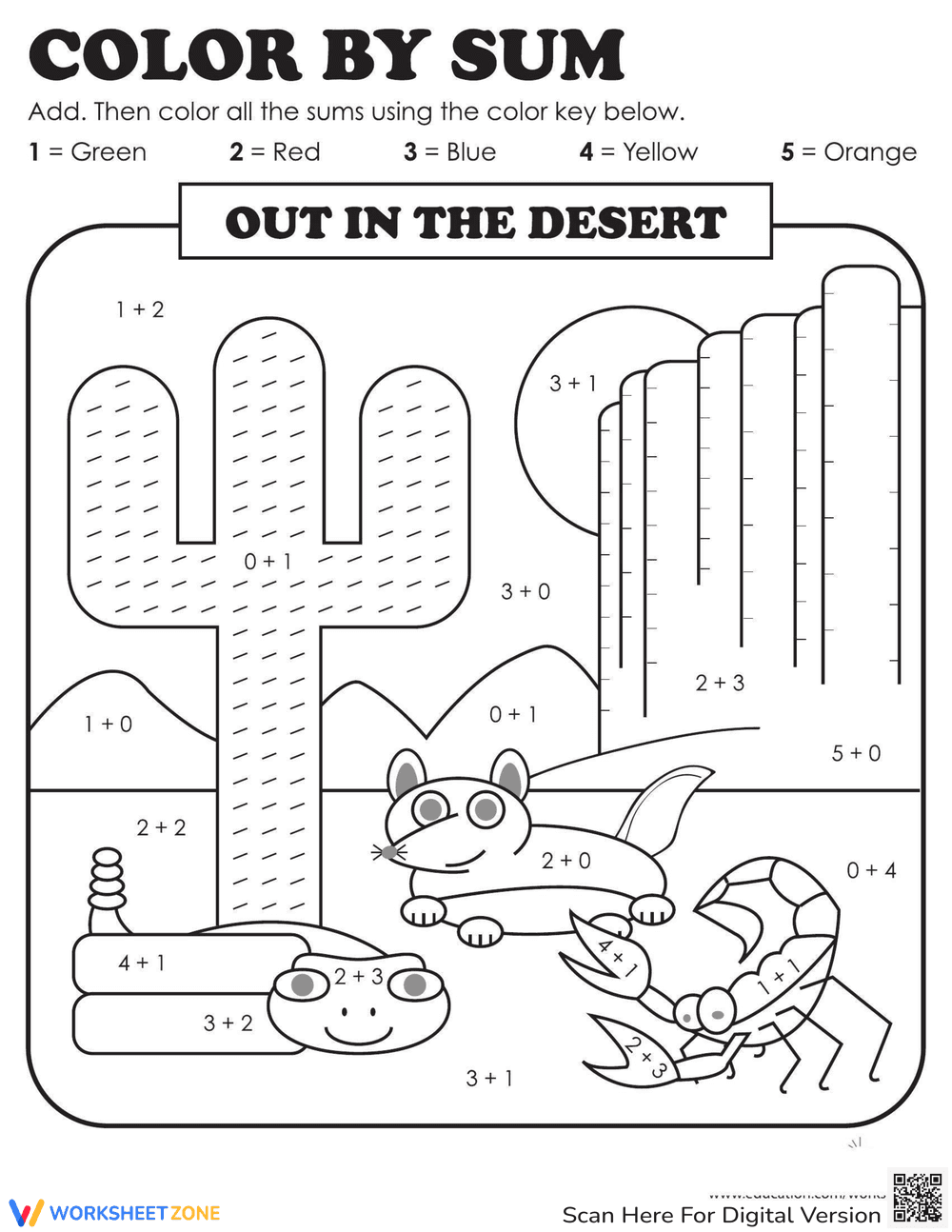
This is a 'Color by Sum' worksheet featuring a desert scene with a cactus, snake, mouse, scorpion, and desert plants. Each section of the picture contains a simple addition problem (e.g., 1+2, 2+0). The worksheet provides a color key where each sum (1 through 5) corresponds to a specific color: 1=Green, 2=Red, 3=Blue, 4=Yellow, and 5=Orange. Students solve the addition problems and then color the corresponding areas based on the color key.
Grade Level Suitability:
This worksheet is most suitable for Kindergarten and 1st grade students. It reinforces basic addition skills with sums up to 5, and the coloring aspect makes it engaging for young learners. The simple addition problems are appropriate for students just beginning to learn addition.
Why Use It:
This worksheet helps students practice basic addition facts in a fun and engaging way. It combines math skills with art, making learning more enjoyable. It also reinforces the connection between numbers and colors, which can be helpful for visual learners. It improves fine motor skills through coloring.
How to Use It:
First, have the student solve each addition problem in the picture. Then, using the provided color key, the student should color each section of the picture according to the sum they calculated. For example, if a section contains the problem '1+2', the student should solve it (1+2=3) and then color that section blue, as 3 corresponds to blue in the color key.
Target Users:
This worksheet is designed for young children, specifically kindergarten and first-grade students who are learning basic addition and number recognition. It's also suitable for parents and teachers looking for a fun and educational activity to reinforce math skills.
This is a 'Color by Sum' worksheet featuring a desert scene with a cactus, snake, mouse, scorpion, and desert plants. Each section of the picture contains a simple addition problem (e.g., 1+2, 2+0). The worksheet provides a color key where each sum (1 through 5) corresponds to a specific color: 1=Green, 2=Red, 3=Blue, 4=Yellow, and 5=Orange. Students solve the addition problems and then color the corresponding areas based on the color key.
Grade Level Suitability:
This worksheet is most suitable for Kindergarten and 1st grade students. It reinforces basic addition skills with sums up to 5, and the coloring aspect makes it engaging for young learners. The simple addition problems are appropriate for students just beginning to learn addition.
Why Use It:
This worksheet helps students practice basic addition facts in a fun and engaging way. It combines math skills with art, making learning more enjoyable. It also reinforces the connection between numbers and colors, which can be helpful for visual learners. It improves fine motor skills through coloring.
How to Use It:
First, have the student solve each addition problem in the picture. Then, using the provided color key, the student should color each section of the picture according to the sum they calculated. For example, if a section contains the problem '1+2', the student should solve it (1+2=3) and then color that section blue, as 3 corresponds to blue in the color key.
Target Users:
This worksheet is designed for young children, specifically kindergarten and first-grade students who are learning basic addition and number recognition. It's also suitable for parents and teachers looking for a fun and educational activity to reinforce math skills.


