


























Views
Downloads

Classifying Matter Printable Worksheet | Grade 7 Science
Paste this activity's link or code into your existing LMS (Google Classroom, Canvas, Teams, Schoology, Moodle, etc.).
Students can open and work on the activity right away, with no student login required.
You'll still be able to track student progress and results from your teacher account.
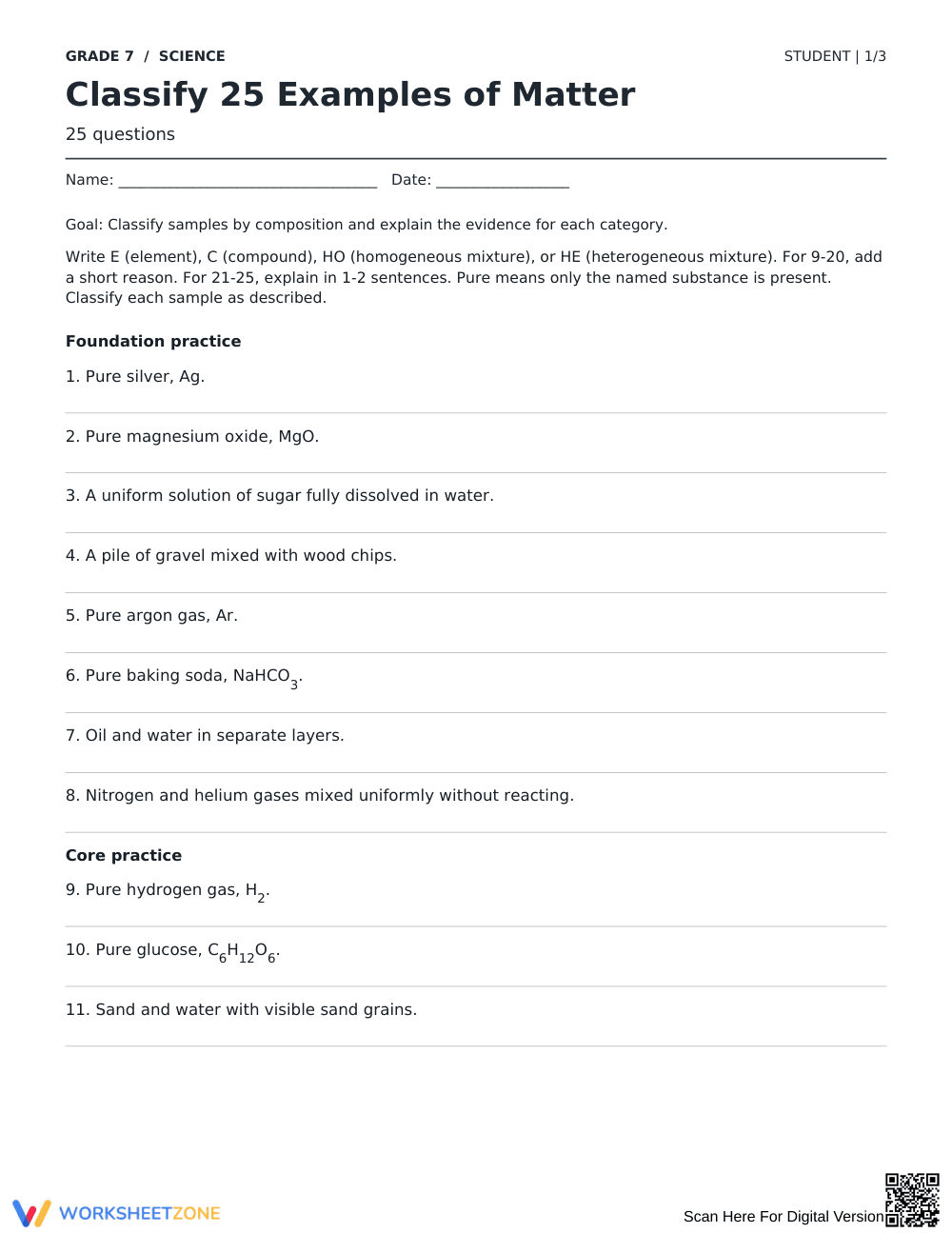
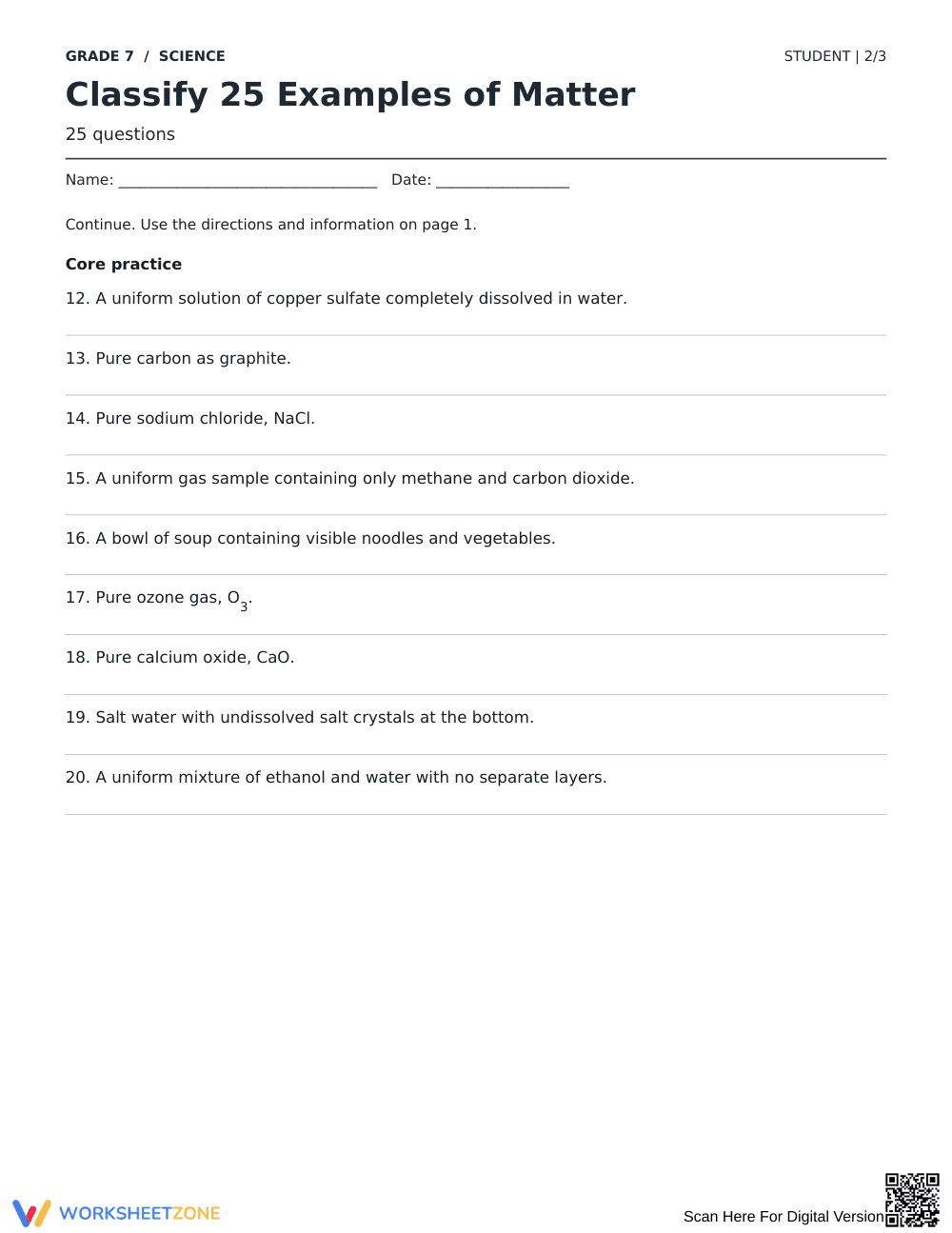
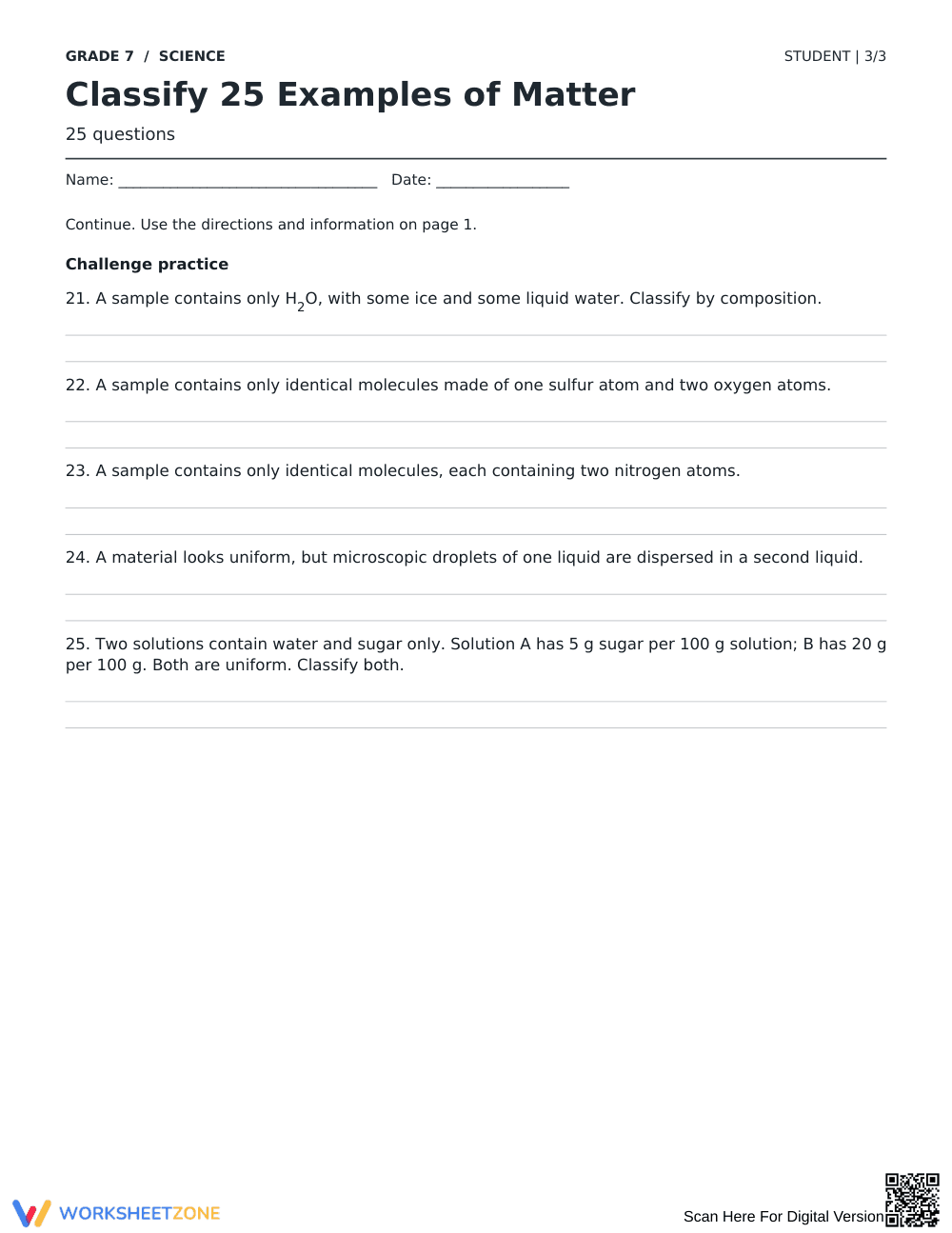
This physical science worksheet equips Grade 7 students to systematically classify 25 distinct chemical substances as elements, compounds, homogeneous mixtures, or heterogeneous mixtures. Learners build conceptual mastery of chemical composition by analyzing chemical formulas, state descriptions, and particle models, transitioning from simple identification to writing evidence-based scientific justifications for each classification.
At a Glance
- Grade: 7 · Subject: Physical Science
- Standard:
MS-PS1-1— Develop models to describe the atomic composition of simple molecules and extended structures- Skill Focus: Classifying matter into elements, compounds, and mixtures
- Format: 3 pages · 25 problems · Answer key included · PDF
- Best For: Classroom independent practice and formative skill review
- Time: 30–40 minutes
What's Inside
This 3-page printable science resource contains 25 structured classification tasks accompanied by a complete 2-page teacher answer key with sample justifications. Across the pages, students analyze chemical formulas (including NaHCO₃ and C₆H₁₂O₆), phase descriptions, and microscopic particle scenarios. Designated writing lines provide ample space for short reasoning and sentence explanations.
Skill Progression
- Guided practice (Questions 1–8): Foundation practice items prompt students to classify pure elements, simple compounds, and basic mixtures using clear formulas and descriptions.
- Supported practice (Questions 9–20): Core practice items require category codes alongside brief written rationales distinguishing diatomic elements, chemical solutions, and multi-phase mixtures.
- Independent practice (Questions 21–25): Challenge practice items demand deeper conceptual evaluation, requiring full sentences to explain phase coexistence and concentration differences.
This deliberate structure reflects the gradual-release model, guiding learners from basic identification to independent scientific reasoning.
Standards Alignment
This resource aligns directly with `MS-PS1-1`: Develop models to describe the atomic composition of simple molecules and extended structures. It reinforces core idea PS1.A by helping students distinguish pure substances from physical mixtures. Both standard codes can be copied directly into lesson plans, IEP goals, or district curriculum mapping tools.
How to Use It
Deploy this worksheet after direct instruction on pure substances and mixtures, or utilize it as a mid-unit checkpoint before lab activities. During independent work, inspect Question 9 and Question 17, where students often misidentify diatomic molecules like H₂ as compounds. Seventh-grade classes typically finish all 25 items in 30–40 minutes.
Who It's For
Designed for Grade 7 physical science classrooms, this activity also supports Grade 8 review. Striving readers benefit from explicit chemical formulas and structured sentence prompts in the core section. Pair this assignment with a hands-on classification lab or an anchor chart illustrating particle arrangements.
Mastering matter classification serves as an essential prerequisite for middle school physical science under standard MS-PS1-1, establishing foundational conceptual knowledge of elements, compounds, and mixtures. According to Fisher & Frey (2014), student achievement in secondary science improves significantly when instructional tasks systematically scaffold from basic categorical recognition to rigorous written justification. By providing twenty-five structured problems that progress from chemical symbol identification to multi-sentence explanatory synthesis, this worksheet embodies that gradual-release architecture. Students do not merely memorize definitions; they actively examine molecular properties, differentiate diatomic elements from bonded compounds, and evaluate phase uniformity across varied physical solutions. This rigorous analytical framework equips seventh-grade learners with the precise scientific vocabulary and evidence-based reasoning required for subsequent chemical equation balancing and molecular modeling. The comprehensive scoring guide and complete answer keys ensure educators can efficiently diagnose misconceptions and verify student readiness for laboratory investigations.


