


























Views
Plays
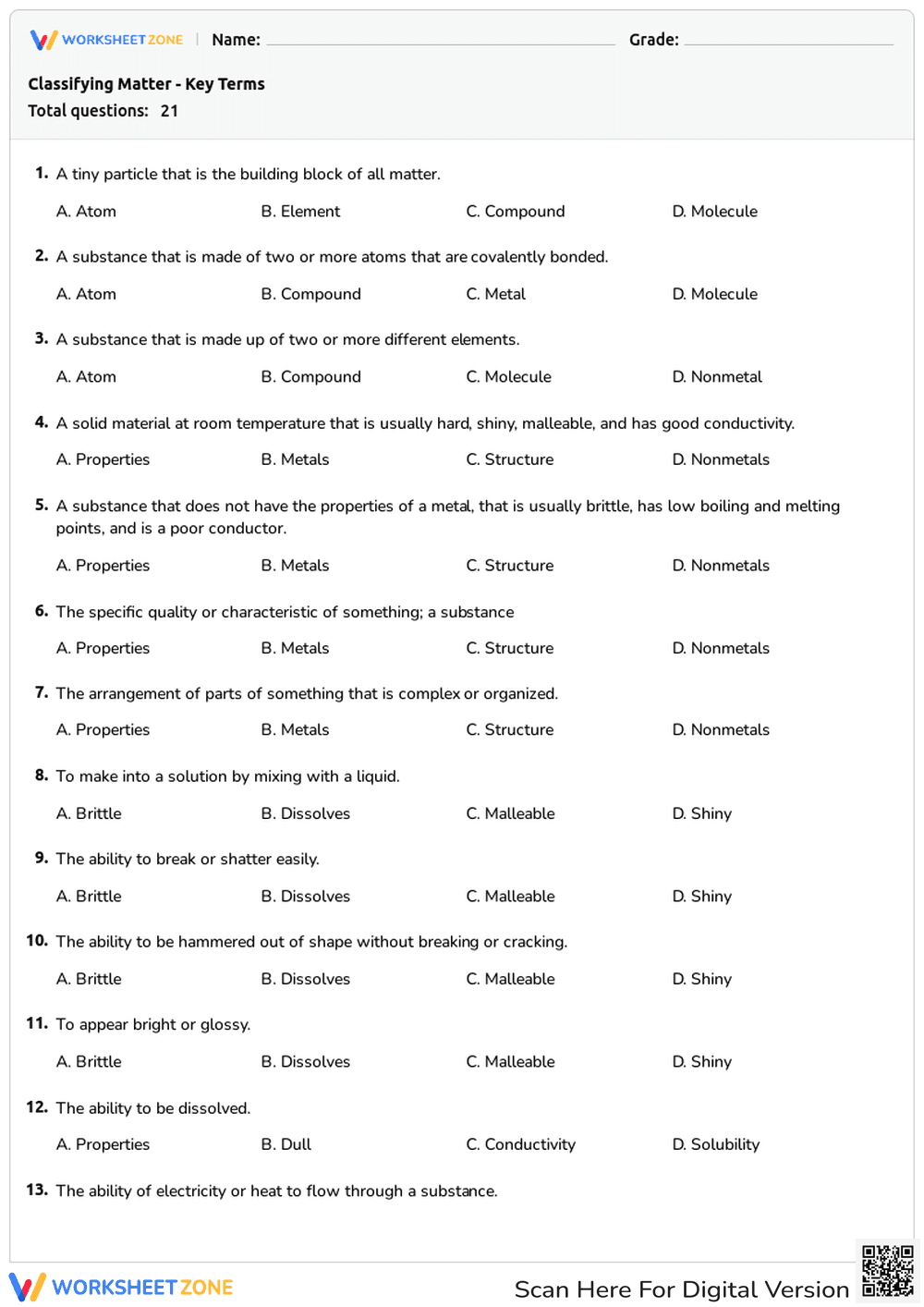


Classifying Matter Worksheet | Grade 6 Essential
Paste this activity's link or code into your existing LMS (Google Classroom, Canvas, Teams, Schoology, Moodle, etc.).
Students can open and work on the activity right away, with no student login required.
You'll still be able to track student progress and results from your teacher account.
This Grade 6 science worksheet provides a comprehensive review of matter classification through 21 targeted multiple-choice questions. Students demonstrate their understanding of atomic structures, chemical compounds, and physical properties like conductivity and malleability. It is designed to solidify foundational chemistry vocabulary before moving into complex chemical reactions or periodic table studies.
At a Glance
- Grade: 6 · Subject: Science
- Standard:
MS-PS1-1— Describe the atomic composition of simple molecules and extended structures- Skill Focus: Matter Classification Vocabulary
- Format: 2 pages · 21 problems · Answer key included · PDF
- Best For: Formative assessment or vocabulary review
- Time: 20–30 minutes
The resource contains two full pages of assessment material featuring 21 multiple-choice items. The first section focuses on technical definitions for terms like "covalently bonded" and "solubility." The second section utilizes creative analogies—comparing atoms to Legos and compounds to "mutts"—to help students build conceptual links. A clear answer key is provided for rapid grading and immediate student feedback.
Zero-Prep Workflow
- Print: Select the two-page PDF and print enough copies for your class (30 seconds).
- Distribute: Hand out the worksheets as a quiet bell-ringer or a post-lecture check (1 minute).
- Review: Use the included answer key to grade or facilitate a peer-review session (5 minutes).
Total teacher preparation time is under two minutes, making this an ideal resource for sub plans or unexpected schedule changes.
Standards Alignment
This worksheet is aligned with MS-PS1-1, which requires students to develop models to describe the atomic composition of simple molecules and extended structures. By mastering the distinction between atoms, elements, and compounds, students build the prerequisite knowledge for NGSS performance expectations. This standard code can be copied directly into lesson plans, IEP goals, or district curriculum mapping tools.
How to Use It
Use this as a formative assessment after an introductory lesson on the properties of matter. It works exceptionally well as a "check for understanding" halfway through a chemistry unit. Observe if students struggle with the analogy section (questions 15-21), as this indicates a need for more concrete modeling. Completion typically takes 20 to 30 minutes depending on student reading speed.
Who It's For
This is ideal for middle school science students in grades 5 through 7. It provides necessary scaffolding for English Language Learners (ELL) through clear definitions and relatable analogies. Pair this worksheet with a physical modeling activity using molecular kits or an anchor chart detailing the differences between metals and nonmetals to support visual learners.
According to the RAND AIRS 2024 report on science literacy, the acquisition of domain-specific vocabulary is a primary predictor of student success in secondary chemistry. This worksheet addresses that need by targeting MS-PS1-1 through 21 rigorous items that bridge the gap between rote memorization and conceptual application. By utilizing link-word analogies—such as comparing atoms to building blocks—the material aligns with Fisher & Frey’s (2014) research on tiered vocabulary instruction. This approach ensures that students do not merely recognize terms but understand the structural relationships between particles. The inclusion of physical properties like conductivity and malleability provides a holistic view of matter classification, making it a versatile tool for diverse classroom settings. This resource serves as a reliable evidence-based instrument for measuring student progress toward NGSS mastery in middle school physical science.


