


























Views
Downloads
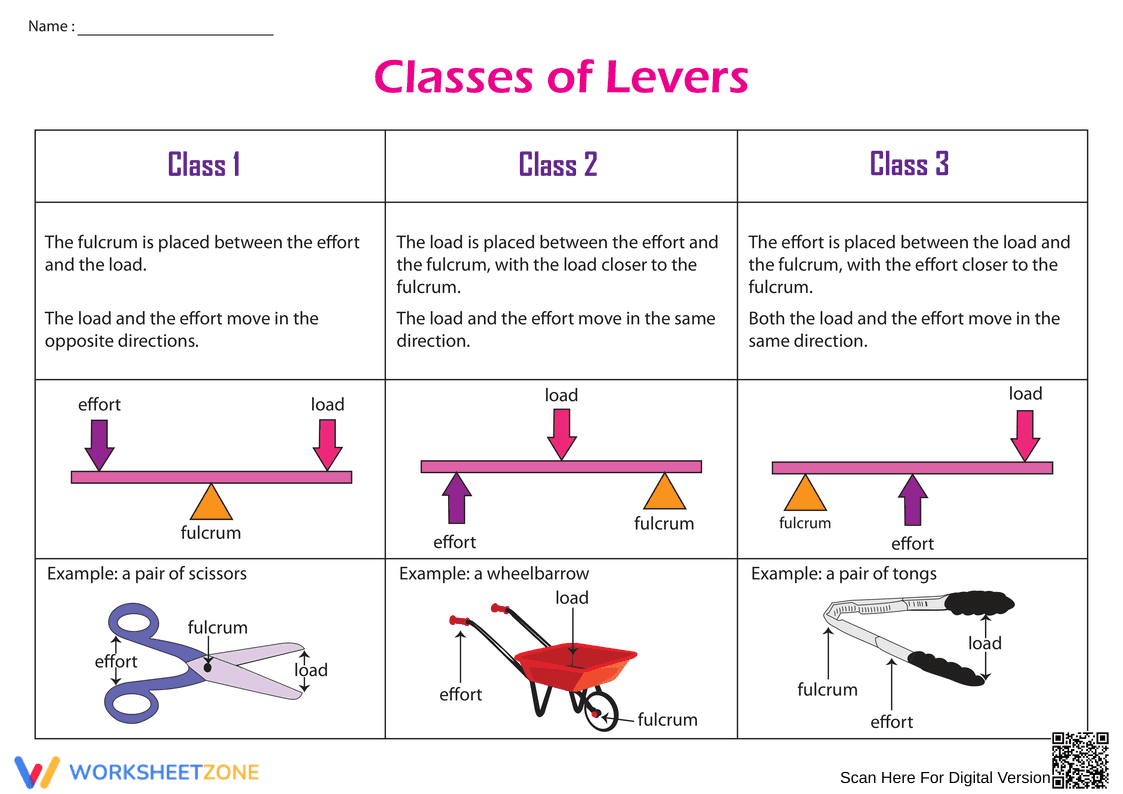

Grade 3-5 Classes of Levers — Printable No-Prep Chart
Paste this activity's link or code into your existing LMS (Google Classroom, Canvas, Teams, Schoology, Moodle, etc.).
Students can open and work on the activity right away, with no student login required.
You'll still be able to track student progress and results from your teacher account.
This Grade 3-5 science reference chart gives students a clear visual breakdown to identify the three classes of levers. By illustrating the relationship between the fulcrum, effort, and load, this resource helps elementary learners understand mechanical advantage in everyday objects before applying these concepts to engineering tasks.
At a Glance
- Grade: 3-5 · Subject: Science
- Standard:
3-PS2-1— Identify how tools manipulate forces to change motion- Skill Focus: Identifying Lever Classes
- Format: 1 page · 0 problems · No answer key · PDF
- Best For: Science notebooks and anchor charts
- Time: 5–10 minutes
Inside this resource, you will find a comprehensive one-page definition chart covering Class 1, Class 2, and Class 3 levers. Each section includes a technical definition of the part arrangement, a simplified force diagram showing the fulcrum's position, and a high-quality illustration of a real-world example like scissors or a wheelbarrow to bridge the gap between theory and practice.
Zero-Prep Workflow
Using this chart requires zero teacher preparation. Step 1: Print the single-page PDF (30 seconds). Step 2: Distribute to students for their science notebooks (30 seconds). Step 3: Review load placement as a quick check for understanding (4 minutes). With a total prep time of under two minutes, this workflow is ideal for substitute plans or quick science mini-lessons.
Standards Alignment
This resource is aligned to 3-PS2-1, which requires students to plan and conduct investigations on the effects of balanced and unbalanced forces on the motion of an object. By understanding how levers redistribute load and effort, students can better explain how forces are applied in mechanical systems. Both standard codes can be copied directly into lesson plans, IEP goals, or district curriculum mapping tools.
How to Use It
To use this effectively, introduce it during the direct instruction phase of a lesson on simple machines. Have students keep the chart on their desks while they experiment with physical levers to verify the load-effort relationships. For a quick formative assessment observation, ask students to find one other object in the classroom that acts as a lever and categorize it using the chart's definitions. Expected review time is 5 to 10 minutes.
Who It's For
This chart is designed for students in grades 3 through 5, particularly those beginning their study of physics and engineering. It is an excellent scaffold for visual learners and students with IEPs who benefit from clear force diagrams. It pairs naturally with a hands-on lab or a reading passage about the history of simple machines.
According to recent research in the RAND AIRS 2024 study on science literacy, visual aids that combine abstract force diagrams with concrete object representations significantly improve retention of mechanical concepts in elementary learners. By explicitly labeling the fulcrum, effort, and load in multiple contexts, this chart adheres to the dual-coding theory of learning, which suggests that verbal and visual information processed together leads to deeper mastery. The 3-PS2-1 standard emphasizes that students must move beyond simple observation to identifying how tools manipulate forces to change motion. This tool bridges that gap by providing a repeatable mental model for analyzing any lever-based tool. High-quality anchor charts serve as vital scaffolds of permanence that students can refer back to throughout an entire unit on work and machines, ensuring that fundamental definitions remain accessible during more complex engineering tasks.


