


























Views
Downloads

Essential Complementary & Supplementary Angles Worksheet
Paste this activity's link or code into your existing LMS (Google Classroom, Canvas, Teams, Schoology, Moodle, etc.).
Students can open and work on the activity right away, with no student login required.
You'll still be able to track student progress and results from your teacher account.
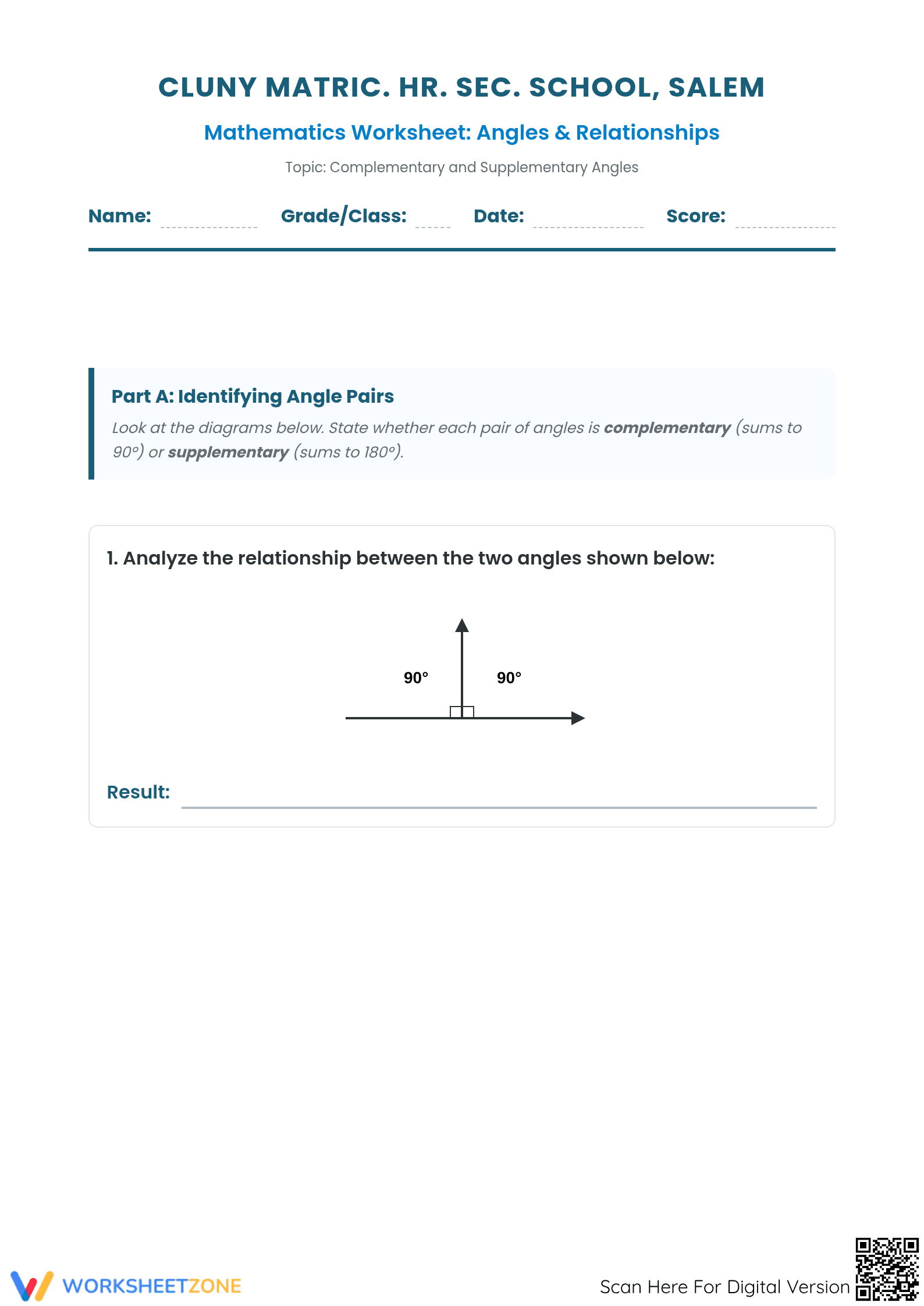
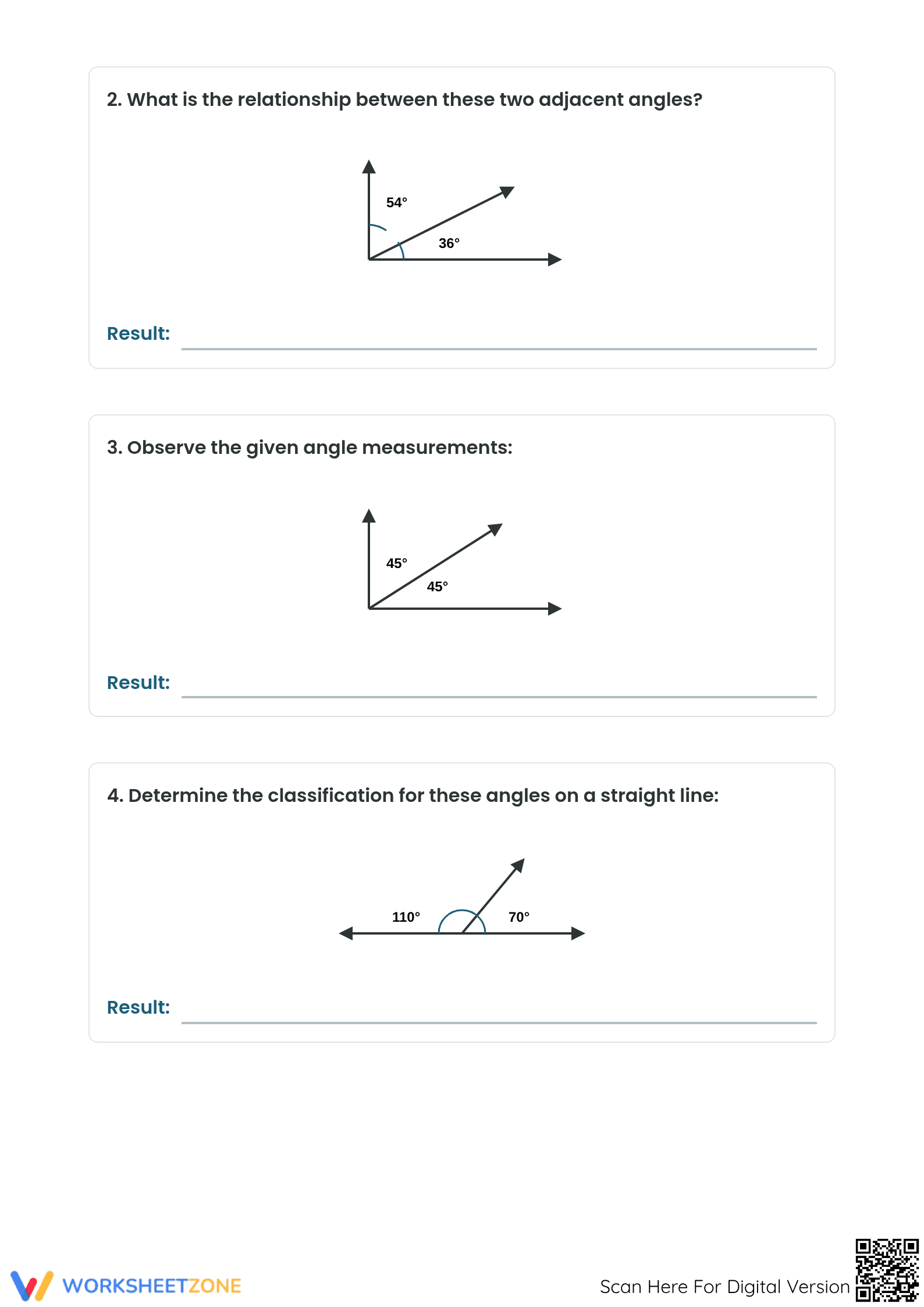
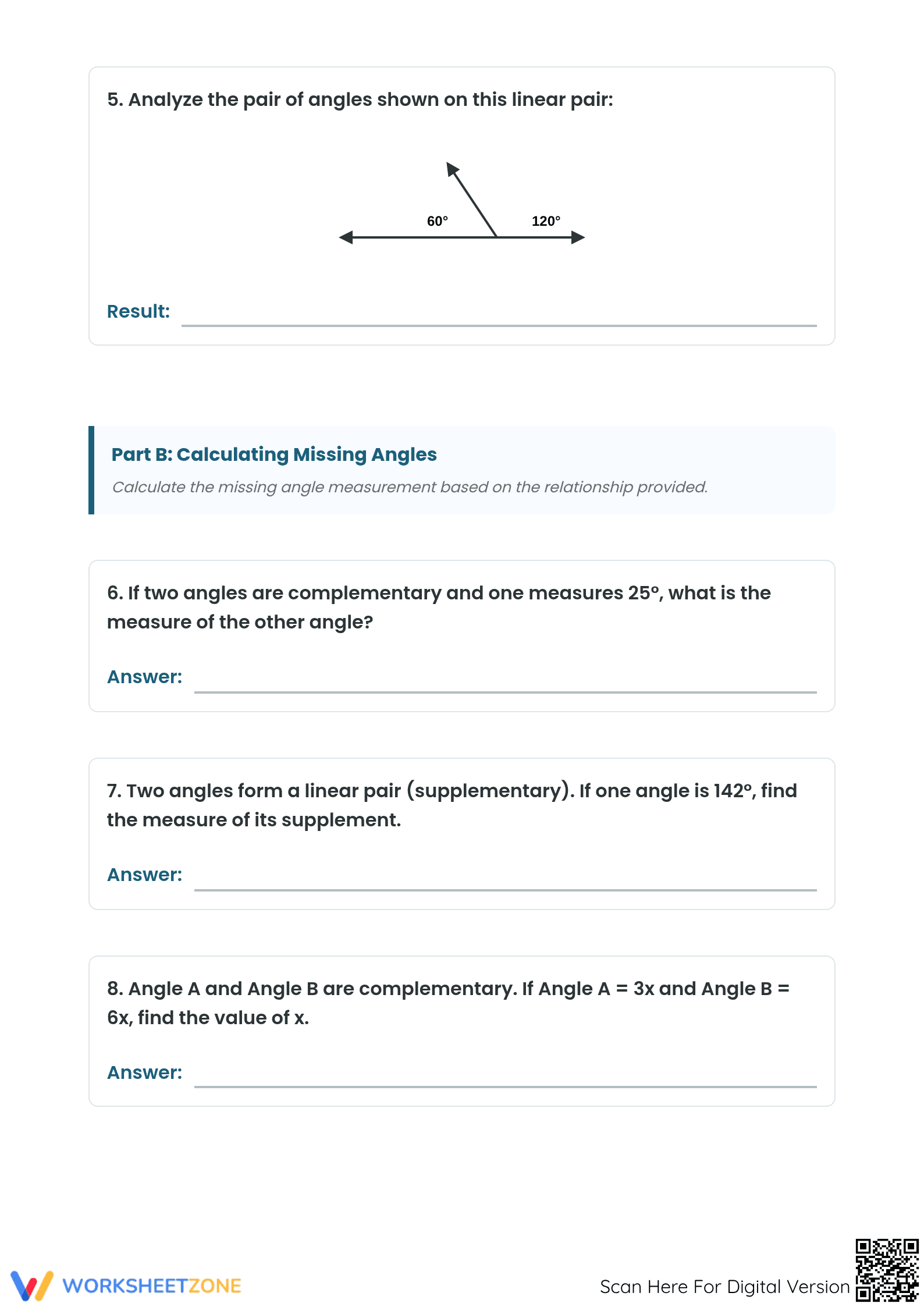
This comprehensive Grade 7 geometry worksheet provides essential practice for mastering complementary and supplementary angle relationships. Students transition from identifying basic pairs to solving complex algebraic equations and real-world word problems. By the end of this activity, learners will confidently calculate unknown measurements and explain geometric properties involving linear pairs and adjacent angles.
At a Glance
- Grade: 7 · Subject: Mathematics
- Standard:
CCSS.MATH.CONTENT.7.G.B.5— Use angle facts to write and solve simple equations for unknown angles.- Skill Focus: Complementary and Supplementary Angle Pairs
- Format: 5 pages · 17 problems · Answer key included · PDF
- Best For: Geometry Mastery and Assessment Prep
- Time: 40–50 minutes
What's Inside
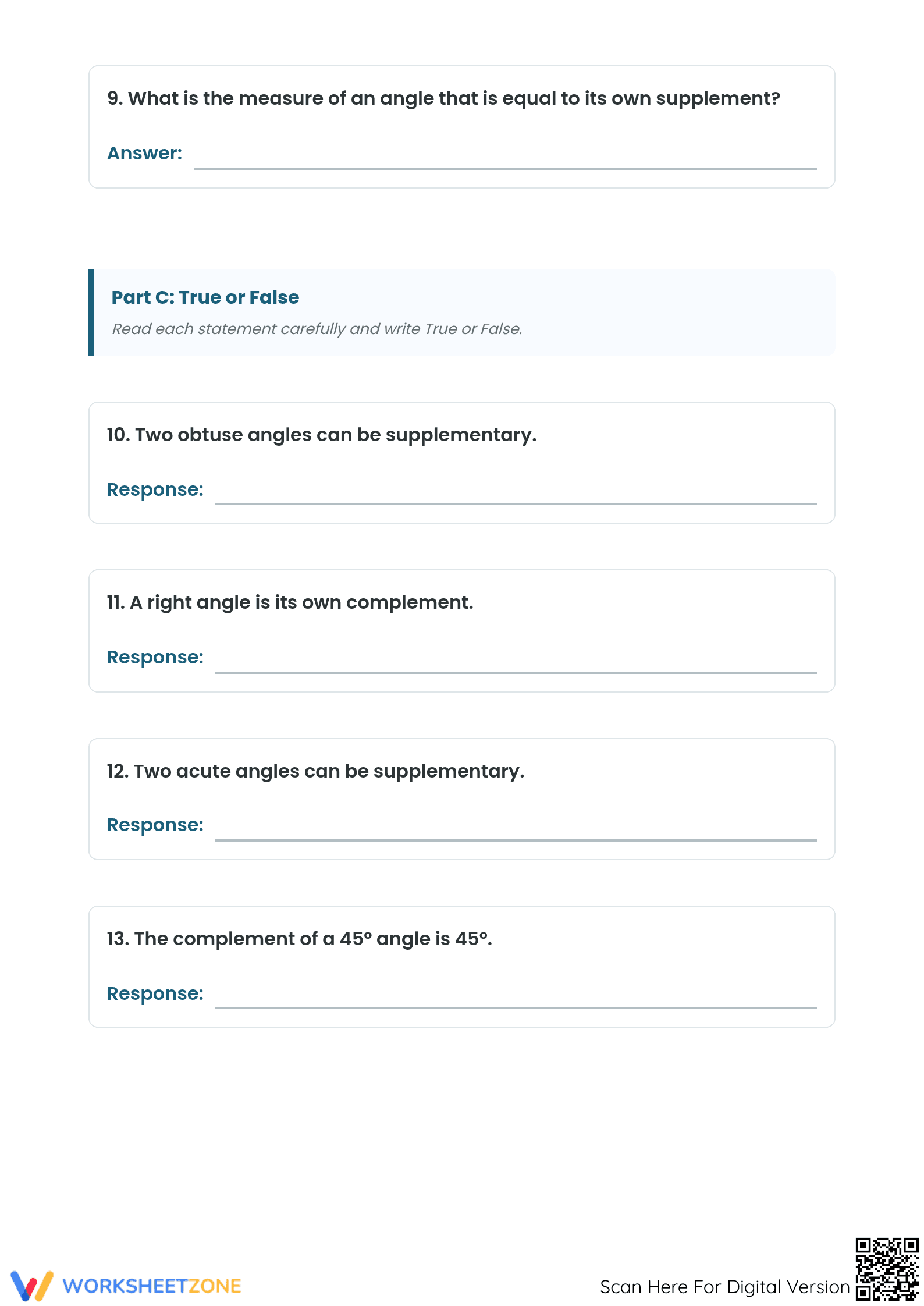
The worksheet spans five high-quality pages, beginning with visual identification tasks and progressing through four distinct sections. It contains 17 structured problems, including multiple-choice diagrams, true-or-false conceptual checks, and real-world application scenarios. A full answer key is included to facilitate immediate feedback or independent student self-correction, ensuring students understand the 90-degree and 180-degree relationships thoroughly.
Skill Progression
- Guided Practice: Five visual identification tasks (Part A) require students to sum visible angles and classify them as complementary or supplementary, reinforcing the basic definitions of 90 and 180 degrees.
- Supported Practice: Four calculation-based problems (Part B) introduce algebraic variables and missing value discovery, moving students from concrete observation to abstract mathematical reasoning.
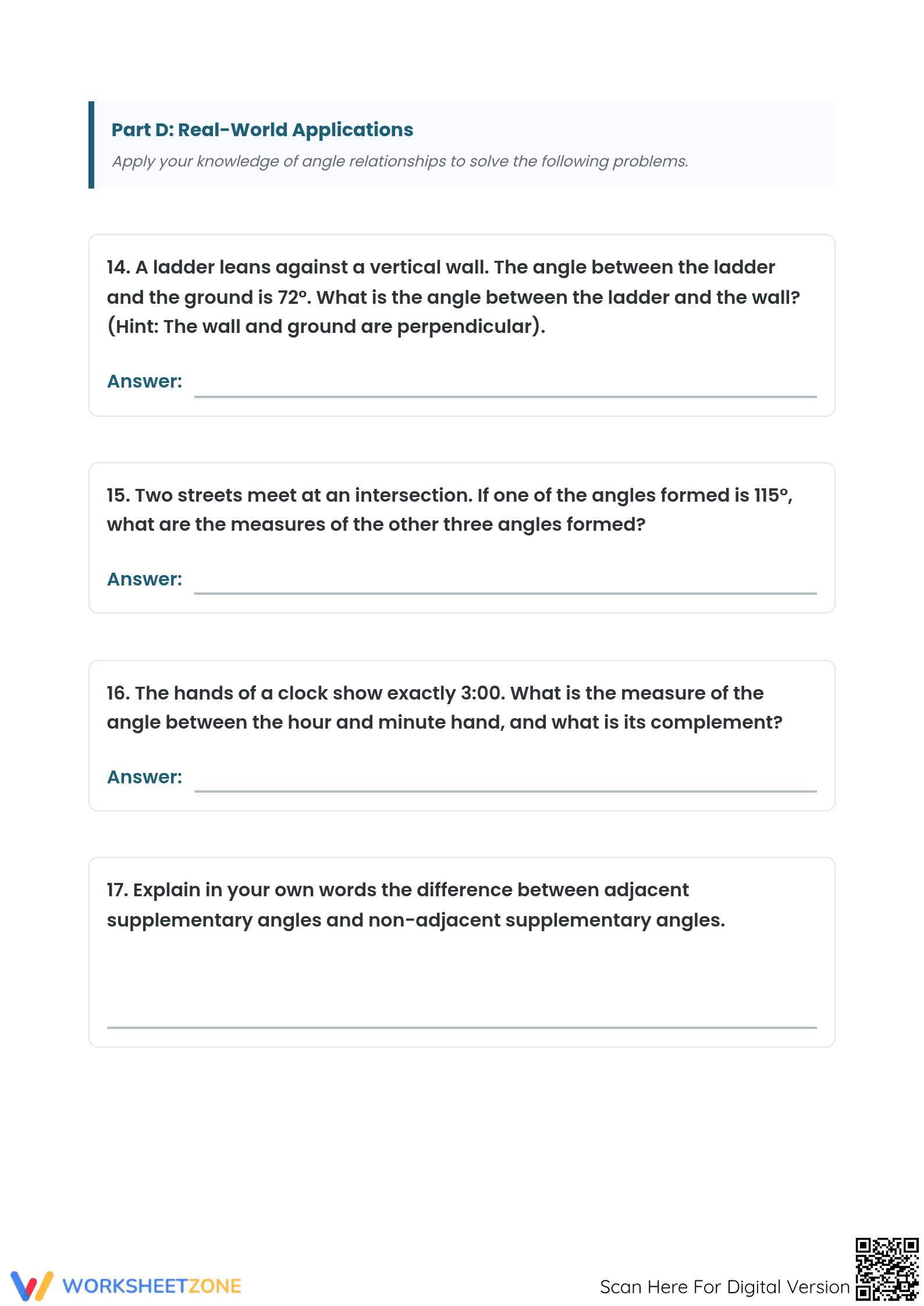
- Independent Practice: Eight advanced items (Parts C and D) challenge students with conceptual true/false statements and complex word problems involving ladders, intersections, and clock hands.
This gradual-release approach ensures students move confidently from "I Do" recognition to "You Do" independent application of geometric proofs.
Standards Alignment
This resource aligns strictly with CCSS.MATH.CONTENT.7.G.B.5: "Use facts about supplementary, complementary, vertical, and adjacent angles in a multi-step problem to write and solve simple equations for an unknown angle in a figure." This standard code can be copied directly into lesson plans, IEP goals, or district curriculum mapping tools for efficient documentation.
How to Use It
Use this worksheet as a summative assessment after a unit on angle relationships or as a collaborative group activity. During instruction, observe how students handle Task 8 (algebraic substitution) to identify misconceptions about variable relationships. Expected completion time is 45 minutes, making it a perfect fit for a standard secondary math block or a comprehensive homework assignment.
Who It's For
This practice is designed for seventh-grade students, but the varying task difficulty makes it suitable for Grade 6 enrichment or Grade 8 remediation. Students with IEPs benefit from the clear visual models in Part A. Pair this worksheet with a protractor-based measurement activity or a "Geometry in Architecture" photo analysis to bridge classroom theory and practical observation.
The instructional design of this angles worksheet reflects the evidence-based practices outlined in the RAND AIRS 2024 report on mathematics achievement, which emphasizes the necessity of connecting geometric definitions to algebraic problem-solving. By requiring students to calculate unknown measurements through the application of the CCSS.MATH.CONTENT.7.G.B.5 standard, the worksheet supports the development of procedural fluency and conceptual understanding. Research from Fisher & Frey (2014) highlights that scaffolded progression—moving from visual identification of complementary and supplementary pairs to multi-step real-world applications—is critical for long-term retention of geometric facts. This 17-task set provides the rigorous practice needed to meet National Assessment of Educational Progress (NAEP) benchmarks for middle school geometry. The inclusion of conceptual true/false checks ensures that students are not merely performing calculations but are internalizing the foundational properties of adjacent and non-adjacent angle relationships.


