


























Views
Downloads

Grade 7 Angles Worksheet: Printable No-Prep Practice
Paste this activity's link or code into your existing LMS (Google Classroom, Canvas, Teams, Schoology, Moodle, etc.).
Students can open and work on the activity right away, with no student login required.
You'll still be able to track student progress and results from your teacher account.
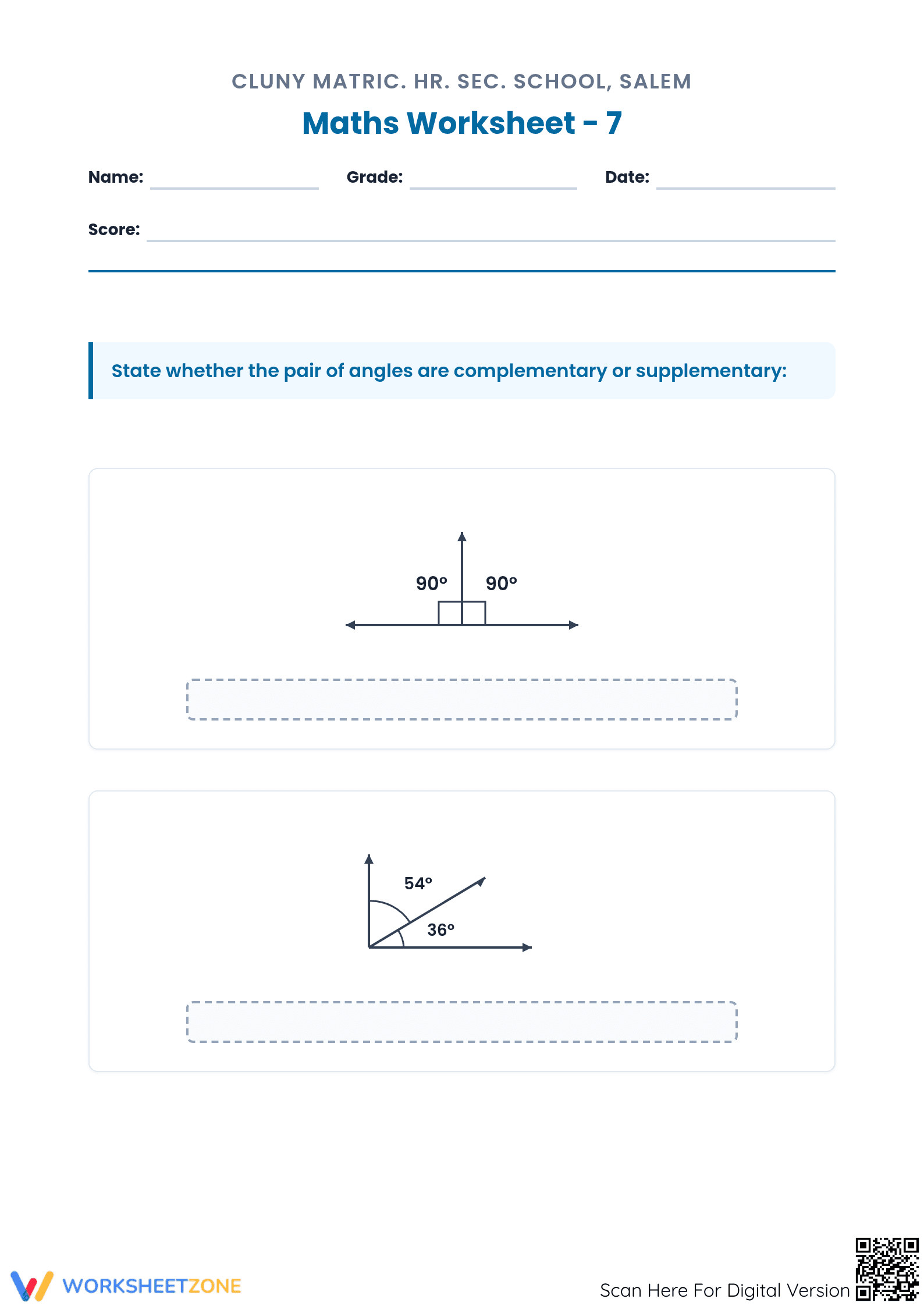
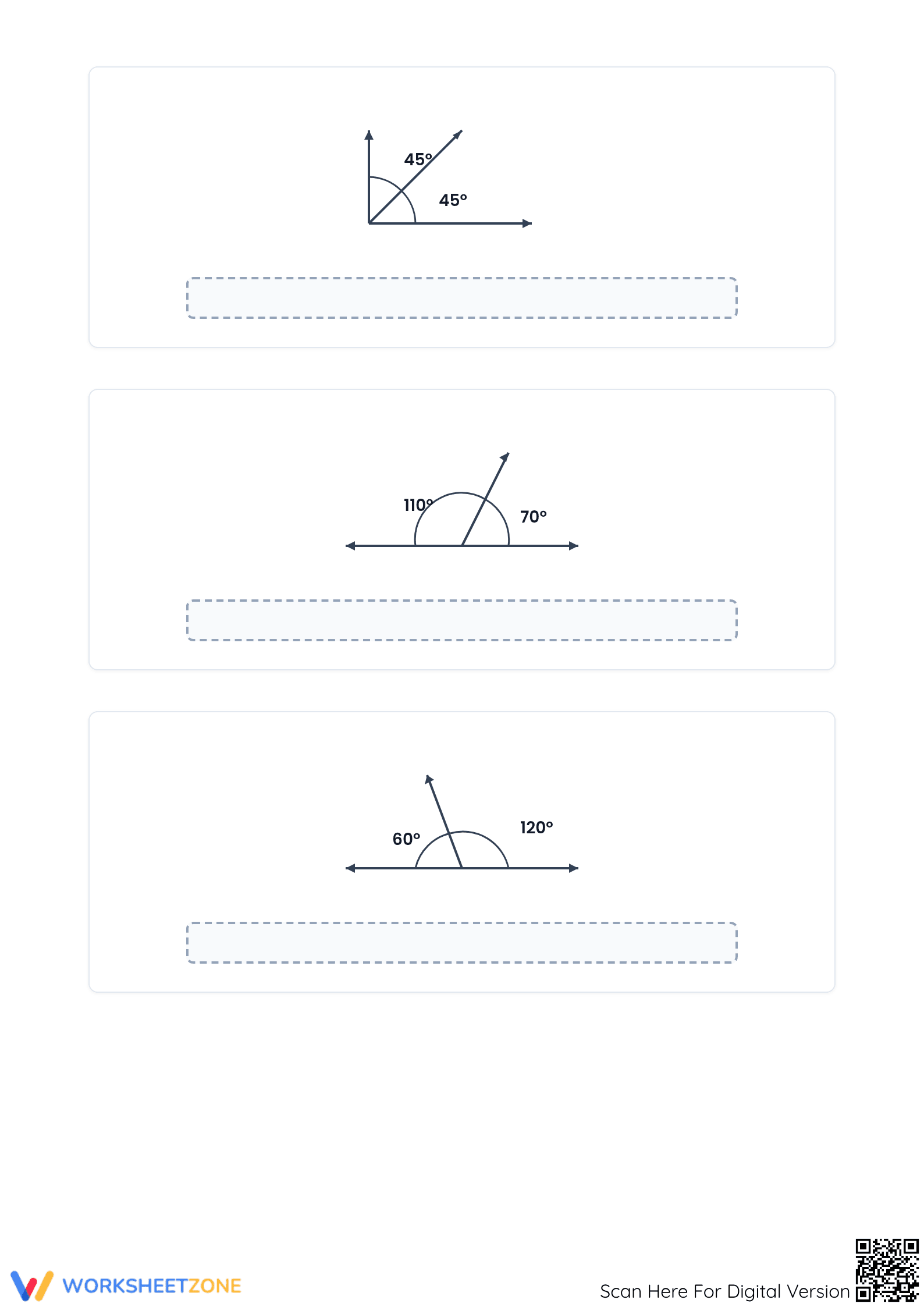
This Grade 7 math worksheet provides targeted practice for students to distinguish between complementary and supplementary angle pairs. By analyzing visual diagrams, learners apply geometric definitions to determine if angle sums equal 90 or 180 degrees. This foundational exercise ensures students can accurately identify angle relationships before progressing to more complex multi-step algebraic geometry problems.
At a Glance
- Grade: 7 · Subject: Math
- Standard:
CCSS.MATH.CONTENT.7.G.B.5— Use facts about supplementary and complementary angles to identify relationships in figures.- Skill Focus: Angle Pair Identification
- Format: 2 pages · 5 problems · Answer key included · PDF
- Best For: Quick formative assessment or bell ringer
- Time: 10–15 minutes
This resource consists of two high-quality PDF pages featuring five distinct geometric diagrams. Each problem presents a pair of adjacent or non-adjacent angles with clearly labeled degree measurements. Students are provided with a dedicated response box below each figure to record their classification. A comprehensive answer key is included, allowing for immediate feedback or self-grading.
Zero-Prep Workflow
- Print: Select the two-page document and print for your class (30 seconds).
- Distribute: Hand out the sheets as a focused bell-ringer or warm-up activity (1 minute).
- Review: Use the included answer key to review the five problems as a whole group to identify common misconceptions (5 minutes).
Total teacher preparation time is under two minutes, making this an ideal solution for busy schedules or emergency sub plans.
Standards Alignment
The primary focus of this worksheet is CCSS.MATH.CONTENT.7.G.B.5: "Use facts about supplementary, complementary, vertical, and adjacent angles in a multi-step problem to write and solve simple equations for an unknown angle in a figure." This standard code can be copied directly into lesson plans, IEP goals, or district curriculum mapping tools.
How to Use It
Use this worksheet as a formative assessment immediately following a direct instruction lesson on angle types. It serves as an excellent check for understanding to ensure students can differentiate between right-angle and straight-line relationships. Alternatively, assign it as a low-stakes homework task to reinforce vocabulary. Observe if students are performing the mental addition or relying solely on the visual cues of the square symbol versus the straight line.
Who It's For
This resource is ideal for Grade 7 students introduced to geometry, though it remains relevant for Grade 8 and 9 students requiring a refresher. It is particularly effective for English Language Learners (ELLs) due to the heavy reliance on visual diagrams rather than word-heavy prompts. This worksheet provides the structured repetition necessary to cement these definitions through five targeted visual exercises.
This Grade 7 geometry resource focuses on the fundamental geometric properties of angle pairs, specifically the distinction between complementary and supplementary relationships. According to Fisher & Frey (2014), the use of visual representations in mathematics, such as the ray and line diagrams provided here, is essential for the gradual release of responsibility as students move from identifying properties to solving complex algebraic equations. By isolating the identification phase, this worksheet ensures students have the prerequisite fluency required for CCSS.MATH.CONTENT.7.G.B.5. Research from the NAEP indicates that students who master basic geometric definitions early are significantly more likely to succeed in high school trigonometry. This 2-page PDF provides the structured repetition necessary to cement these definitions through five targeted visual exercises, making it a reliable tool for formative assessment or independent practice.


