


























Views
Plays



Essential Grade 10 Science Quiz | Comprehensive Review
Paste this activity's link or code into your existing LMS (Google Classroom, Canvas, Teams, Schoology, Moodle, etc.).
Students can open and work on the activity right away, with no student login required.
You'll still be able to track student progress and results from your teacher account.
This Grade 10 Science quiz provides a rigorous assessment of core concepts across chemistry, biology, and environmental science. Students demonstrate mastery of the law of conservation of mass, cellular biology, and ecosystem dynamics through 24 targeted multiple-choice questions. It is designed to evaluate student understanding and identify specific knowledge gaps before high-stakes testing.
At a Glance
- Grade: 10 · Subject: Science
- Standard:
HS-PS1-7— Use mathematical representations to support the claim that atoms are conserved- Skill Focus: Integrated Science Review
- Format: 8 pages · 24 problems · Answer key included · PDF
- Best For: Formative assessment and end-of-unit review
- Time: 30–45 minutes
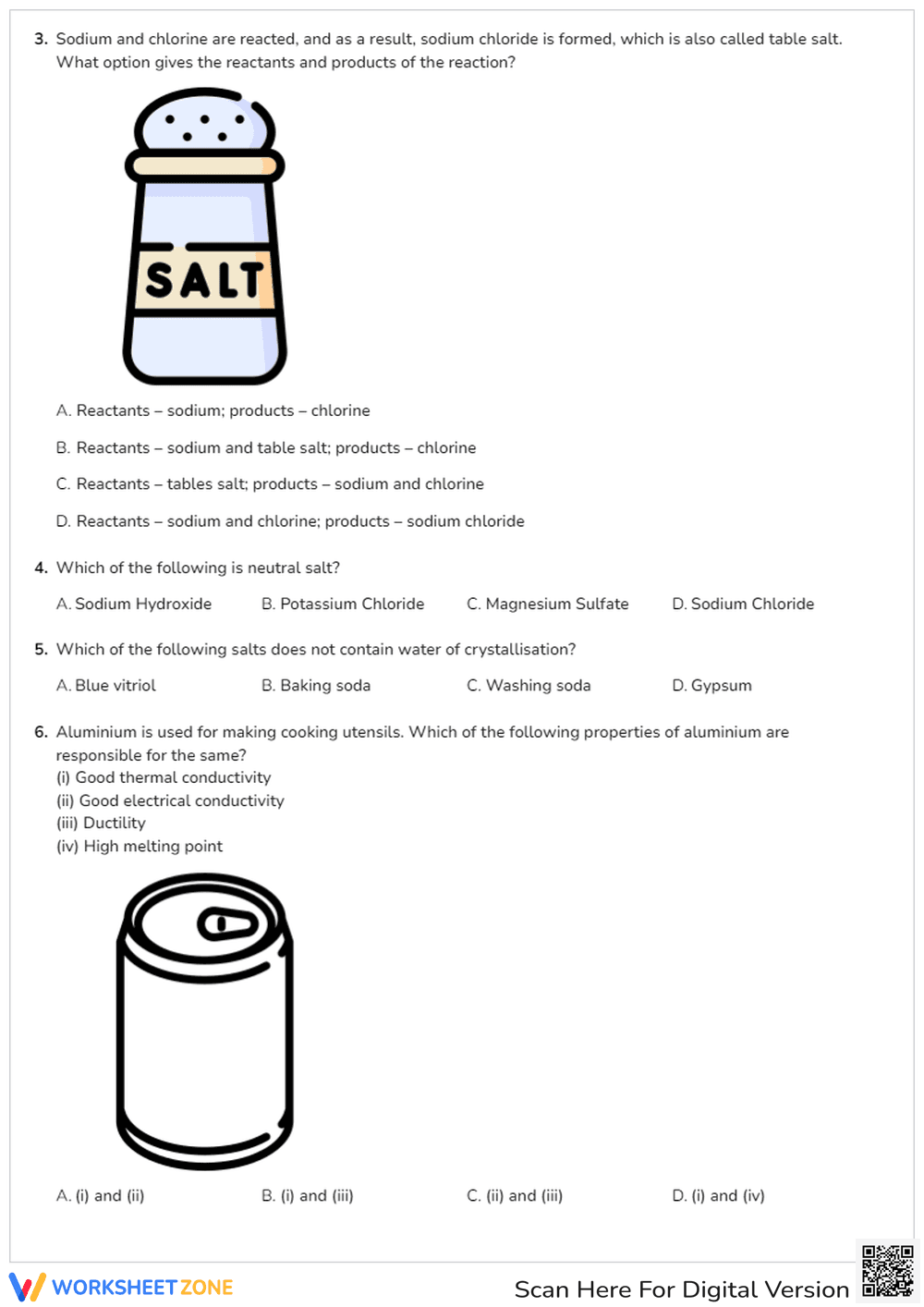
Inside this comprehensive 8-page PDF, you will find 24 multiple-choice questions accompanied by clear, illustrative diagrams. The quiz covers diverse topics including chemical reactions, the ozone layer, human anatomy (neurons), and genetics. Each question is formatted for clarity, ensuring that students can focus on the scientific content without being hindered by complex layouts.
The zero-prep workflow is designed for maximum efficiency in busy secondary classrooms. First, print the 8-page document (30 seconds). Second, distribute the quiz to students as a bell-ringer or formal assessment (1 minute). Finally, use the included answer key to review results or facilitate peer-grading (5 minutes). Total teacher preparation time is under 2 minutes, making it an ideal sub plan.
This resource is primarily aligned with HS-PS1-7, focusing on the conservation of mass in chemical reactions. It also supports HS-LS1-2 by requiring students to explain how hierarchical organization of interacting systems provides specific functions within multicellular organisms. Both standard codes can be copied directly into lesson plans, IEP goals, or district curriculum mapping tools.
Use this worksheet as a mid-term diagnostic tool to gauge retention across multiple scientific disciplines. It is particularly effective during the "Evaluate" phase of the 5E instructional model. Teachers should observe student responses to the diagram-based questions, such as the neuron structure or electrolytic refining, to assess visual literacy in science. Completion typically takes 35 minutes.
This quiz is ideal for Grade 10 students in general science or integrated chemistry and biology courses. It provides necessary scaffolds through visual aids for English Language Learners and students with IEPs. It pairs naturally with a comprehensive science study guide or an interactive notebook review session to reinforce core curriculum concepts.
Scientific literacy at the high school level requires the ability to synthesize information across various domains, from molecular chemistry to global ecology. This Grade 10 Science Quiz addresses this need by aligning with HS-PS1-7, which emphasizes the conservation of matter and energy. According to the RAND AIRS 2024 report, frequent low-stakes retrieval practice, such as multiple-choice quizzes, significantly improves long-term retention of complex scientific terminology and conceptual frameworks. By engaging with 24 diverse tasks, students reinforce their understanding of the law of conservation of mass and the functional organization of living systems. This resource provides the structured practice necessary for students to move from rote memorization to the application of scientific principles. Research from Fisher & Frey (2014) suggests that using visual representations alongside text-based questions helps bridge the gap for diverse learners, ensuring equitable access to rigorous science curriculum standards.


