


























Views
Plays
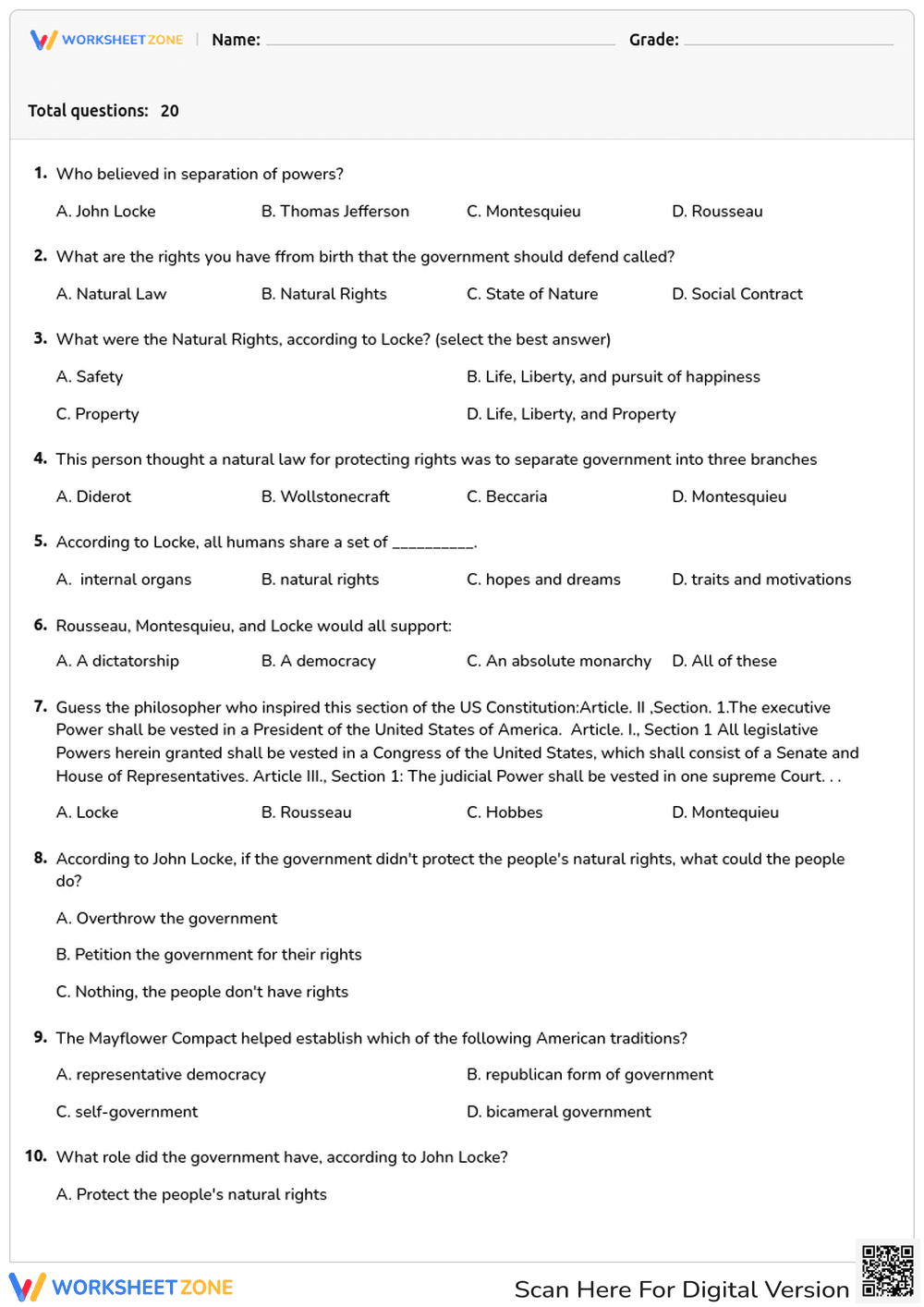



Civics & Government Review | Grade 8 Essential Worksheet
Paste this activity's link or code into your existing LMS (Google Classroom, Canvas, Teams, Schoology, Moodle, etc.).
Students can open and work on the activity right away, with no student login required.
You'll still be able to track student progress and results from your teacher account.
This comprehensive Civics & Government review worksheet empowers students to master the foundational principles of American democracy. By analyzing the influence of Enlightenment philosophers on the U.S. Constitution, learners gain a clear understanding of how concepts like natural rights and the separation of powers function within a modern governing framework.
At a Glance
- Grade: 8 · Subject: Civics & Government
- Standard:
CCSS.ELA-LITERACY.RH.6-8.2— Determine the central ideas or information of a primary or secondary source- Skill Focus: Enlightenment Influences
- Format: 3 pages · 20 problems · Answer key included · PDF
- Best For: Summative unit review and test preparation
- Time: 20–30 minutes
Inside this three-page PDF, you will find 20 carefully crafted multiple-choice questions. The assessment covers critical historical milestones, including the Magna Carta, the Mayflower Compact, and the English Bill of Rights. Each question is designed to challenge students to connect 18th-century philosophical movements to specific articles and sections of the United States Constitution, ensuring a deep grasp of the material.
Zero-Prep Workflow
- Print: Generate the three-page document for your entire class in seconds (30 seconds).
- Distribute: Hand out the 20-question quiz to your students for independent work (1 minute).
- Review: Go over the answers as a whole group to address common misconceptions and reinforce key terms (15 minutes).
Total teacher preparation time is under two minutes, making this an excellent option for emergency sub plans or last-minute review sessions.
Standards Alignment
This worksheet is primarily aligned with CCSS.ELA-LITERACY.RH.6-8.2, which requires students to determine the central ideas or information of a primary or secondary source and provide an accurate summary of the source distinct from prior knowledge or opinions. Both standard codes can be copied directly into lesson plans, IEP goals, or district curriculum mapping tools.
How to Use It
Use this worksheet as a summative assessment at the conclusion of a unit on the Foundations of Government. Alternatively, assign it as a collaborative review activity where students must justify their answers using their class notes. During the activity, observe if students can distinguish between Locke’s social contract and Montesquieu’s separation of powers. Completion typically takes 20–30 minutes.
Who It's For
This resource is ideal for general education middle school students in grades 6, 7, and 8. It provides necessary scaffolding for students who require clear, concise question stems. For an enriched experience, pair this worksheet with a primary source analysis of the Declaration of Independence or an anchor chart detailing the three branches of government.
This Civics & Government review resource is meticulously designed to support the mastery of CCSS.ELA-LITERACY.RH.6-8.2, focusing on the ability of students to determine central ideas from historical texts and philosophical influences. By examining the contributions of Enlightenment thinkers like John Locke and Baron de Montesquieu, students develop a robust understanding of the intellectual foundations of the United States Constitution. According to research by Fisher & Frey (2014) regarding disciplinary literacy, providing structured review materials that bridge historical context with modern governance principles is vital for long-term retention in social studies. This 20-question assessment serves as a high-quality tool for identifying student misconceptions regarding natural rights and the separation of powers before high-stakes testing. Educators can utilize this printable PDF to facilitate evidence-based discussions, ensuring that every learner can articulate how the social contract theory directly influenced the American tradition of self-government and individual liberty.


