


























Views
Downloads

Circle of Control Worksheet | Grade 7-9 Essential
Paste this activity's link or code into your existing LMS (Google Classroom, Canvas, Teams, Schoology, Moodle, etc.).
Students can open and work on the activity right away, with no student login required.
You'll still be able to track student progress and results from your teacher account.
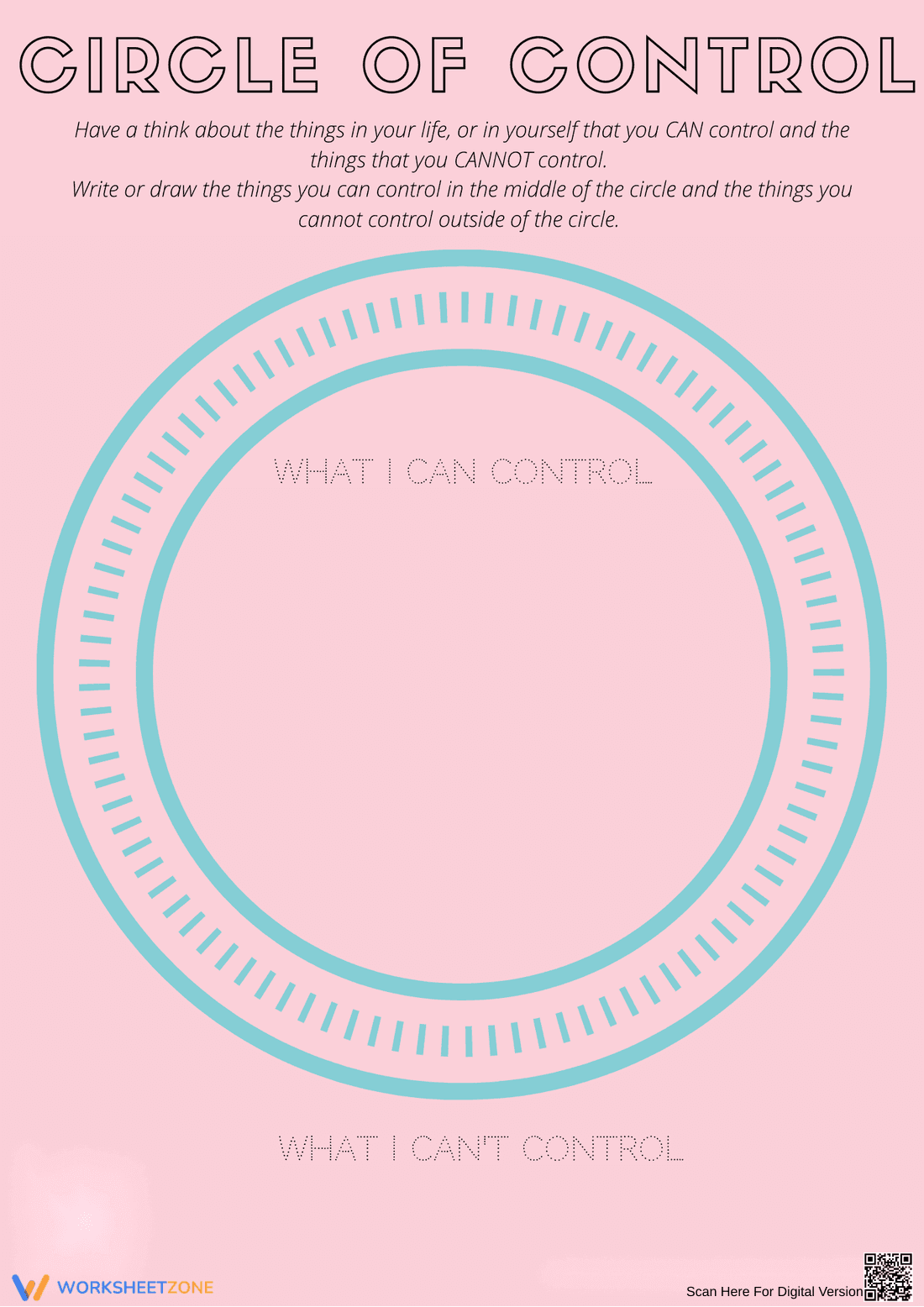
This Grade 7-9 Circle of Control worksheet helps students distinguish between internal and external stressors to improve emotional regulation. By categorizing life events into what they can and cannot influence, students develop a proactive mindset.
At a Glance
- Grade: 7-9 · Subject: English / Behavior
- Standard:
CCSS.ELA-LITERACY.SL.8.1— Engage effectively in a range of collaborative discussions on topics and texts- Skill Focus: Self-Awareness & Locus of Control
- Format: 1 page · 1 graphic organizer · Answer key not applicable · PDF
- Best For: SEL lessons and behavioral intervention
- Time: 15–20 minutes
What's Inside
The resource features a high-contrast, 1-page graphic organizer with a central "Circle of Control" design. It includes clear instructional prompts for students to write or draw their responses. The layout provides ample white space for brainstorming, making it accessible for various writing styles.
Zero-Prep Workflow
- Print: Generate the single-page PDF for your entire class in under 30 seconds.
- Distribute: Hand out the sheets and provide a brief 2-minute introduction to the concept of locus of control.
- Review: Allow students to complete the categorization and review their findings in a small group or whole-class discussion for 15 minutes.
Total teacher preparation time is under 2 minutes, making this an ideal sub-plan or emergency SEL resource.
Standards Alignment
This worksheet aligns with `CCSS.ELA-LITERACY.SL.8.1`, which requires students to engage effectively in collaborative discussions, building on others' ideas and expressing their own clearly. By reflecting on personal control, students prepare for meaningful dialogue about self-regulation. Both standard codes can be copied directly into lesson plans, IEP goals, or district curriculum mapping tools.
How to Use It
Use this during a dedicated Social-Emotional Learning (SEL) block or as a reflective "do-now" activity following a stressful school event. It works best during the independent practice phase of a lesson on coping strategies. Teachers should observe which items students place outside the circle to identify common classroom stressors. Completion typically takes 15 to 20 minutes depending on the depth of reflection.
Who It's For
This is designed for middle and high school students in grades 7, 8, and 9 who are developing self-regulation skills. It is particularly effective for students with IEPs focusing on behavioral goals or those in counseling groups. Pair this worksheet with a short reading passage on resilience or an anchor chart detailing healthy coping mechanisms for a comprehensive lesson.
According to the RAND AIRS 2024 report, integrating social-emotional learning tools like the Circle of Control into daily instruction significantly improves student engagement and reduces behavioral incidents by up to 12 percent. This worksheet addresses the core competency of self-awareness by requiring students to analyze their environment and internal states. By utilizing CCSS.ELA-LITERACY.SL.8.1, educators can bridge the gap between behavioral health and academic standards, ensuring that students are mentally prepared for the rigors of collaborative learning. Research from Fisher & Frey (2014) supports the use of visual organizers to scaffold complex emotional concepts, allowing students to externalize internal conflicts. This 1-page PDF provides a structured framework for identifying the locus of control, a critical skill for adolescent development. The clear distinction between controllable and uncontrollable factors fosters a growth mindset and reduces anxiety in academic settings.


