


























0
Views
0
Downloads

0.0
0
Save
0 Likes
Share
Utilizing the Circle of Control Worksheet
0 Views
0 Downloads
Paste this activity's link or code into your existing LMS (Google Classroom, Canvas, Teams, Schoology, Moodle, etc.).
Students can open and work on the activity right away, with no student login required.
You'll still be able to track student progress and results from your teacher account.
Information
Description
What It Is:
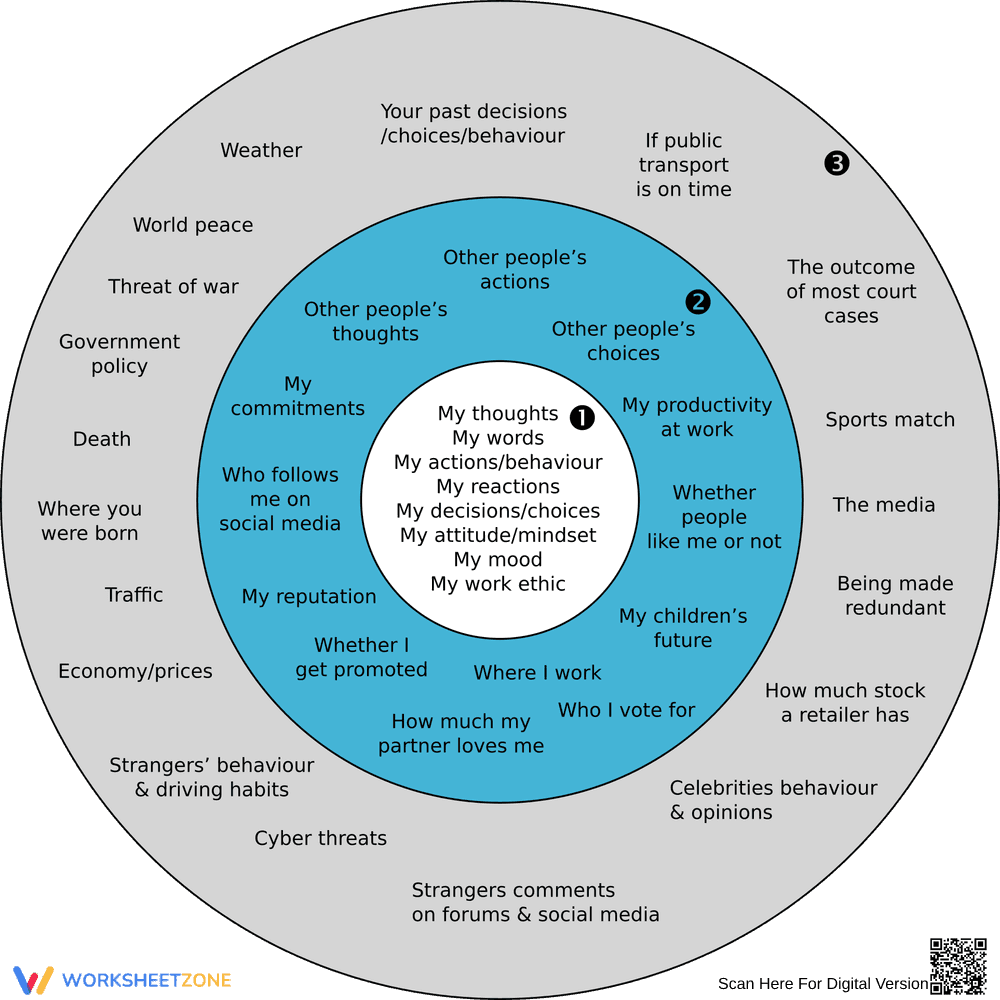
This is a worksheet presenting a circular diagram with three concentric circles. The innermost circle is labeled '1' and contains personal factors like 'My thoughts,' 'My words,' 'My actions/behavior,' 'My mood,' and 'My work ethic.' The middle circle, labeled '2,' expands to 'Other people's thoughts,' 'Other people's actions,' and 'Other people's choices,' with elements like 'My productivity at work' and 'Whether people like me or not.' The outermost circle, labeled '3,' includes broader external factors like 'Weather,' 'World peace,' 'Government policy,' 'Economy/prices,' 'Cyber threats,' 'Sports match,' and 'The outcome of most court cases.'
Grade Level Suitability:
This worksheet appears suitable for high school (Grades 9-12) and even introductory college-level courses. The concepts of internal versus external influences and personal responsibility require abstract thinking and social awareness typically developed in older adolescents and young adults.
Why Use It:
This worksheet can be used to help students understand the difference between internal and external influences on their lives. It promotes self-reflection and critical thinking about the factors that are within their control versus those that are not. It encourages students to consider the interconnectedness of personal actions, societal factors, and broader world events.
How to Use It:
Students can begin by identifying the personal factors in the innermost circle. They can then analyze the influences in the middle circle, considering how other people's actions and choices impact them. Finally, they can explore the external factors in the outermost circle and discuss how these influence their lives. The worksheet could be used for brainstorming, group discussions, or individual reflection exercises. Students could also add their own factors to each circle.
Target Users:
This worksheet is ideal for high school students, college students, and adults interested in self-improvement, social awareness, and understanding the complexities of personal and external influences. It is particularly useful for psychology, sociology, and personal development courses.
This is a worksheet presenting a circular diagram with three concentric circles. The innermost circle is labeled '1' and contains personal factors like 'My thoughts,' 'My words,' 'My actions/behavior,' 'My mood,' and 'My work ethic.' The middle circle, labeled '2,' expands to 'Other people's thoughts,' 'Other people's actions,' and 'Other people's choices,' with elements like 'My productivity at work' and 'Whether people like me or not.' The outermost circle, labeled '3,' includes broader external factors like 'Weather,' 'World peace,' 'Government policy,' 'Economy/prices,' 'Cyber threats,' 'Sports match,' and 'The outcome of most court cases.'
Grade Level Suitability:
This worksheet appears suitable for high school (Grades 9-12) and even introductory college-level courses. The concepts of internal versus external influences and personal responsibility require abstract thinking and social awareness typically developed in older adolescents and young adults.
Why Use It:
This worksheet can be used to help students understand the difference between internal and external influences on their lives. It promotes self-reflection and critical thinking about the factors that are within their control versus those that are not. It encourages students to consider the interconnectedness of personal actions, societal factors, and broader world events.
How to Use It:
Students can begin by identifying the personal factors in the innermost circle. They can then analyze the influences in the middle circle, considering how other people's actions and choices impact them. Finally, they can explore the external factors in the outermost circle and discuss how these influence their lives. The worksheet could be used for brainstorming, group discussions, or individual reflection exercises. Students could also add their own factors to each circle.
Target Users:
This worksheet is ideal for high school students, college students, and adults interested in self-improvement, social awareness, and understanding the complexities of personal and external influences. It is particularly useful for psychology, sociology, and personal development courses.


