


























Views
Downloads
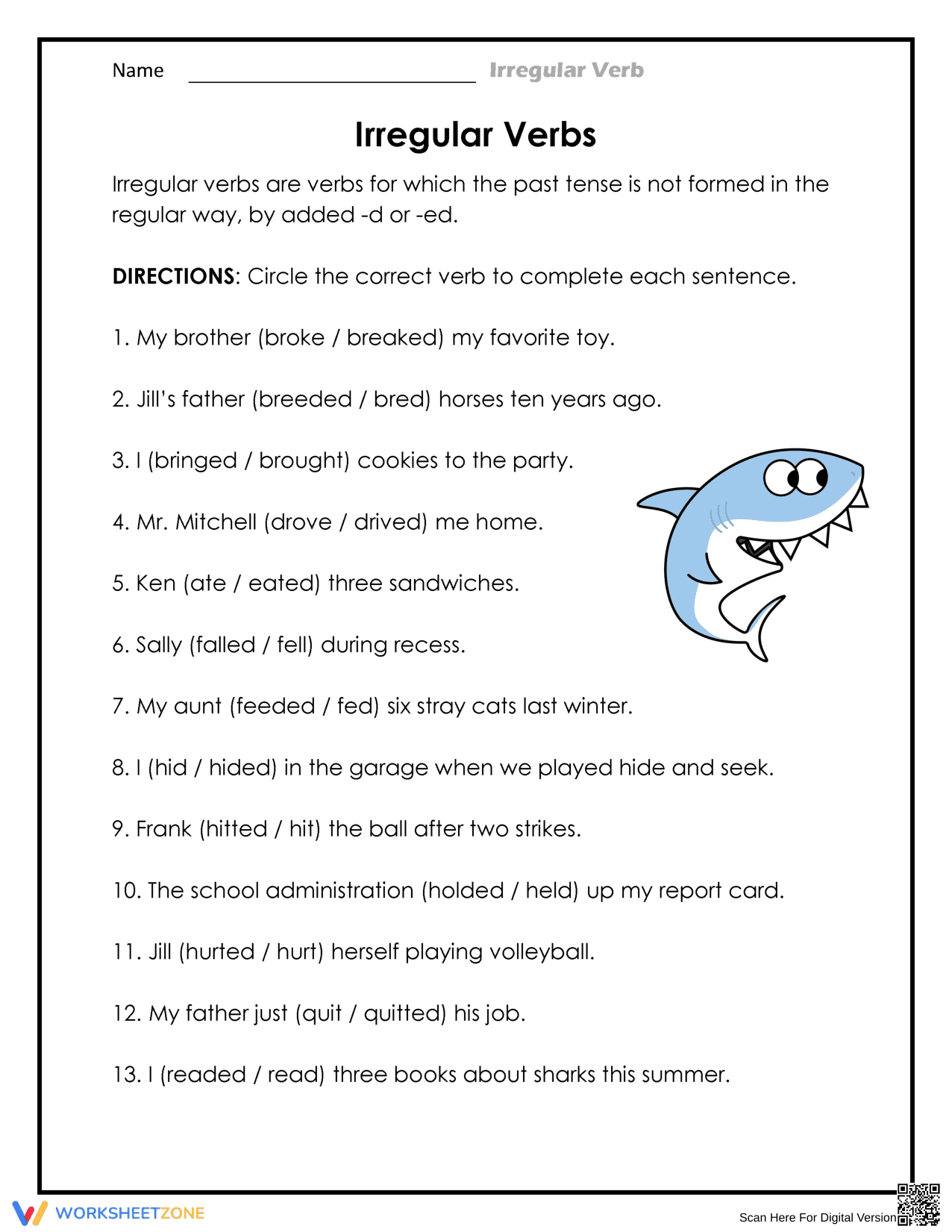

Essential Irregular Verbs Worksheet | Grade 3-5 ELA
Paste this activity's link or code into your existing LMS (Google Classroom, Canvas, Teams, Schoology, Moodle, etc.).
Students can open and work on the activity right away, with no student login required.
You'll still be able to track student progress and results from your teacher account.
Mastering irregular past tense verbs is a critical milestone for elementary writers. This worksheet provides focused practice to help students identify and use irregular verb forms correctly in context. By choosing between common errors and correct forms, students internalize the patterns of English grammar, improving both their reading comprehension and their narrative writing fluency.
At a Glance
- Grade: 3–5 · Subject: ELA Grammar
- Standard:
CCSS.ELA-LITERACY.L.3.1.D— Form and use regular and irregular verbs correctly in sentences- Skill Focus: Irregular Past Tense Verbs
- Format: 1 page · 13 problems · Answer key included · PDF
- Best For: Independent grammar practice or homework
- Time: 10–15 minutes
This resource features thirteen carefully crafted sentences where students must choose between a regularized (incorrect) verb and its true irregular past tense form. The layout is clean and includes a playful shark illustration to engage younger learners. Each task is a "Circle It!" challenge, providing a low-stakes but effective environment for reinforcing grammar rules. A comprehensive answer key is included for rapid grading.
Zero-Prep Workflow
The workflow for this resource is designed for maximum efficiency in busy classrooms. Step 1: Print the single-page PDF (30 seconds). Step 2: Distribute to students for independent work or as a quick bell-ringer activity (1 minute). Step 3: Review answers together using the included key or have students self-correct to promote metacognition (2 minutes). Total teacher preparation time is under two minutes, making it an excellent option for sub plans.
Standards Alignment
This worksheet is directly aligned to CCSS.ELA-LITERACY.L.3.1.D, which requires students to form and use regular and irregular verbs correctly. It also supports higher-grade mechanics review for Grade 4 and Grade 5 students who need reinforcement of inflectional endings. Both standard codes can be copied directly into lesson plans, IEP goals, or district curriculum mapping tools.
How to Use It
Use this worksheet as a formative assessment after a direct instruction lesson on past tense verbs to gauge immediate understanding. Alternatively, assign it as a no-prep activity to ensure students continue practicing core mechanics even during transition times. Observe students as they work to identify common misconceptions, such as the tendency to add "-ed" to irregular stems. Expect most students to complete the thirteen tasks within fifteen minutes.
Who It's For
This resource is ideal for Grade 3, 4, and 5 students who are refining their command of English conventions. It is particularly helpful for English Language Learners (ELL) who often struggle with the non-intuitive nature of irregular past tense forms. Pair this with a list of common irregular verbs or a classroom anchor chart for additional support during the independent practice phase of your lesson.
The mastery of irregular verb forms is a foundational component of linguistic development, as noted in the RAND AIRS 2024 report on elementary literacy benchmarks. Because these verbs do not follow the standard rule of adding a suffix, students require repeated, contextualized exposure to move from rote memorization to fluent application in writing. This worksheet utilizes a selective response format, which NAEP research suggests is an effective way to isolate specific mechanical skills without overwhelming the student's cognitive load. By focusing on thirteen high-frequency irregular verbs like "broke," "brought," and "read," the resource targets the most common inflectional errors found in student writing samples. Educators can use these results to drive data-informed instruction, ensuring that every learner meets the requirements of CCSS.ELA-LITERACY.L.3.1.D. This targeted approach supports the gradual release of responsibility model, providing the necessary scaffold for students to eventually produce error-free narratives independently in their own creative work.


