


























Views
Downloads

Cinderella Running Printable Coloring Page | Essential
Paste this activity's link or code into your existing LMS (Google Classroom, Canvas, Teams, Schoology, Moodle, etc.).
Students can open and work on the activity right away, with no student login required.
You'll still be able to track student progress and results from your teacher account.
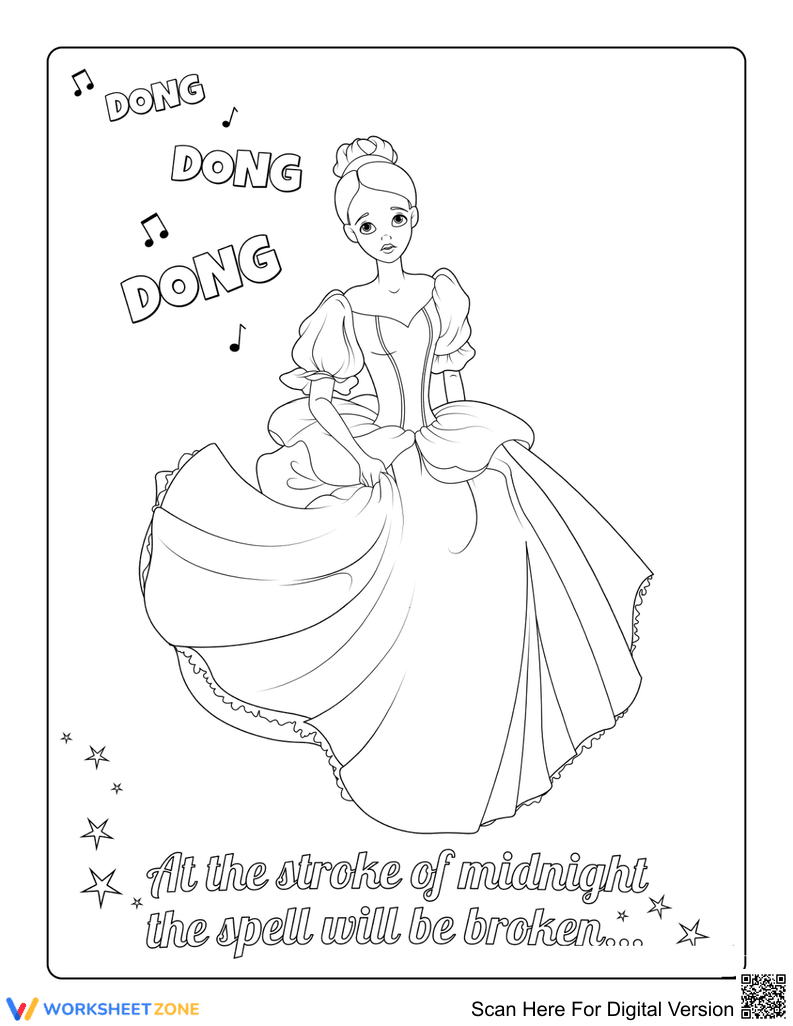
This Cinderella running coloring page provides early learners with a high-quality creative outlet to develop fine motor control while engaging with a classic literary character. By focusing on the iconic scene of Cinderella fleeing the ball, students connect visual imagery with narrative plot points, enhancing their comprehension of story sequences and character motivations in a low-stress, artistic format.
At a Glance
- Grade: Kindergarten · Subject: English
- Standard:
CCSS.ELA-LITERACY.RL.K.3— Identify characters, settings, and major events in a story with prompting- Skill Focus: Fine motor skills & character recognition
- Format: 1 page · 1 task · Answer key not applicable · PDF
- Best For: Morning work or story extension
- Time: 15–20 minutes
Inside this resource, you will find a single-page, high-resolution line art illustration of Cinderella in her ballgown. The clean lines are specifically designed for young children who are still mastering pencil grip and spatial awareness. The worksheet is formatted as a standard PDF, ensuring that the proportions remain consistent across all printer types without requiring any resizing or technical adjustments.
Zero-Prep Workflow
- Print: Generate the single-page PDF in under 30 seconds.
- Distribute: Hand out the sheets to students with crayons or colored pencils in about 1 minute.
- Review: Discuss the character's role in the story as students work to reinforce literacy goals.
Total teacher preparation time is under 2 minutes, making it an ideal choice for emergency sub plans or transition periods.
Standards Alignment
This worksheet aligns with `CCSS.ELA-LITERACY.RL.K.3`, which requires students to identify characters and major events in a story. By coloring Cinderella during a pivotal moment of her narrative, students reinforce their understanding of the setting and event components of the fairy tale. Both standard codes can be copied directly into lesson plans, IEP goals, or district curriculum mapping tools.
How to Use It
Use this worksheet during a Fairy Tale unit after a read-aloud of Cinderella. It serves as an excellent formative assessment tool; observe which students can identify the character and describe why she is running. It is also effective as a quiet-time activity for students who finish their primary literacy tasks early, providing a 15-20 minute window of focused engagement.
Who It's For
This resource is primarily for Kindergarten and Grade 1 students, though it is accessible to any learner working on hand-eye coordination. It is particularly helpful for English Language Learners (ELLs) who can use the visual as a bridge to vocabulary development. Pair this with a Cinderella picture book or a character trait anchor chart to deepen the instructional impact.
According to research by Fisher & Frey (2014) on the gradual release of responsibility, visual aids and creative tasks like coloring serve as essential scaffolds for early literacy. Engaging with character-based imagery allows students to internalize narrative structures before they are expected to produce complex written summaries. This worksheet supports CCSS.ELA-LITERACY.RL.K.3 by providing a concrete visual anchor for the abstract concept of character identification. Studies in the RAND AIRS 2024 report suggest that integrating fine motor activities with core content areas improves student retention and engagement in early childhood settings. By providing 1 focused task on a single page, this resource minimizes cognitive load while maximizing the opportunity for students to demonstrate their understanding of a major story event through artistic expression. This approach is consistent with best practices for foundational literacy development in the United States.


