


























Views
Downloads

Cinderella Plot Diagram Worksheet | Grade 6-9 Essential
Paste this activity's link or code into your existing LMS (Google Classroom, Canvas, Teams, Schoology, Moodle, etc.).
Students can open and work on the activity right away, with no student login required.
You'll still be able to track student progress and results from your teacher account.
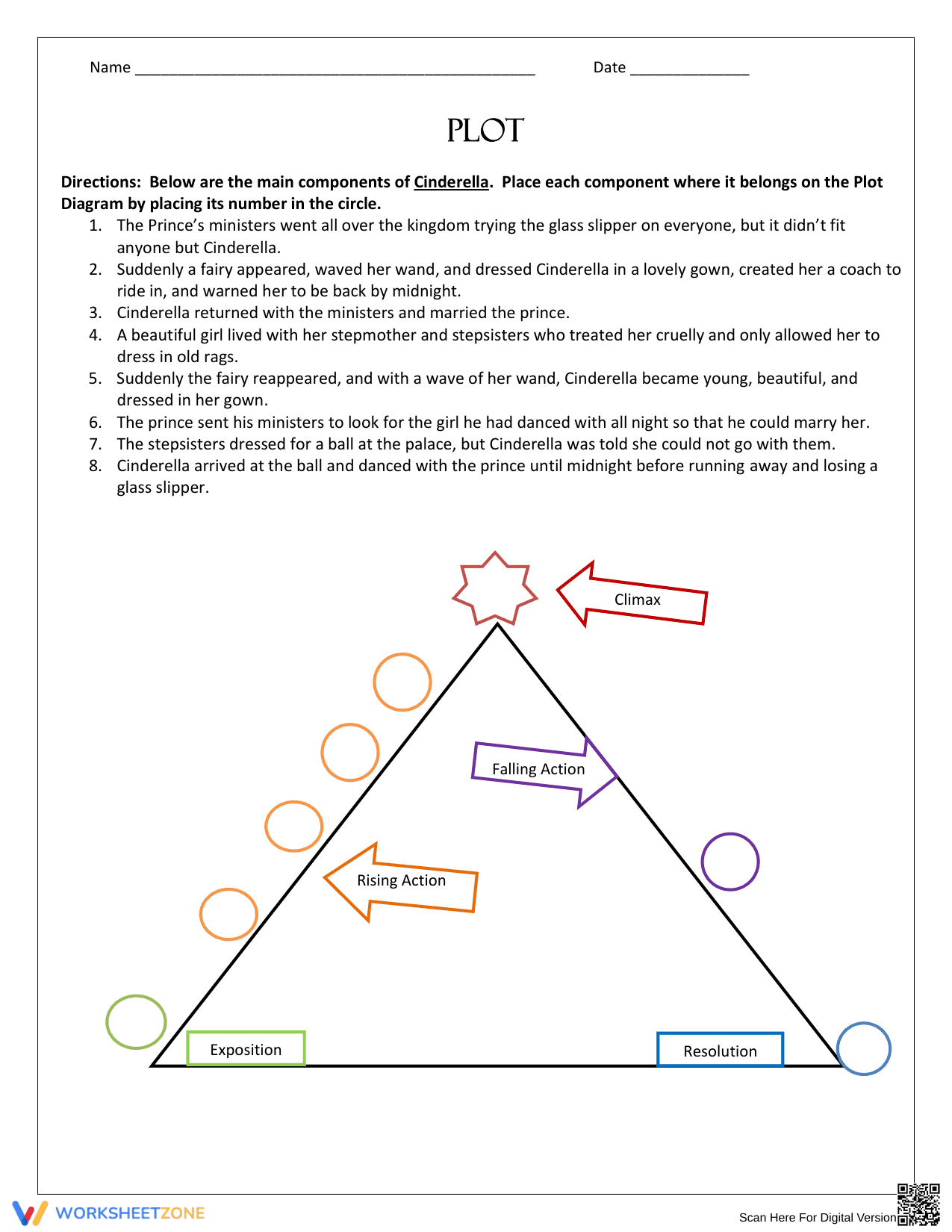
This Cinderella Plot Diagram worksheet helps students master story structure by identifying and sequencing key narrative events. Students analyze eight specific plot components from the classic fairy tale and map them onto a visual diagram. This activity reinforces the understanding of exposition, rising action, climax, falling action, and resolution in a literary text.
At a Glance
- Grade: 6–9 · Subject: ELA
- Standard:
CCSS.ELA-LITERACY.RL.6.3— Describe how a story plot unfolds and how characters respond as it moves- Skill Focus: Story Structure & Plot Elements
- Format: 1 page · 8 problems · Answer key included · PDF
- Best For: Literacy centers and quick formative checks
- Time: 15–20 minutes
This single-page PDF features a clear, geometric plot diagram with designated spaces for each narrative stage. Above the diagram, students are provided with eight scrambled plot points from Cinderella, such as the fairy godmother's arrival and the prince's search for the slipper. The layout is designed for immediate comprehension, including a full answer key for efficient grading.
Zero-Prep Workflow
- Print: Select the page and print copies for your class.
- Distribute: Hand out the worksheets during your story structure unit.
- Review: Use the answer key for quick grading or a whole-class review. This resource is perfect for substitute plans or bell-ringer activities.
Standards Alignment — Primary standard CCSS.ELA-LITERACY.RL.6.3 requires students to describe how a particular story's or drama's plot unfolds in a series of episodes. By physically mapping the sequence of Cinderella, students visualize the relationship between rising action and the ultimate climax. This standard code can be copied directly into lesson plans, IEP goals, or district curriculum mapping tools.
How to Use It
Use this as a formative assessment after reading a version of Cinderella to check for comprehension of narrative arcs. It works exceptionally well in small groups where students can debate which event constitutes the true climax versus the rising action. Teachers should observe if students can differentiate between the resolution and the falling action events.
Who It's For
This resource is designed for middle school students in Grades 6-9 who need a structured approach to analyzing literature. It provides excellent scaffolding for English Language Learners (ELLs) by using a familiar story to teach complex literary terms. Pair this with a character analysis chart or a short story passage for a complete ELA lesson.
Analyzing story structure through visual organizers like plot diagrams is a high-leverage instructional practice. This worksheet aligns with CCSS.ELA-LITERACY.RL.6.3, focusing on how students describe narrative progression. Research from RAND AIRS 2024 indicates that graphic organizers significantly improve reading comprehension for middle school students by providing a mental framework for text analysis. By identifying the exposition, rising action, climax, and resolution of Cinderella, students develop skills for advanced literary criticism. This resource provides 8 targeted tasks for precise skill measurement. The familiar narrative reduces cognitive load, letting students focus on the mechanics of plot construction. Educators can utilize this printable PDF as a reliable tool for independent practice and test preparation, ensuring students meet grade-level expectations for literary analysis and structural understanding.


