


























Views
Downloads
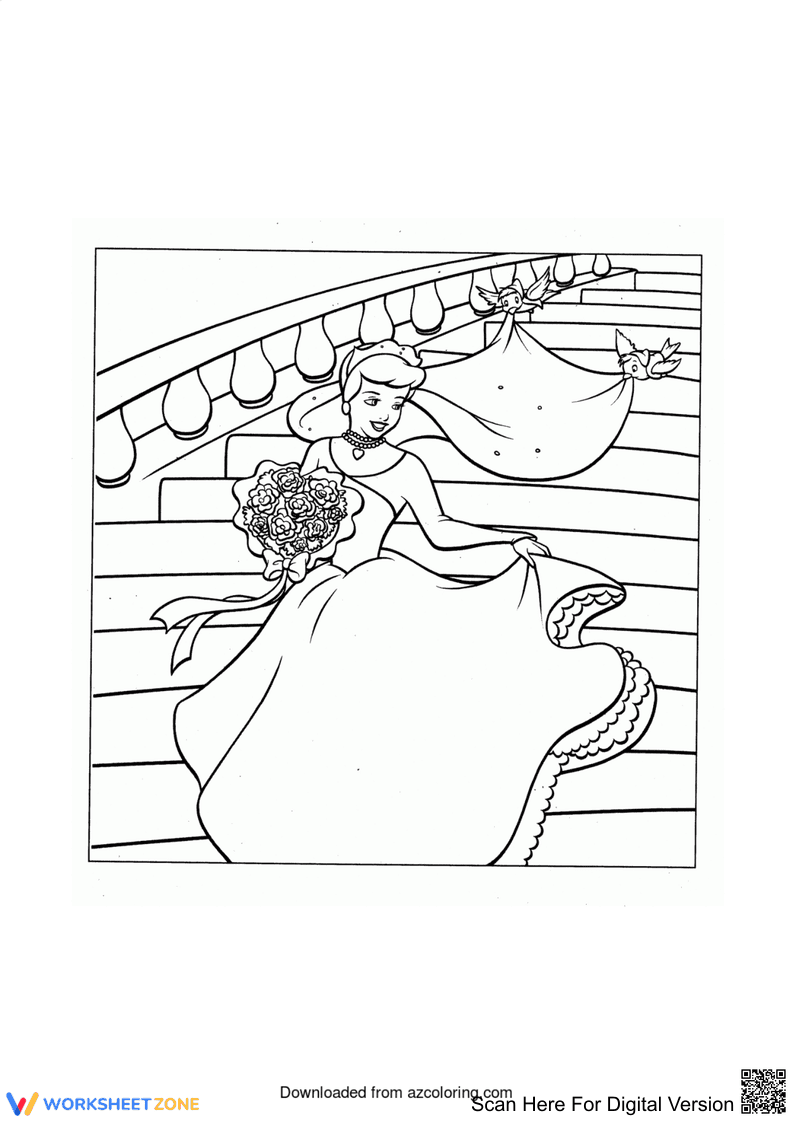

Cinderella Coloring Page | Printable PreK-1 Worksheet
Paste this activity's link or code into your existing LMS (Google Classroom, Canvas, Teams, Schoology, Moodle, etc.).
Students can open and work on the activity right away, with no student login required.
You'll still be able to track student progress and results from your teacher account.
This printable Cinderella coloring page provides young learners with an engaging way to develop fine motor control while connecting to classic literature. Students practice grip and coordination as they color a detailed illustration of Cinderella in her wedding dress, reinforcing story comprehension through visual art.
At a Glance
- Grade: Kindergarten · Subject: English
- Standard:
CCSS.ELA-LITERACY.RL.K.7— Connect illustrations to the story- Skill Focus: Fine motor skills and story recall
- Format: 1 page · 1 task · No answer key · PDF
- Best For: Independent practice and storytime extension
- Time: 15–20 minutes
This single-page resource features a high-quality, black-and-white illustration of Cinderella walking down a staircase in her wedding dress, accompanied by helpful birds carrying her veil. The bold outlines provide clear boundaries for early learners practicing crayon or marker control. Because this is an open-ended creative task, no answer key is required, allowing students to use their imagination to complete the scene.
This worksheet is designed for immediate classroom use with zero teacher preparation.
- Print (1 minute): Simply download the PDF and print the desired number of copies. The high-contrast lines ensure clean reproduction on standard school printers.
- Distribute (1 minute): Hand out the pages along with crayons, colored pencils, or markers. No complex instructions are needed.
- Review (0 minutes): As an independent creative activity, there is no formal grading required. Teachers can simply display the finished artwork.
Total prep time is under two minutes, making this an excellent emergency sub plan or quick transition activity.
This activity aligns with CCSS.ELA-LITERACY.RL.K.7: With prompting and support, describe the relationship between illustrations and the story in which they appear. By engaging with the visual representation of the story's conclusion, students reinforce their understanding of narrative structure and character outcomes. Both standard codes can be copied directly into lesson plans, IEP goals, or district curriculum mapping tools.
Teachers can utilize this coloring page as a calming transition activity after reading a version of the Cinderella fairy tale aloud. While students color, educators can walk around the room and ask formative assessment questions, such as asking the child to describe what is happening in the picture or how the character feels. It also serves as an excellent morning work assignment, taking 15 to 20 minutes to complete while the teacher handles attendance.
This resource is primarily designed for preschool, kindergarten, and first-grade students who are developing their fine motor skills and pencil grip. It naturally accommodates varying ability levels, as students can choose to color simply or add their own detailed background elements. This page pairs perfectly with a fairy tale unit, serving as a companion to read-aloud sessions or a visual anchor chart about story endings.
Integrating visual arts with early literacy instruction provides significant benefits for young learners. When students engage with materials aligned to CCSS.ELA-LITERACY.RL.K.7, they practice how to connect illustrations to the story, which builds foundational reading comprehension. According to EdReports 2024, incorporating fine motor activities into literacy blocks solidifies cognitive connections between visual processing and narrative recall. The physical act of coloring strengthens the hand muscles required for early handwriting, while the thematic content keeps students focused on the academic topic. This dual-purpose approach ensures that even transition times or independent centers contribute meaningfully to a child's developmental milestones. By providing structured yet creative tasks, educators can foster both artistic expression and literary engagement in the early childhood classroom, supporting holistic student growth.


