


























Views
Plays



Industrial Revolution Quiz | Grade 9-12 Essential
Paste this activity's link or code into your existing LMS (Google Classroom, Canvas, Teams, Schoology, Moodle, etc.).
Students can open and work on the activity right away, with no student login required.
You'll still be able to track student progress and results from your teacher account.
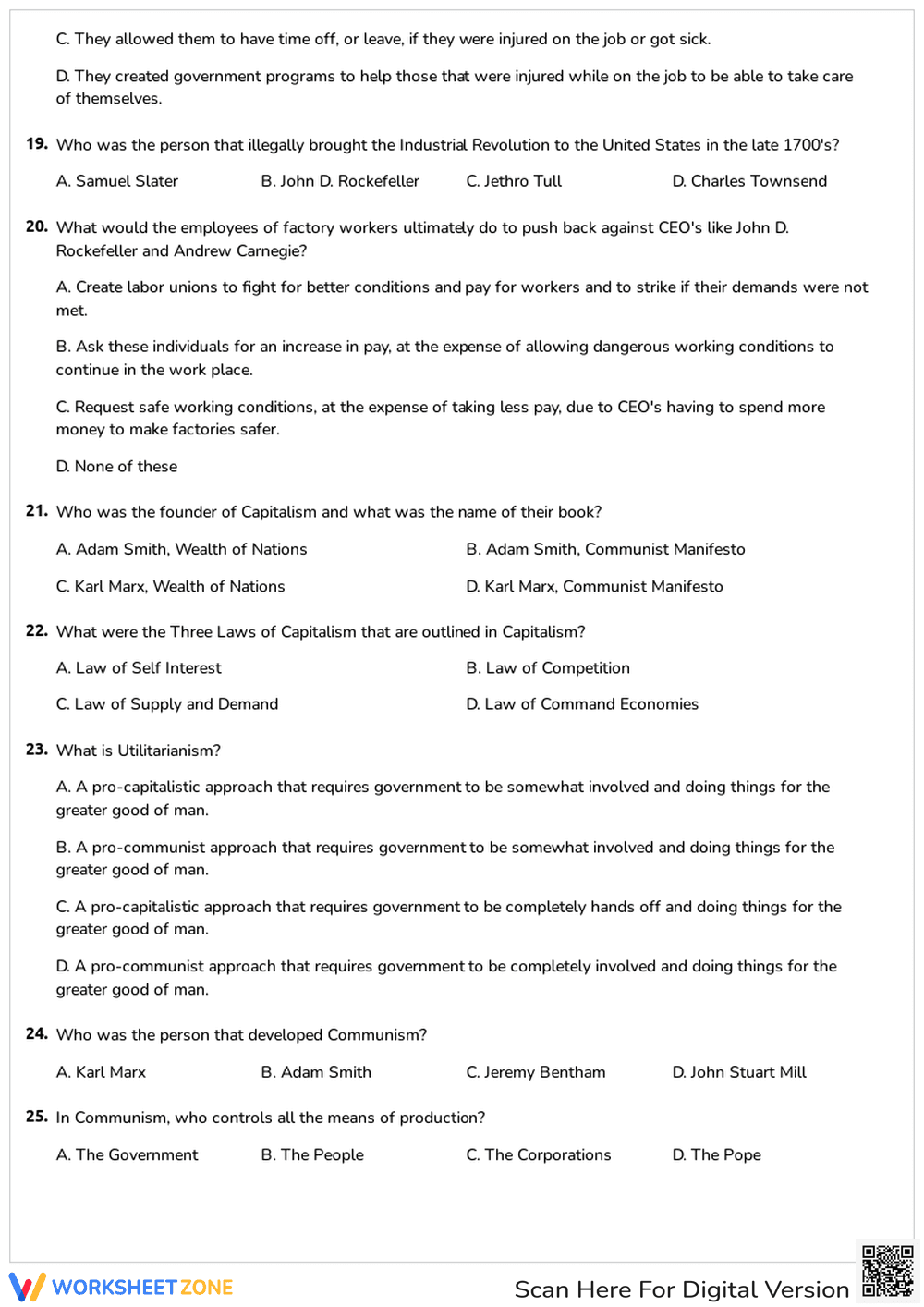
This Industrial Revolution assessment provides a comprehensive evaluation of student understanding regarding the shift from agrarian societies to industrial powerhouses. Students will demonstrate mastery of key economic theories, social changes, and technological advancements that defined the 18th and 19th centuries. By identifying core concepts like urbanization and capitalism, learners solidify their grasp of modern historical foundations.
At a Glance
- Grade: 9-12 · Subject: Social Studies
- Standard:
CCSS.ELA-LITERACY.RH.9-10.4— Determine the meaning of economic and historical vocabulary in context.- Skill Focus: Industrialization and Economic Theory
- Format: 3 pages · 25 problems · Answer key included · PDF
- Best For: Summative unit assessment or formal review
- Time: 20–30 minutes
What's Inside
This three-page printable resource features 25 high-quality assessment items. The task mix includes 21 multiple-choice questions and 4 true-false statements designed to probe both vocabulary recall and conceptual synthesis. Key topics covered include the transition from the domestic system to the factory system, the rise of corporations, and the ideological divide between Adam Smith’s capitalism and Karl Marx’s communism.
Zero-Prep Workflow
- Print: Generate the three-page PDF for your class size in under one minute.
- Distribute: Hand out the worksheets as a quiet individual assessment or a collaborative review activity.
- Review: Use the included answer data to facilitate a rapid whole-class review or to input scores directly into your gradebook.
Total teacher prep time is under two minutes, making this an ideal resource for busy educators or emergency sub plans.
Standards Alignment
This worksheet is primarily aligned with CCSS.ELA-LITERACY.RH.9-10.4: "Determine the meaning of symbols, key terms, and other domain-specific words and phrases as they are used in a specific scientific or technical context relevant to grades 9-10 texts and topics." It also supports historical analysis by requiring students to identify the causes and effects of industrialization in England and the United States. Both standard codes can be copied directly into lesson plans, IEP goals, or district curriculum mapping tools.
How to Use It
Use this worksheet as a summative quiz after completing a unit on the Age of Industry. It is particularly effective when assigned during the independent practice phase of a lesson to gauge individual student mastery. For a formative approach, have students complete the quiz in pairs and then use a "think-pair-share" strategy to discuss the dangerous working conditions and the rise of labor unions. Completion typically ranges from 20 to 30 minutes.
Who It's For
This resource is tailored for High School World History or Economics students. It provides necessary scaffolding for general education learners while offering the depth required for honors-level discussions on utilitarianism and market laws. It pairs naturally with primary source readings from "The Wealth of Nations" or "The Communist Manifesto" to provide a balanced view of economic history.
According to research by Fisher & Frey (2014) on disciplinary literacy, the acquisition of specialized domain vocabulary is a critical predictor of success in high school social studies. This worksheet directly addresses this need by requiring students to differentiate between complex economic systems and historical labor structures using the CCSS.ELA-LITERACY.RH.9-10.4 framework. By engaging with 25 targeted questions, students move beyond rote memorization toward a functional understanding of how the Industrial Revolution reshaped global society. This structured approach to assessment allows educators to identify specific gaps in student knowledge regarding the transition from domestic manufacturing to mass production, facilitating data-driven instructional adjustments in real-time. By focusing on the interplay between technological innovation and social reform, the resource ensures that learners develop the analytical skills necessary for advanced historical inquiry and standardized testing success in the social sciences.


