


























Views
Downloads
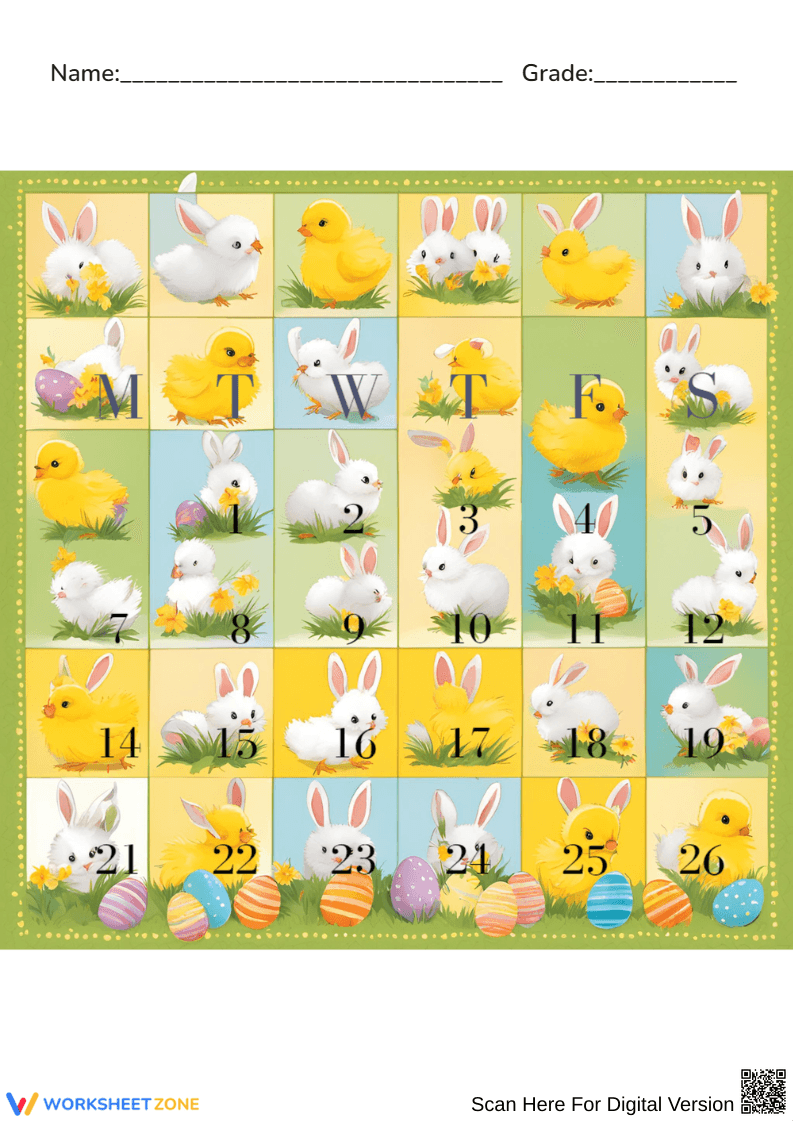

Printable Easter Counting Calendar | Grade K Math
Paste this activity's link or code into your existing LMS (Google Classroom, Canvas, Teams, Schoology, Moodle, etc.).
Students can open and work on the activity right away, with no student login required.
You'll still be able to track student progress and results from your teacher account.
This engaging Easter-themed countdown calendar helps early learners practice number recognition and sequential counting up to twenty-six. Featuring cheerful spring imagery like baby chicks and bunnies, this visual tool provides a fun, seasonal context for students to build foundational math skills while anticipating the upcoming holiday.
At a Glance
- Grade: Kindergarten · Subject: Math
- Standard:
CCSS.MATH.CONTENT.K.CC.A.1— Count sequentially to recognize numbers- Skill Focus: Number recognition and counting
- Format: 1 page · 26 tasks · No answer key · PDF
- Best For: Morning work or calendar time
- Time: 5–10 minutes
Inside this single-page resource, teachers will find a beautifully illustrated grid featuring twenty-six numbered squares alongside days of the week. Each square contains a distinct spring-themed illustration paired with a clear numeral. The layout mimics a traditional calendar, making it an excellent visual aid for introducing basic calendar concepts. No answer key is required, as the resource functions primarily as a visual counting guide.
This resource is designed for immediate classroom implementation with a streamlined zero-prep workflow:
- Print (1 minute): Download the PDF and print in full color.
- Distribute (1 minute): Display a single enlarged copy on your interactive whiteboard or bulletin board.
- Review (3 minutes): Guide the class in counting the days together.
With a total teacher prep time of under two minutes, this calendar is an ideal, stress-free addition to your spring lesson plans or a reliable backup for a sub plan.
This counting activity is aligned to CCSS.MATH.CONTENT.K.CC.A.1, which requires students to count to 100 by ones and by tens. By focusing on numbers one through twenty-six, this calendar provides targeted practice for early sequential counting. Both standard codes can be copied directly into lesson plans, IEP goals, or district curriculum mapping tools.
This versatile calendar serves as an excellent anchor for daily morning meetings. Teachers can have students cross off one square each day, reinforcing one-to-one correspondence before direct instruction begins. Alternatively, place it in a math center where students use small manipulatives to cover specific numbers. As a formative assessment tip, observe whether students can independently identify the number that comes next without recounting from one. Expected completion time is 5 to 10 minutes.
This resource is designed for Kindergarten students developing foundational counting skills, though it is appropriate for preschool learners needing a seasonal review. To differentiate, ask advanced students to identify odd and even numbers. This calendar pairs perfectly with a direct instruction lesson on the days of the week.
Integrating seasonal visual aids into early childhood mathematics instruction significantly enhances student engagement and retention of foundational concepts. According to a comprehensive review by EdReports 2024, utilizing thematic materials like this calendar supports the development of essential numeracy skills by providing a meaningful context for abstract concepts. When students interact with the CCSS.MATH.CONTENT.K.CC.A.1 standard—specifically the ability to count sequentially to recognize numbers—within a familiar and visually stimulating framework, their cognitive load is reduced. This allows early learners to focus more effectively on numeral identification. Regular, brief interactions with counting tools during daily routines, such as morning meetings, have been shown to solidify one-to-one correspondence and build mathematical confidence. By incorporating this structured countdown, educators blend seasonal excitement with rigorous academic practice.


