


























Views
Plays




Hormone Chemistry Worksheet | Grade 11-12 Essential Science
Paste this activity's link or code into your existing LMS (Google Classroom, Canvas, Teams, Schoology, Moodle, etc.).
Students can open and work on the activity right away, with no student login required.
You'll still be able to track student progress and results from your teacher account.
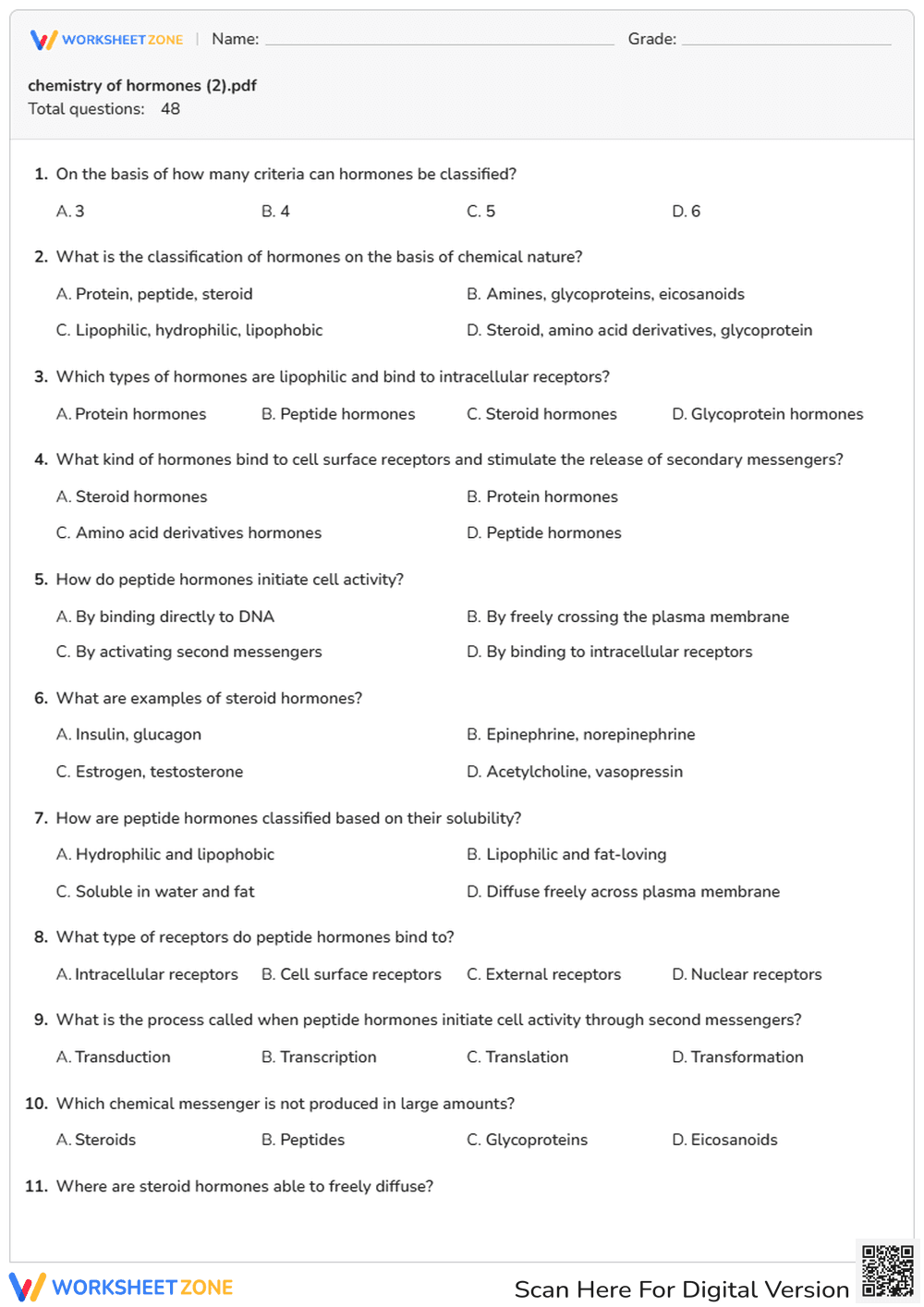
Master the complex biochemical pathways of the endocrine system with this comprehensive assessment tool. This worksheet focuses on the structural and functional differences between various hormone classes, ensuring students can predict physiological responses based on chemical nature. By the end of these exercises, learners will demonstrate a sophisticated understanding of how molecular structure dictates cellular interaction.
At a Glance
- Grade: 11-12 · Subject: Biology / Chemistry
- Standard:
HS-LS1-2— Illustrate how interacting systems provide specific functions within multicellular organisms- Skill Focus: Endocrine signaling and molecular classification
- Format: 6 pages · 48 problems · Answer key included · PDF
- Best For: Unit review or formative assessment
- Time: 45–60 minutes
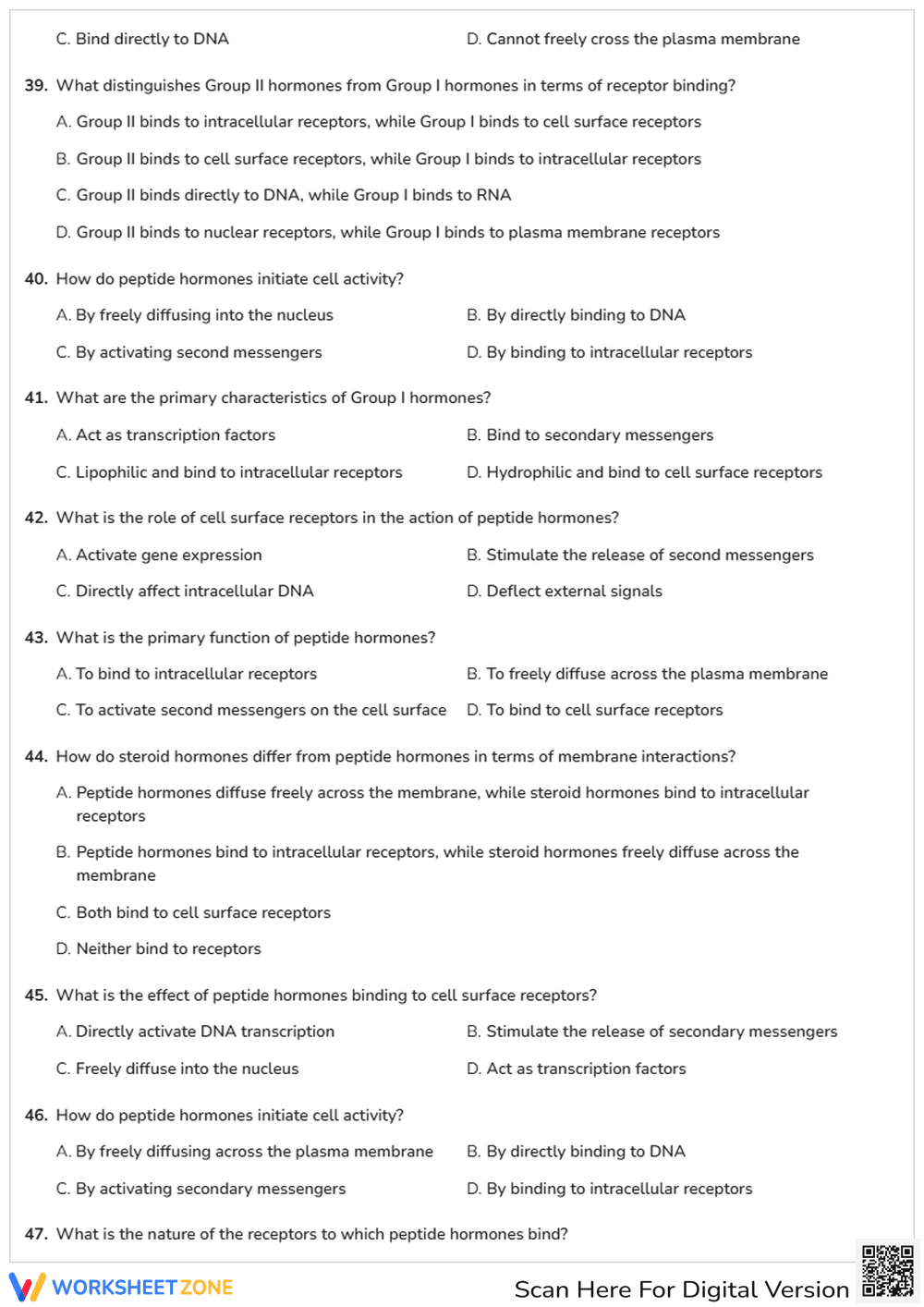
What’s Inside: This extensive 6-page PDF contains 48 carefully crafted multiple-choice questions. The content spans the full spectrum of endocrinology, including solubility profiles (lipophilic vs. hydrophilic), receptor locations (intracellular vs. cell surface), and the specific roles of second messengers like cAMP. The structured format allows for a thorough exploration of the nuances of Group I and Group II hormone classifications without requiring additional teacher preparation.
Skill Progression
- Guided Practice: The initial 15 questions establish foundational knowledge, asking students to identify basic chemical categories and examples of steroid versus peptide hormones.
- Supported Practice: Questions 16 through 35 require students to apply their knowledge to signaling pathways, specifically focusing on the transduction of external signals via internal intermediaries.
- Independent Practice: The final 13 questions challenge students to differentiate between complex mechanisms of action, such as the specific binding behaviors of glycoproteins and eicosanoids.
This sequence follows a gradual-release model, moving from simple identification to the analysis of complex biological interactions.
Standards Alignment
This resource is aligned to `HS-LS1-2`, which requires students to develop and use models to illustrate the hierarchical organization of interacting systems. By analyzing how hormones act as messengers between distant organs, students fulfill the requirements for understanding system integration. Both standard codes can be copied directly into lesson plans, IEP goals, or district curriculum mapping tools.
How to Use It
This worksheet is ideal for use during the middle of a human physiology unit. Assign it as a mid-unit check for understanding after direct instruction on the endocrine system. For a formative assessment observation, monitor student progress on questions regarding second messengers; difficulty here often indicates a need to review cell membrane permeability. Expected completion time ranges from 45 to 60 minutes depending on student prior knowledge.
Who It's For
This material is designed for high school juniors and seniors enrolled in AP Biology, Anatomy and Physiology, or advanced Chemistry courses. It provides necessary rigor for college-bound students while offering clear, structured questions that support diverse learners. It pairs naturally with a molecular model kit or a diagram of the fluid mosaic model of the cell membrane.
According to research from Fisher & Frey (2014), the use of structured multiple-choice assessments in high school science helps solidify the academic vocabulary necessary for mastery of complex systems. This worksheet addresses the `HS-LS1-2` standard by requiring students to categorize hormones based on their chemical nature and signaling mechanisms. By evaluating 48 distinct scenarios, students build the cognitive stamina required for high-stakes testing while reinforcing the plain-English skill of explaining how chemical messengers regulate homeostasis. The inclusion of specific distractors targeting common misconceptions about lipid solubility ensures that the data gathered from this quiz is both valid and reliable for instructional planning.


