


























Views
Plays


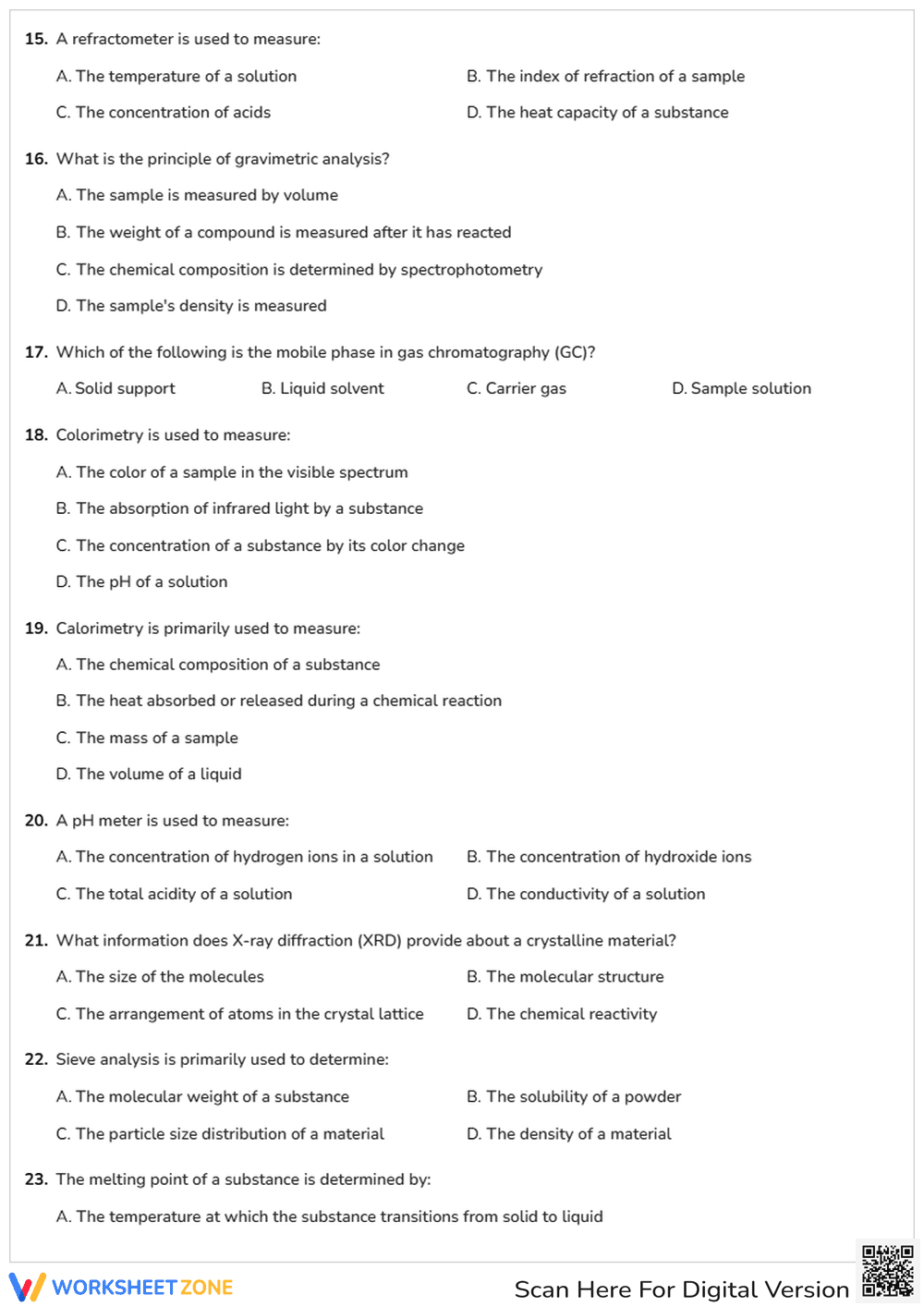


Essential Lab Techniques Quiz | College No-Prep Worksheet
Paste this activity's link or code into your existing LMS (Google Classroom, Canvas, Teams, Schoology, Moodle, etc.).
Students can open and work on the activity right away, with no student login required.
You'll still be able to track student progress and results from your teacher account.
This comprehensive 114-question assessment provides a rigorous review of essential chemical laboratory techniques and analytical instrumentation. Designed for college-level chemistry students, it ensures mastery of complex methodologies ranging from spectroscopy to chromatography. Students will demonstrate their ability to identify appropriate tools and interpret experimental parameters for precise chemical analysis.
At a Glance
- Grade: College · Subject: Chemistry
- Standard:
HS-PS1-3— Plan and conduct an investigation to gather evidence to compare bulk properties.- Skill Focus: Analytical Instrumentation
- Format: 16 pages · 114 problems · Answer key included · PDF
- Best For: Comprehensive exam review and sub plans
- Time: 90–120 minutes
This massive 16-page PDF contains 114 high-quality multiple-choice questions. The content spans the entire spectrum of modern analytical chemistry, including Infrared (IR) spectroscopy, High-Performance Liquid Chromatography (HPLC), UV-Vis, and Karl Fischer titration. It also covers fundamental laboratory equipment like centrifuges, furnaces, and viscometers, alongside advanced topics like NMR and LC-MS. A complete answer key is provided for rapid grading.
Zero-Prep Workflow
- Print (1 minute): Select the specific pages or the entire 16-page set to create a robust exam booklet for your students.
- Distribute (1 minute): Hand out the clear, numbered question sheets to students for independent work or collaborative group study.
- Review (10 minutes): Use the included answer key to facilitate a whole-class review or provide immediate feedback on student performance.
This resource is an ideal emergency sub plan for advanced science courses, requiring zero teacher setup beyond basic printing.
Standards Alignment
The primary alignment is to HS-PS1-3, which requires students to plan and conduct investigations to gather evidence to compare the structure of substances and their bulk properties. While designed for college-level Chemical Laboratory Clinics, it directly supports advanced placement and undergraduate laboratory competencies. Both standard codes can be copied directly into lesson plans, IEP goals, or district curriculum mapping tools.
How to Use It
Assign this worksheet as a summative assessment at the end of an analytical chemistry unit to gauge student retention of instrumentation principles. Alternatively, use it as a structured study guide where students work in pairs to research the answers to unfamiliar techniques. During the session, observe which instrumentation categories cause the most hesitation to inform future direct instruction. The expected completion time is between 90 and 120 minutes.
Who It's For
This resource is tailored for undergraduate chemistry majors, pharmacy students, and advanced high school learners in AP or IB programs. It serves as an excellent companion to laboratory manuals or textbook chapters on instrumental analysis. Pair this with a hands-on lab rotation to bridge the gap between theoretical knowledge and practical application.
This 114-question assessment aligns with the rigorous demands of modern science education by focusing on the technical literacy required for laboratory success. According to Fisher & Frey (2014), the use of comprehensive question banks supports the gradual release of responsibility by allowing students to test their knowledge across a wide breadth of content before moving into independent research. The inclusion of specific instrumentation parameters, such as HPLC retention factors and spectroscopic absorbance, mirrors the complexity found in professional clinical environments. By engaging with these 114 tasks, students build the cognitive endurance necessary for high-stakes professional certification exams. Research from EdReports (2024) emphasizes that high-quality, standards-aligned materials are critical for ensuring that all students have access to grade-level rigor. This worksheet provides that rigor through its extensive coverage of HS-PS1-3 and related analytical competencies, making it a vital tool for any advanced chemistry curriculum.


