




























Views
Downloads

Catch a Ray of Sunlight: Essential Reflection Worksheet

Paste this activity's link or code into your existing LMS (Google Classroom, Canvas, Teams, Schoology, Moodle, etc.).
Students can open and work on the activity right away, with no student login required.
You'll still be able to track student progress and results from your teacher account.
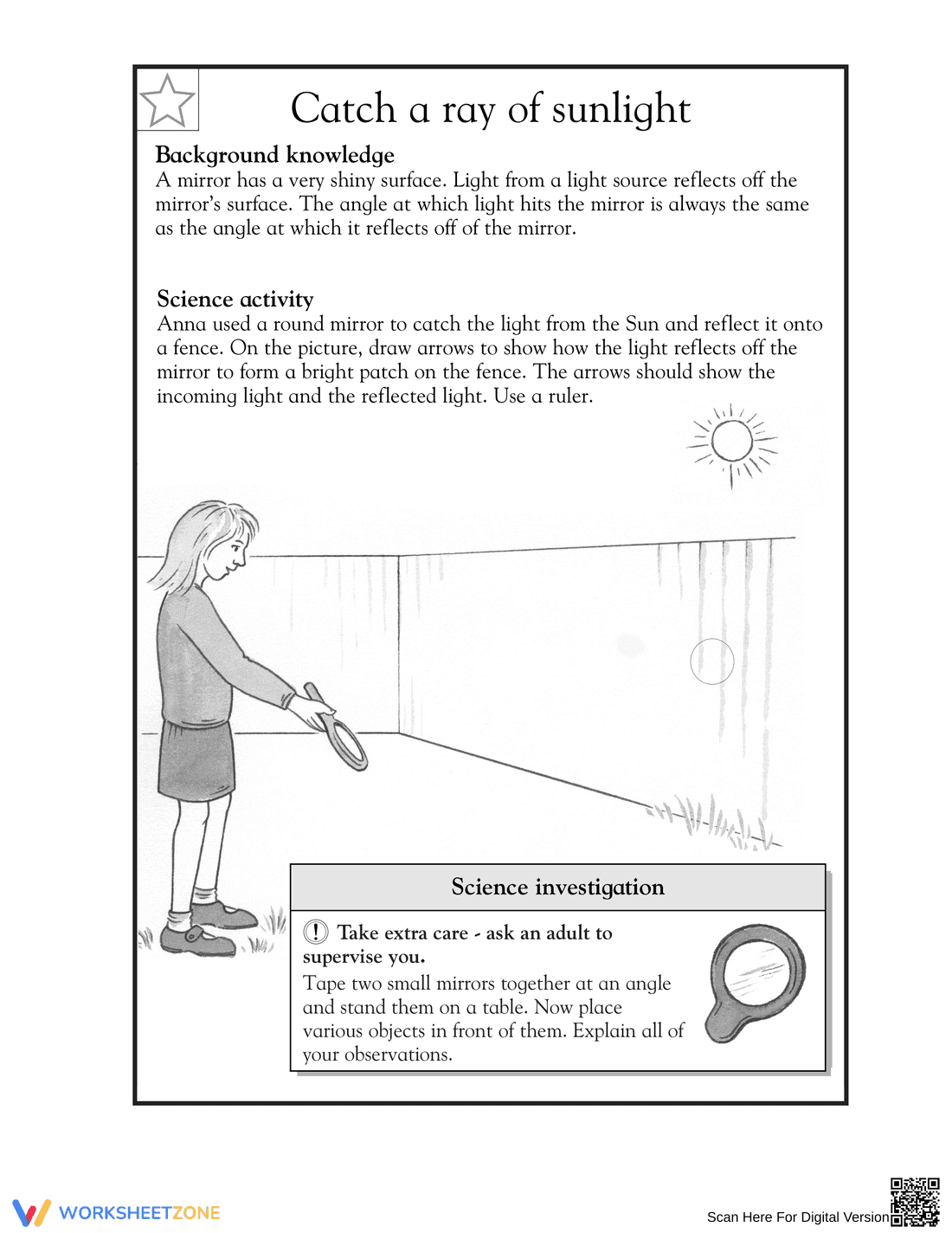
This Grade 4 science worksheet helps students visualize how light behaves when it strikes a reflective surface. By modeling rays of sunlight hitting a mirror and bouncing onto a target, learners develop a concrete understanding of reflection. Students achieve a clear grasp of the law of reflection through both diagramming and hands-on investigation.
At a Glance
- Grade: 4 · Subject: Science
- Standard:
4-PS4-2— Describe that light reflecting from objects allows those objects to be seen- Skill Focus: Light reflection and angles
- Format: 2 pages · 2 problems · Answer key included · PDF
- Best For: Introduction to light and optics units
- Time: 15–20 minutes
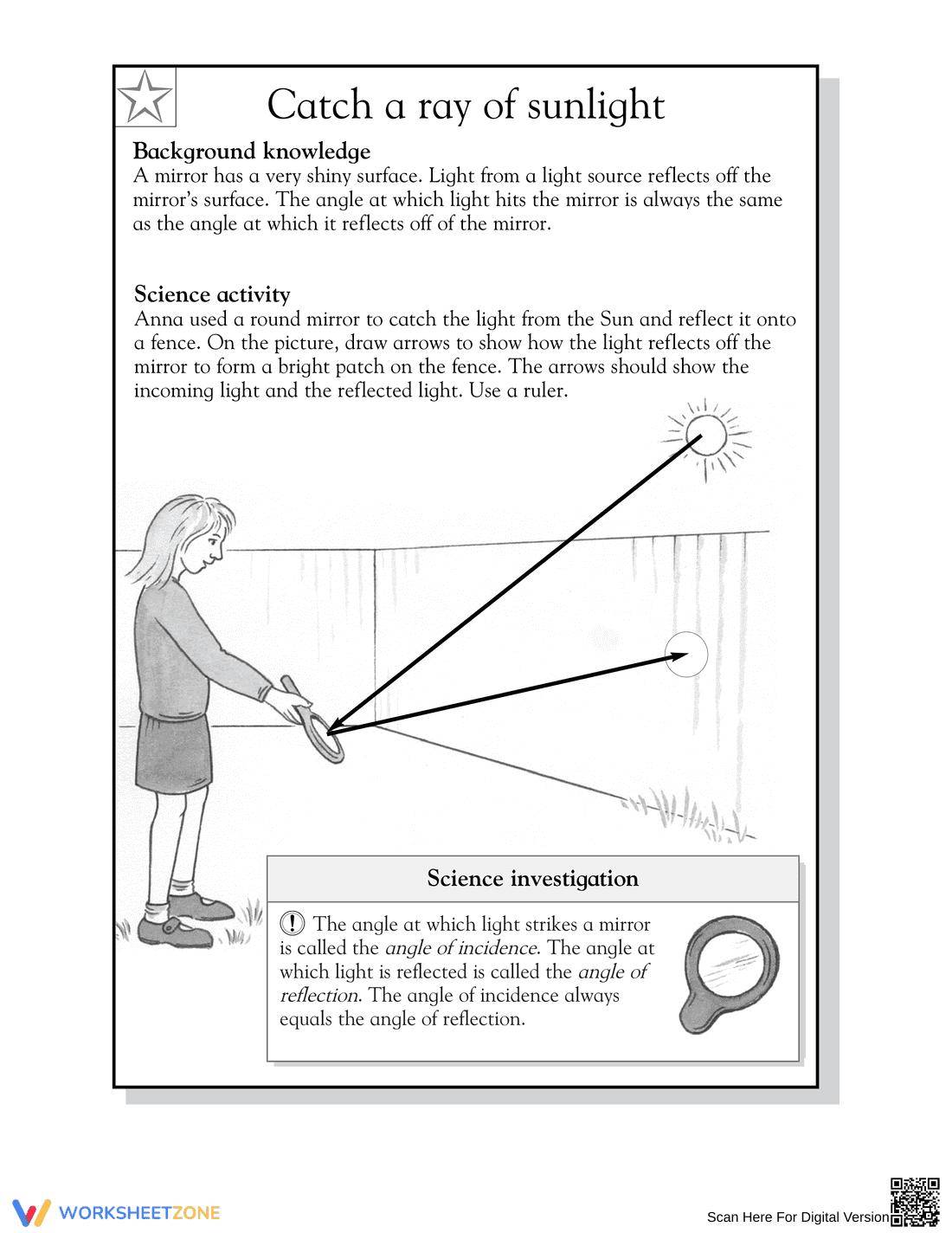
This 2-page PDF features a structured science activity and a follow-up extension. The first page provides background knowledge on mirror surfaces and reflection angles, followed by a diagramming task where students use a ruler to show incoming and reflected light rays. The second page serves as a full answer key. A "Science Investigation" section offers instructions for a hands-on experiment using two mirrors and various objects.
Zero-Prep Workflow
- Print (30 seconds): Simply print the single-sided activity sheet and the accompanying answer key for quick distribution.
- Distribute (30 seconds): Hand out the sheets along with rulers to ensure students can draw precise, straight lines for their light ray models.
- Review (1 minute): Use the included visual answer key to quickly check student diagrams for accuracy in showing the equal angles of incidence and reflection.
Total teacher prep time is under 2 minutes, making this an ideal resource for substitute plans or spontaneous science demonstrations.
Standards Alignment
This resource is primary aligned to 4-PS4-2: "Develop a model to describe that light reflecting from objects and entering the eye allows objects to be seen." By drawing the path of the light ray from the sun to the mirror and then to the fence, students create a functional model of reflection behavior. Both standard codes can be copied directly into lesson plans, IEP goals, or district curriculum mapping tools.
How to Use It
Use this worksheet during the "Explain" or "Elaborate" phase of a 5E lesson on light. After a brief demonstration with a real mirror and flashlight, assign the diagramming task to verify that students understand the "bouncing" behavior of light. For a formative assessment, observe whether students draw the reflected ray at approximately the same angle as the incoming ray, which signals an early grasp of the law of reflection. Completion takes 15 to 20 minutes.
Who It's For
This activity is designed for Grade 3 and Grade 4 students beginning their study of physical science and optics. It is particularly helpful for visual learners who need a concrete representation of invisible light paths. Pair this worksheet with a short reading passage on electromagnetic radiation or a direct instruction lesson using a laser pointer and a mirror.
The 4-PS4-2 standard emphasizes the development of models to represent physical phenomena, a core practice in the NGSS framework. Research by Fisher & Frey (2014) supports the use of "gradual release" models where students move from observing a phenomenon to diagramming it independently. This worksheet focuses on the plain-English skill of predicting light paths based on the angle of incidence. By providing a clear target (the fence) and a source (the sun), the activity scaffolds the spatial reasoning required to understand reflection. Such structured modeling tasks are proven to improve long-term retention of optical concepts compared to reading alone. The inclusion of a hands-on investigation further reinforces the conceptual link between theory and observation, ensuring students see the science in action rather than just on the page.


