


























Views
Downloads

Printable Carnivores Worksheet | Grade 1 Science Essential
Paste this activity's link or code into your existing LMS (Google Classroom, Canvas, Teams, Schoology, Moodle, etc.).
Students can open and work on the activity right away, with no student login required.
You'll still be able to track student progress and results from your teacher account.
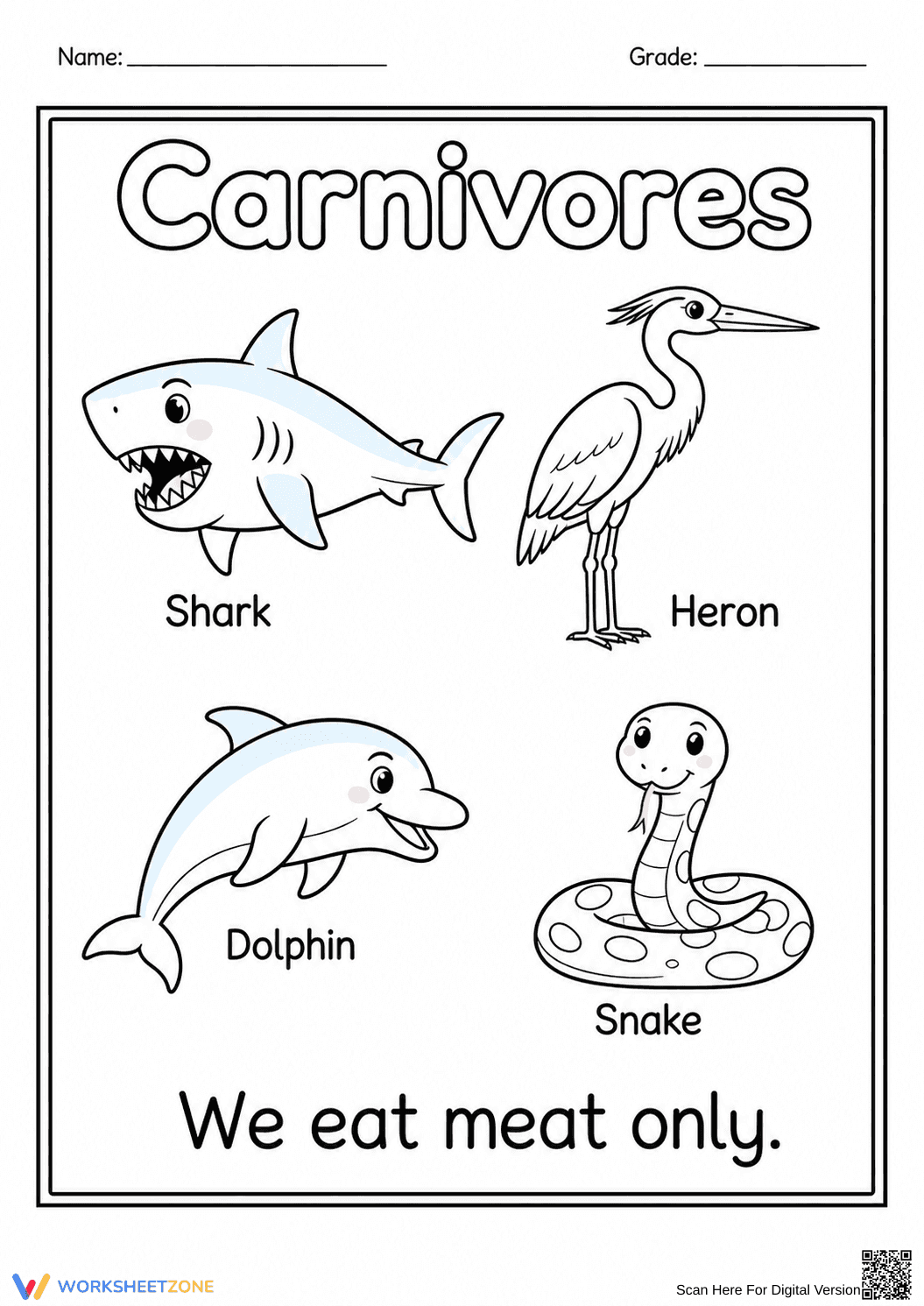
Help your students master the concept of animal diets with this engaging and printable carnivores worksheet. Designed specifically for Grade 1 learners, this activity focuses on identifying animals that eat meat only, providing a foundational understanding of the natural world and life science cycles. Students will observe diverse examples to build essential classification skills.
At a Glance
- Grade: Grade 1 · Subject: Science
- Standard:
K-LS1-1— Use observations to describe patterns of what plants and animals need to survive- Skill Focus: Identifying Carnivores
- Format: 1 page · 4 problems · Answer key included · PDF
- Best For: Early Science Introduction
- Time: 10–15 minutes
This single-page resource features four clear illustrations of carnivores: a shark, heron, dolphin, and snake. Each animal is labeled to support literacy development while students focus on the primary science objective. The worksheet includes a clear, simple definition of what a carnivore is—an animal that eats meat only—ensuring students have a constant reference point during the activity.
This zero-prep resource is designed for immediate integration. Teachers follow a simple three-step workflow: Print the single-page PDF (30 seconds), distribute for a 10-minute session, and review as a group. Total teacher prep time is under 2 minutes, making this ideal for morning work or sub-plans. The clear layout ensures students begin immediately without complex instructions.
This resource is fully aligned to K-LS1-1: "Use observations to describe patterns of what plants and animals (including humans) need to survive." By observing that these specific animals eat only meat, students identify a critical survival pattern. This standard code can be copied directly into lesson plans, IEP goals, or district curriculum mapping tools.
Use this worksheet as an introductory activity during a unit on living things. Before direct instruction, ask students to look at the pictures and guess what they have in common. During instruction, use it as a formative assessment to observe if students can differentiate meat-eaters from other groups. It is expected to take 10 to 15 minutes to complete.
This activity is perfect for kindergarten and first-grade students beginning their exploration of biology. It serves as an excellent resource for English Language Learners due to the visual labels. Pair this worksheet with a short informational text or a classroom anchor chart about animal diets for a complete science lesson.
The K-LS1-1 standard requires students to use observations to describe patterns of what plants and animals need to survive, making the identification of dietary patterns like carnivory a foundational early science skill. This worksheet facilitates these observations through clear visual representations of meat-eaters including sharks and snakes. According to the RAND AIRS 2024 report on early childhood science education, structured visual aids significantly enhance the retention of biological classifications in primary learners by bridging the gap between abstract concepts and observable physical traits. By focusing on the 'meat only' diet, students develop the categorical thinking necessary for later life science mastery. This resource serves as a vital component in a comprehensive living things unit, ensuring that young learners can accurately distinguish between different animal survival strategies. The inclusion of diverse species encourages broader ecological understanding while maintaining a grade-appropriate reading level for independent practice.


