


























Views
Downloads




Grade K Reading Comprehension — Printable No-Prep Worksheet
Paste this activity's link or code into your existing LMS (Google Classroom, Canvas, Teams, Schoology, Moodle, etc.).
Students can open and work on the activity right away, with no student login required.
You'll still be able to track student progress and results from your teacher account.
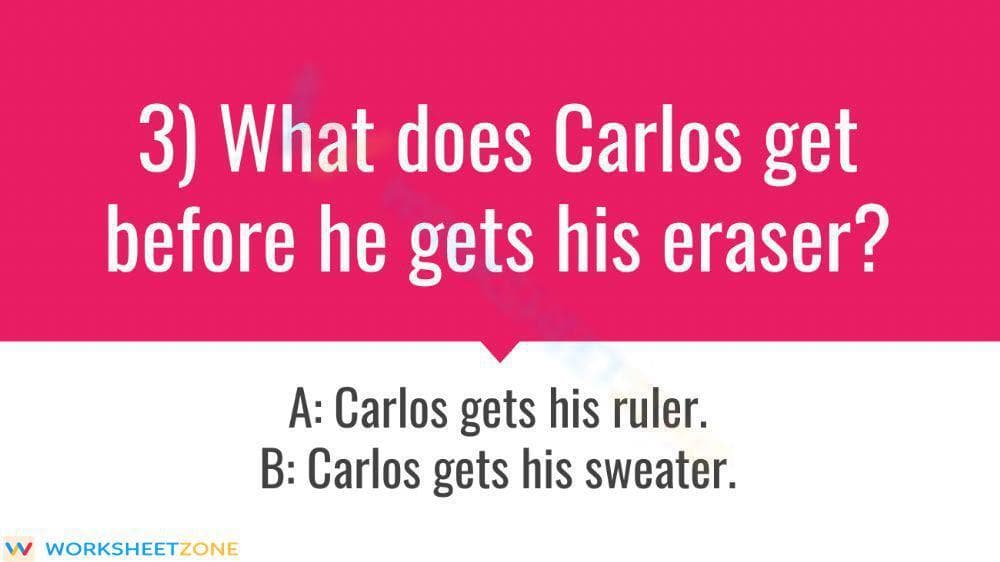
This reading comprehension worksheet for Kindergarten and first-grade students provides a quick, effective way to assess understanding of key details in a text. After reading the story "Carlos Goes to School," learners will answer five targeted multiple-choice questions, strengthening their ability to recall information, sequence events, and identify the main idea.
At a Glance
- Grade: K-1 · Subject: ELA / Reading
- Standard:
CCSS.ELA-LITERACY.RL.K.1— Ask and answer questions about key details in a text.- Skill Focus: Reading Comprehension, Key Details, Sequencing
- Format: 1 page · 5 problems · Answer key included · PDF
- Best For: Exit tickets, independent practice, formative checks
- Time: 5–10 minutes
This one-page PDF features five multiple-choice questions about "Carlos Goes to School." Each question has two simple answer choices (A or B), ideal for young readers. The tasks check for recall, character feelings, and event order. A full answer key is included for quick grading.
Zero-Prep Workflow
Save valuable time with this print-and-go resource. The workflow is straightforward:
- Print: The single worksheet page prints in seconds.
- Distribute: Hand out immediately after reading the story.
- Review: Use the answer key for instant grading and feedback.
With a total prep time under two minutes, it's a reliable choice for sub plans, literacy centers, or a fast formative check.
Standards Alignment
This worksheet is directly aligned with CCSS.ELA-LITERACY.RL.K.1, which requires students to, with prompting and support, ask and answer questions about key details in a text. The questions also touch on CCSS.ELA-LITERACY.RL.K.2, as students identify what the story is mostly about. Both standard codes can be copied directly into lesson plans, IEP goals, or district curriculum mapping tools.
How to Use It
Use this worksheet as an exit ticket after a read-aloud to gauge comprehension. It also works well as an independent task during literacy centers. For a quick formative check, notice if students refer back to the text to confirm their answers. Expected completion time is 5-10 minutes.
Who It's For
This resource is for Kindergarten and early first-grade learners. Its clear format helps students demonstrate understanding without being overwhelmed. The simple choices are also effective for English Language Learners. For extra support, pair it with a visual sequencing chart of the story.
This worksheet provides targeted practice for CCSS.ELA-LITERACY.RL.K.1, a foundational standard for early literacy. By asking students to answer five questions about key details in a story, it builds the core skills necessary for more advanced textual analysis. Research consistently shows that the ability to recall and sequence information is a strong predictor of later reading proficiency. According to a comprehensive meta-analysis reported in a RAND AIRS 2024 study, structured comprehension tasks that focus on explicit information are highly effective for emergent readers. This print-and-go resource offers a practical application of these findings, giving teachers a reliable tool to measure and support student progress in understanding narrative texts. The worksheet's clear format isolates the skill of retrieving information, ensuring that assessment results accurately reflect comprehension rather than other cognitive loads.


