


























Views
Downloads
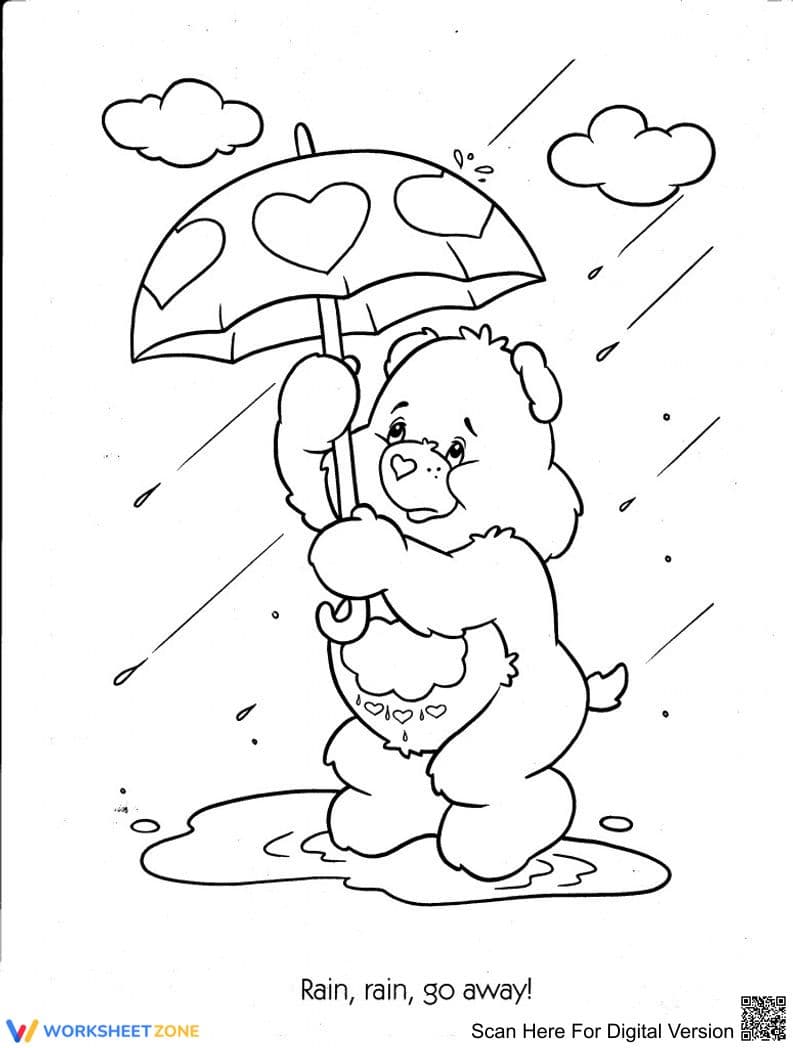

Grade K Care Bears Coloring Page — Printable No-Prep Sheet
Paste this activity's link or code into your existing LMS (Google Classroom, Canvas, Teams, Schoology, Moodle, etc.).
Students can open and work on the activity right away, with no student login required.
You'll still be able to track student progress and results from your teacher account.
This printable Care Bears coloring page develops essential fine motor control and reinforces early literacy connections for young learners. By engaging with a familiar character holding an umbrella above the caption "Rain, rain, go away!", students practice proper pencil grip, spatial awareness, and visual-text association in a motivating creative format.
At a Glance
- Grade: Kindergarten · Subject: ELA & Fine Arts
- Standard:
CCSS.ELA-LITERACY.RL.K.7— Connect illustrations to story concepts and printed text words- Skill Focus: Fine motor control and visual literacy
- Format: 1 page · 1 coloring task · Open-ended practice · PDF
- Best For: Morning work and rainy day sub plans
- Time: 15–20 minutes
This single-page printable features a bold-lined illustration of a Care Bear holding an umbrella beneath rain clouds. The bottom includes the familiar rhyme, "Rain, rain, go away!", providing an authentic reading connection. The bold outlines assist young artists in coloring within the boundaries. The open-ended task requires no answer key, allowing for complete creative expression.
Zero-Prep Classroom Workflow
Designed for immediate classroom deployment, this worksheet requires zero advanced preparation, making it ideal for emergency sub plans or unexpected indoor recess.
- Print (30 seconds): Generate class sets from the print-ready PDF without complex formatting.
- Distribute (30 seconds): Pass out the single sheet alongside crayons or washable markers.
- Review (1 minute): Read the bottom caption aloud together to establish the literacy connection before coloring begins.
Total teacher preparation time remains under two minutes, providing a reliable activity when transitions require calming focus.
Standards Alignment
This worksheet aligns directly with primary standard CCSS.ELA-LITERACY.RL.K.7, requiring students to describe the relationship between illustrations and the story in which they appear. As students color, they visually process the accompanying text caption. Additionally, it supports CCSS.ELA-LITERACY.RF.K.1 by reinforcing basic print concepts as teachers point to the words. Both standard codes can be copied directly into lesson plans, IEP goals, or district curriculum mapping tools.
How to Use It in the Classroom
This resource serves as an excellent transition activity following direct instruction during a morning weather circle. First, teachers can utilize it as independent morning work that settles students while building motor stamina. Second, it functions perfectly during indoor recess on rainy days. While students work independently for 15 to 20 minutes, teachers can conduct quick formative assessments by observing pencil grip and hand-eye coordination.
Who It's For and Differentiation
This worksheet is tailored for Kindergarten and first-grade students developing foundational fine motor skills. For students needing motor accommodations, provide larger, triangular crayons to ease hand fatigue. For advanced learners, encourage tracing the printed letters or writing a weather sentence on the back. This activity pairs naturally with a read-aloud of weather-themed picture books.
Integrating structured coloring activities within early childhood literacy routines provides dual benefits for physical motor development and conceptual comprehension. Aligned with CCSS.ELA-LITERACY.RL.K.7, this resource prompts young learners to connect illustrations to story concepts and printed text words, reinforcing the direct relationship between visual depictions and written language. According to Fisher & Frey (2014), purposeful independent practice that links familiar visual concepts to foundational literacy targets significantly enhances student engagement and schema retention. By engaging in this targeted fine motor practice, students strengthen the intrinsic hand muscles required for subsequent handwriting tasks while simultaneously processing thematic vocabulary. This synthesis of physical skill acquisition and visual literacy ensures that classroom transition activities remain highly productive, supporting essential developmental milestones within a low-stress, engaging academic framework.


