


























Views
Downloads

Car Counting Worksheet | Printable Grade K Math
Paste this activity's link or code into your existing LMS (Google Classroom, Canvas, Teams, Schoology, Moodle, etc.).
Students can open and work on the activity right away, with no student login required.
You'll still be able to track student progress and results from your teacher account.
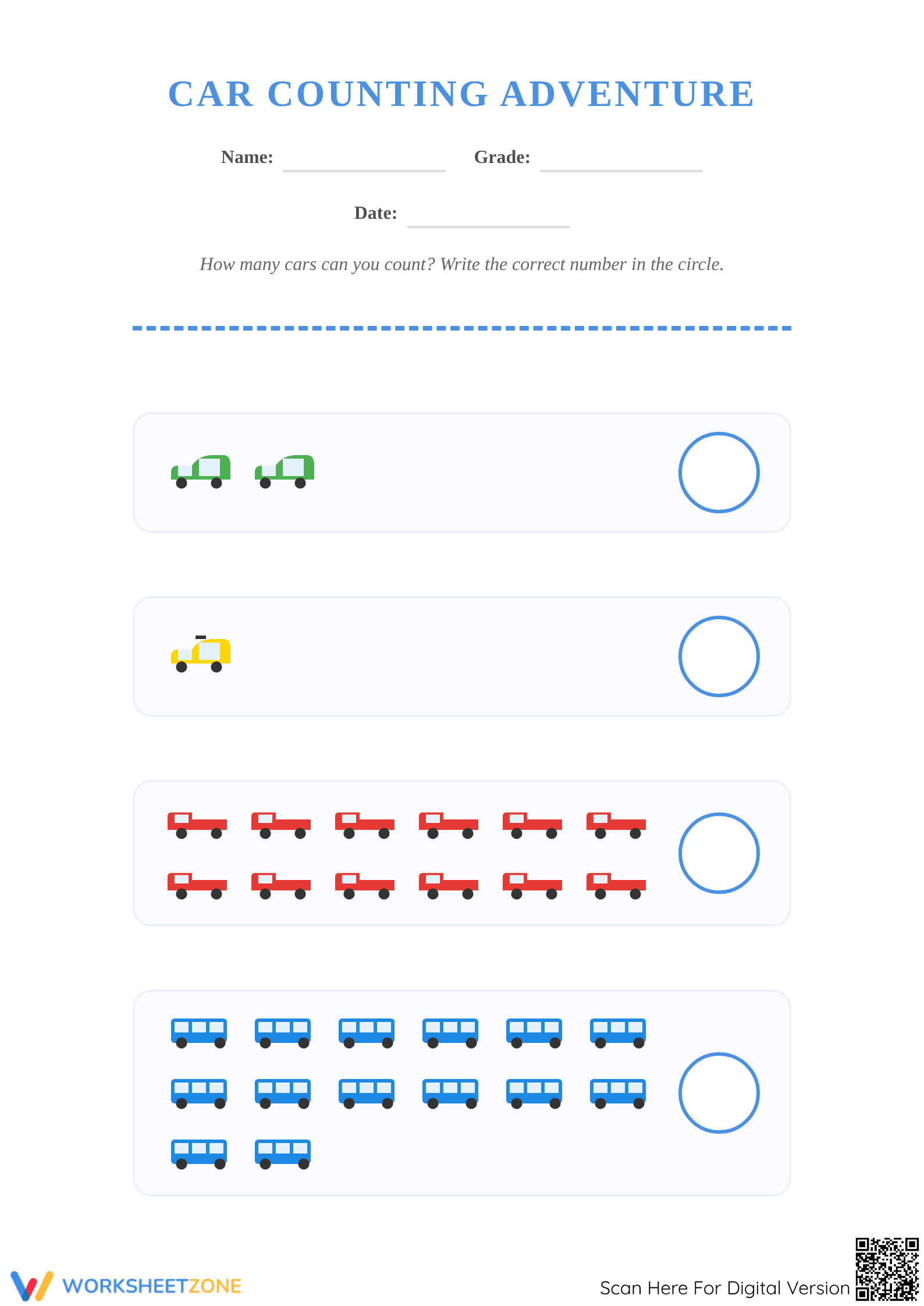
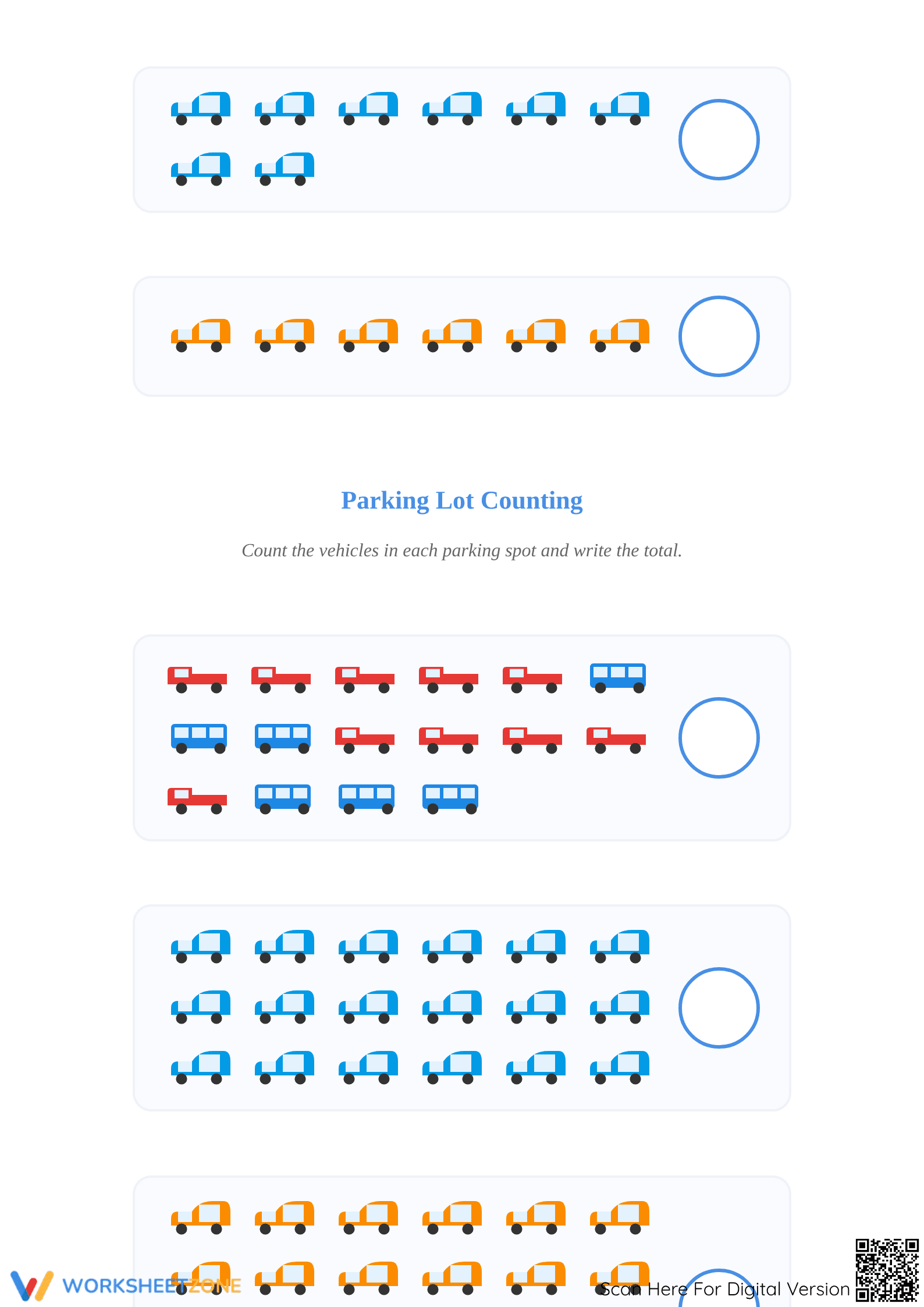
This foundational mathematics resource provides Kindergarten students with focused practice in counting objects and understanding cardinality. By engaging with high-interest visuals of cars, trucks, and buses, learners develop the essential ability to answer "how many?" questions for sets ranging from 1 to 24. This worksheet ensures students move beyond rote counting to true numerical comprehension.
At a Glance
- Grade: K · Subject: Mathematics
- Standard:
K.CC.B.5— Count to answer how many objects there are in a scattered or linear arrangement- Skill Focus: Counting and Cardinality
- Format: 3 pages · 10 problems · Answer key included · PDF
- Best For: Independent morning work or math centers
- Time: 15–20 minutes
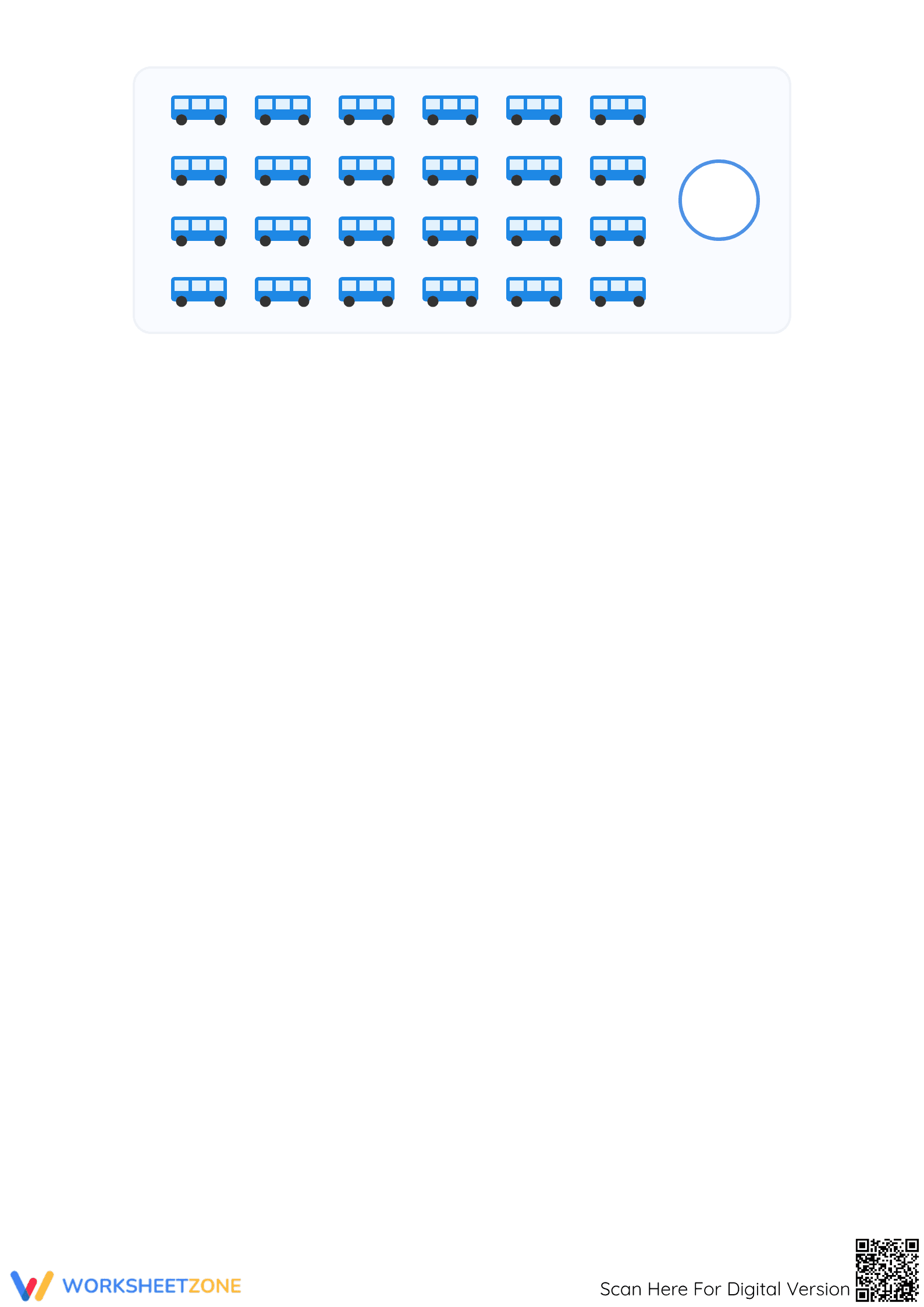
What's Inside: This 3-page printable pack features ten distinct counting tasks. Each problem presents a group of colorful vehicles—including green sedans, yellow taxis, red trucks, and blue buses—arranged in clear rows or arrays. Students count the items and write the corresponding numeral in a large, designated circle. A comprehensive answer key is included to facilitate quick grading and self-correction.
Zero-Prep Workflow
- Print (30 Seconds): Select the desired pages and print enough copies for your small group or entire class.
- Distribute (1 Minute): Hand out the sheets alongside pencils; no additional manipulatives or teacher setup is required.
- Review (30 Seconds): Use the provided answer key to verify student work or project the answer key for a quick whole-class check.
Total teacher preparation time remains under two minutes, making this an ideal solution for emergency substitute plans or transition periods.
Standards Alignment
The primary focus is CCSS.MATH.CONTENT.K.CC.B.5: "Count to answer 'how many?' questions about as many as 20 things arranged in a line, a rectangular array, or a circle." This worksheet extends slightly beyond 20 to challenge advancing learners. Both standard codes can be copied directly into lesson plans, IEP goals, or district curriculum mapping tools.
How to Use It
This resource is best utilized during the independent practice portion of a math lesson on cardinality. For a formative assessment, observe students as they count: notice if they use a touch-and-count strategy or if they can subitize smaller groups. It also serves as an excellent "exit ticket" to gauge mastery of one-to-one correspondence before moving to addition. Expected completion time is approximately 15 to 20 minutes.
Who It's For
Specifically designed for Kindergarten students, this worksheet is also suitable for Preschool learners ready for higher numbers or First Grade students needing a remedial review of cardinality. It pairs naturally with physical car counters or a transportation-themed anchor chart. The clear, uncluttered design supports students with focusing difficulties by providing ample white space between tasks.
This car counting resource aligns with foundational counting principles identified in early childhood mathematics research. By utilizing high-interest car and bus icons, the worksheet reduces cognitive load and increases engagement during initial cardinality acquisition. Aligned to standard K.CC.B.5, the resource requires students to demonstrate one-to-one correspondence while answering the fundamental "how many?" question for sets ranging from two to twenty-four items. According to research by Fisher & Frey (2014), the gradual release of responsibility is supported here through the transition from small, easily subitizable groups to larger, structured arrays that require systematic counting strategies. This structural design ensures that students move beyond rote counting to true cardinality, where the last number named indicates the total size of the set. The inclusion of an answer key allows for immediate corrective feedback, a critical component in developing mathematical confidence and accuracy in Kindergarten learners.


