


























Views
Downloads

Candy Hearts Science Experiment | Essential Grade 6-12 Guide
Paste this activity's link or code into your existing LMS (Google Classroom, Canvas, Teams, Schoology, Moodle, etc.).
Students can open and work on the activity right away, with no student login required.
You'll still be able to track student progress and results from your teacher account.
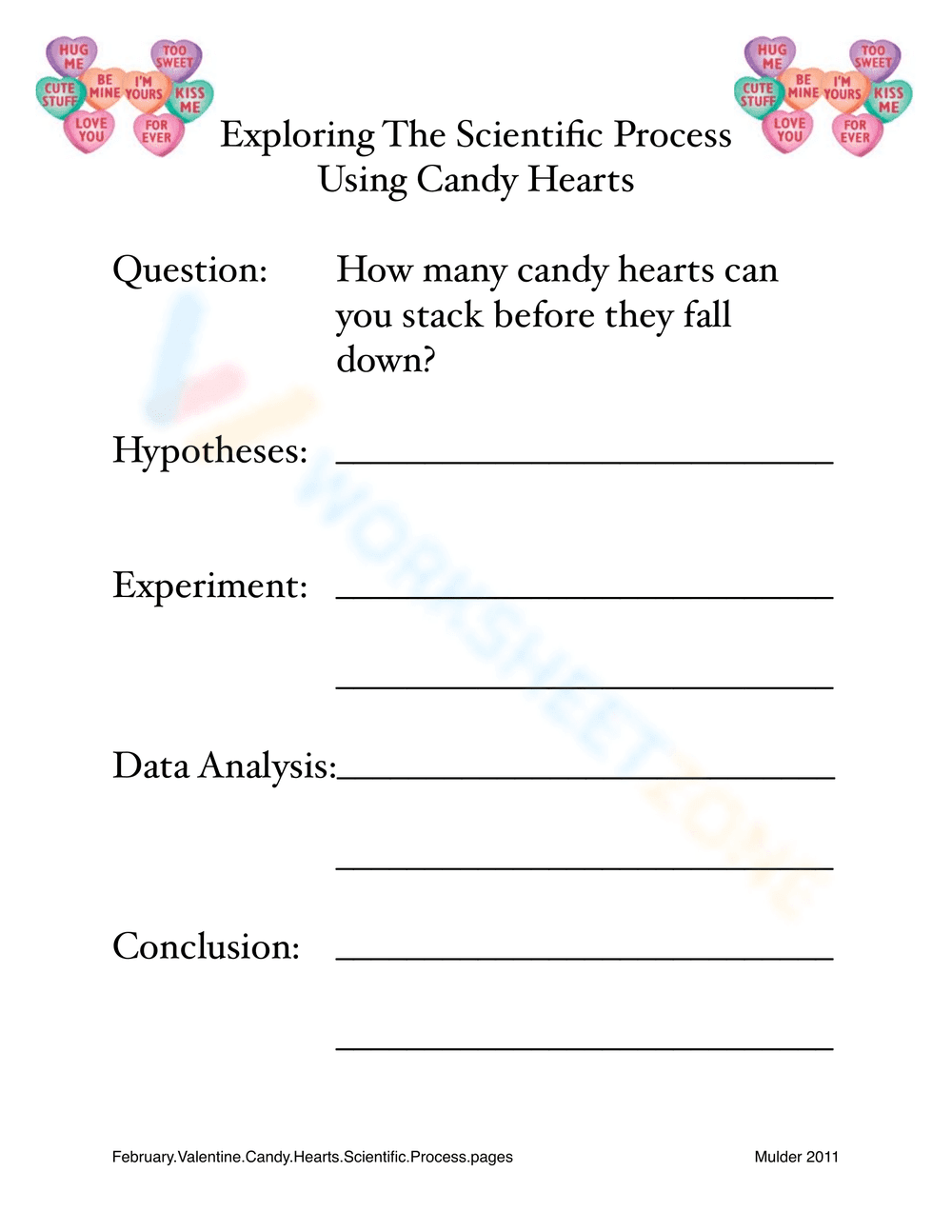
This Grade 6-12 science worksheet guides students through a hands-on exploration of the scientific method using seasonal candy hearts. Students move from forming a hypothesis to drawing a final conclusion based on empirical evidence. It provides a structured framework for a physics-based stacking challenge that reinforces core inquiry skills and data recording.
At a Glance
- Grade: 6-12 · Subject: Science
- Standard:
MS-ETS1-1— Define the criteria and constraints of a design problem to ensure a solution- Skill Focus: Scientific Method Application
- Format: 1 page · 4 tasks · No answer key · PDF
- Best For: Seasonal lab activity or sub plan
- Time: 20–30 minutes
The worksheet features a clean, one-page layout designed for immediate student use. It includes dedicated writing spaces for a hypothesis, experimental procedure, data analysis, and a concluding statement. The prompt focuses on a stacking challenge, requiring students to observe physical properties and record quantitative data without the need for complex laboratory equipment.
The zero-prep workflow is designed for maximum efficiency in a busy classroom. First, print the single-page PDF (30 seconds). Second, distribute the sheets along with a box of candy hearts to student groups (1 minute). Third, facilitate the hands-on stacking and review the written conclusions as a class (20 minutes). Total teacher preparation time is under 2 minutes, making it an excellent choice for emergency sub plans.
This resource aligns with `MS-ETS1-1`, focusing on defining criteria and constraints within a design challenge. It also supports `MS-PS1-2` by requiring students to analyze and interpret data on the properties of substances. Both standard codes can be copied directly into lesson plans, IEP goals, or district curriculum mapping tools to ensure compliance with state and national frameworks.
Use this as a formative assessment during a unit on the scientific method or as a high-engagement Valentine's Day activity. Teachers should observe how students formulate their hypotheses—specifically looking for "If... then..." statements. The expected completion time is 25 minutes, making it an ideal "bell-to-bell" activity for short periods or as a transition between more intensive units.
This is designed for middle and high school students who need a concrete application of abstract scientific steps. It is particularly effective for English Language Learners (ELLs) due to its clear, sequential structure and limited text density. Pair this with a digital timer and a brief introductory video on structural stability or friction to deepen the learning experience.
The use of hands-on manipulatives like candy hearts in science education is supported by Fisher & Frey (2014), who emphasize the importance of purposeful play in developing cognitive models. By engaging with the `MS-ETS1-1` standard through a physical stacking task, students bridge the gap between theoretical inquiry and tangible results. Research from the RAND AIRS 2024 report indicates that structured lab reports significantly improve student retention of the scientific process compared to passive observation. This worksheet provides the necessary scaffolding to ensure that the 4-step inquiry process—hypothesis, experiment, analysis, and conclusion—is followed with fidelity. It serves as a reliable tool for teachers looking to integrate seasonal themes without sacrificing academic rigor or standards alignment in the secondary science classroom.


